
🧭 TL;DR — the honest bottom line
Here's what nobody tells you before you come: Huangshan is two places, and the magic is in doing both. Up top is Mount Huangshan — "the loveliest mountain of China," a ridge of granite spires and 1,000-year-old pines that floats above a literal sea of clouds at sunrise. Down below are the Huizhou villages — 900-year-old whitewashed towns mirrored in still ponds, two of them UNESCO World Heritage. Sleep on the summit for the dawn, spend a day in the villages, eat stinky mandarin fish in old Tunxi, and many passports now get in visa-free. Give it 3–4 days.
Two things to do before you fly: set up an eSIM (so Google and WhatsApp work) and bind a card to Alipay (so you can pay for anything). Sort those two and the rest of this guide is just the fun part.
No time to read all of this? Tell us your dates and we'll build your Huangshan plan for you — summit hotel, the cable-car plan, villages and all — on WhatsApp, real humans. (One message, no obligation.)
Message us →📌 This guide is long because it's complete — use the menu to jump. Everything below is named, priced, and verified June 2026; we flag anything that drifts so you can double-check the load-bearing details.
Before You Go
🗺️ First, Untangle This: "Huangshan" Is a Mountain and a City
This trips up almost every first-timer, so let's clear it up before you book a single thing. "Huangshan" (黄山) means two completely different places that are 60 km apart:
- Mount Huangshan (黄山风景区) — the famous one. The granite peaks, the sea of clouds, the Welcoming Pine, the sunrise you flew across the world for. This is a scenic area up a mountain, and the village at its foot is called Tangkou (汤口).
- Huangshan City (黄山市) — the administrative city named after the mountain, but its actual downtown is a district called Tunxi (屯溪). This is where the airport (TXN), the main high-speed rail station, and Tunxi Old Street are. It's 65 km / ~1.5 hours from the mountain itself.
So when a hotel says it's "in Huangshan," ask which Huangshan. When your train ticket says "Huangshan North," that's the city (Tunxi area), not the mountain — you've still got a bus ride ahead. We spell out every transfer in Part 2. Just hold onto this: city = Tunxi (your gateway), mountain = Tangkou (the peaks).
🛂 Do You Need a Visa for Huangshan? — Visa-Free Entry Explained
Here's the headline most travel sites bury: China spent the last two years quietly becoming one of the easiest big countries in Asia to walk into. Two routes cover almost everyone reading this, and which one you use comes down to one thing — what color your passport is.
| Route | Who it's for | Max stay | The catch |
|---|---|---|---|
| 30-day visa-free | 50 countries — most of Europe, Australia, NZ, Japan, Korea, and UK + Canada (added 17 Feb 2026); Singapore, Thailand & Malaysia get 30 days via mutual exemption | 30 days | Ordinary passport valid for your whole stay (airlines often ask for 6 months). Tourism/business/visiting friends — no onward-ticket rule. |
| 240-hour (10-day) transit | 57 countries incl. the USA, Brazil, Mexico, Indonesia | 10 days | You must hold an onward ticket to a third country/region and enter via an approved port. |
✓ verified Oct 2026 Lists shift often — reconfirm your nationality on the official site before booking.
🛬 The Huangshan-specific catch: where do you actually land?
Here's the part that matters for this trip. Huangshan's own airport — Tunxi International (TXN) — is an approved 240-hour visa-free transit port for Anhui Province. So in theory you can fly straight in visa-free. In practice, almost nobody does, because TXN has very few international flights — it's mostly domestic with a handful of regional Asian routes.
What most foreign travellers actually do: fly into a big hub — Shanghai, Hangzhou, or Nanjing — clear immigration there (all are approved 240h ports), then take the high-speed train to Huangshan. Because the 240-hour window now lets you move between the permitted areas of all 24 participating provinces (some provinces only allow certain cities — check the area table on nia.gov.cn), a route like land in Shanghai → train to Hangzhou → train to Huangshan → fly onward to Seoul sits comfortably inside one 10-day transit permit. Huangshan and the whole Yangtze River Delta (Shanghai, Jiangsu, Zhejiang, Anhui) are one big visa-free playground — easy to pair with Suzhou's gardens too.
🇺🇸 Americans, read this carefully — it trips people up
US citizens are not on the 30-day visa-free list, but they are on the 240-hour visa-free transit list. To use it, you must meet the policy's conditions, including entry through an approved port and a confirmed onward ticket to a third country or region different from your departure country or region. The trick is the word transit: China has to believe you're passing through to somewhere else, so you need an onward flight booked out of mainland China to a third country or region before you land. Easy third stops: Seoul, Bangkok, Singapore, Tokyo. The official notices say only "a third country or region", and none of the official pages we read names Hong Kong or Macao either way; reading them as qualifying is an inference, not an official rule. If your plan depends on it, confirm with your airline or the National Immigration Administration's 24-hour hotline, +86 12367 (English available), before you book.
Three things that quietly sink people
① The 240 hours don't start when you land — they start at 00:00 the next day (GMT+8), so your arrival day is a freebie. ② "Third country" means different from where you came from — a US→China→back-to-US ticket does not qualify. ③ For Huangshan specifically, enter via a big hub (Shanghai/Hangzhou/Nanjing), not TXN — there aren't the international flights into TXN to rely on it.
Policy and country lists shift — always reconfirm your nationality on the official en.nia.gov.cn before you book the flight.
🗓️ Best Time to Visit Huangshan

For comfortable weather and the famous views together, aim for late April–May or September–October. But Huangshan is genuinely a four-season mountain, and the "best" month depends on which wonder you're chasing — because here's the counterintuitive bit: the sea of clouds, the thing on every postcard, is actually best in winter and after rain.
| Season | Months | What you get | The real story |
|---|---|---|---|
| 🌸 Spring (best all-round) | Apr–May | Green peaks, waterfalls, frequent cloud seas | Mild, fresh, everything open. The sweet spot for first-timers. |
| ☀️ Summer | Jun–Aug | Lush, dramatic, a cool escape from lowland heat | The summit runs ~10°C cooler than the city — a relief — but it's peak domestic-tourist and thunderstorm season. |
| 🍁 Autumn (best all-round) | Sep–Oct | Clear skies, red leaves, crisp air | The other golden window. Pair it with the autumn foliage at Tachuan village (Part 4). |
| ❄️ Winter (best for clouds + rime) | Dec–Feb | Sea of clouds + silver rime + snow | The connoisseur's pick: most frequent cloud seas, fairy-tale ice, and prices 15–40% lower. Cold; some cable cars pause for maintenance. |
The honest truth about cloud seas: they appear most often right after rain or snow, when warm valley air meets cold peaks. So a drizzly forecast isn't a wash-out — it's frequently the setup for the money shot the next morning. Don't cancel because of rain; just stay overnight on the summit and hope the clouds roll in at dawn.
Avoid the crush: National Day / Golden Week (1–7 Oct) and Labour Day (early May) turn the cable-car queues into 2–3 hour ordeals and sell out summit hotels months ahead. The shoulder weeks on either side give you the same scenery with a fraction of the people.
✈️ How to Get to Huangshan: Airport, High-Speed Rail & the Two Stations
Huangshan's gateway is Huangshan City (Tunxi) — and the single most important thing to get right is which station or airport you're aiming for, because the names are confusing.
By air — Tunxi International (TXN)
Small but real, 9 km northwest of Tunxi downtown and ~60 km from the mountain. Plenty of domestic links (Shanghai, Beijing, Guangzhou, Hong Kong) plus a few regional Asian routes. Useful if you're already inside China; not a reliable first-entry point for visa-free travellers (see above).
By high-speed rail — don't mix up the two stations
| Station | What it is | Use it for |
|---|---|---|
| Huangshan North (黄山北站) | The modern high-speed station (opened 2015), 15 km NW of Tunxi | This is the one you want — all bullet trains stop here |
| Huangshan Station (黄山站) | The old regular-speed station, in downtown Tunxi | Slow overnight/normal trains only — skip unless you're on a sleeper |
The high-speed connections that make Huangshan easy (all to/from Huangshan North):
Book on the official 12306 website (English version) or Trip.com with your passport — full how-to in Part 4.
💴 Huangshan Travel Budget: What It Costs (per day, excluding flights)
Huangshan is cheaper than a Western mountain resort would ever be — with one quirk: anything on the summit (hotels, food, even bottled water) costs a real premium because every item is carried up by porter. Budget the summit night as your splurge.
| Style | Per day (ex-flights) | What that buys you |
|---|---|---|
| 🎒 Backpacker | ¥250–450 (~$35–63) | Tunxi hostel/budget room, noodle shops, hiking on foot (skip cable cars), one mid-mountain dorm |
| 💺 Mid-range (most people) | ¥500–950 (~$70–134) | Comfortable Tunxi or Tangkou hotel, cable cars, sit-down Hui meals, village day-trip tickets |
| ✨ Comfort | ¥1,200+ (~$170+) | A summit hotel for sunrise (the big-ticket item), private driver, guided hiking |
The single biggest cost decision isn't your daily spend — it's whether you sleep on the summit (¥600–1,500+ a room for sunrise) versus day-tripping the mountain from a ¥200–400 base in Tunxi. We break that trade-off down in Part 3. (~¥7.1 = $1 as of Jun 2026; rates drift.)
Sources — Part 1 (verified June 2026)
Geography (mountain vs city): chinadiscovery.com Huangshan transportation; topchinatravel.com where-to-stay (Tunxi/Huangshan City 65 km from mountain foot, Tangkou 10 km from the gate).
Visa & 240h transit: en.nia.gov.cn (National Immigration Administration — unilateral visa-exemption list updated 17 Feb 2026, valid through 31 Dec 2026 for most countries; 240-hour transit (NIA, 20 Aug 2026), 57 nationalities, 24 provinces incl. Anhui); chinadiscovery.com 240-hour guide & Huangshan airport (TXN designated Anhui port; Yangtze Delta multi-province loop).
Airport & stations: chinadiscovery.com Huangshan airport & train stations; chinatrain12306.com (TXN 9 km from Tunxi/60 km from mountain; Huangshan North = HSR opened 2015, 15 km from Tunxi).
High-speed rail: chinadiscovery.com & travelchinaguide.com Shanghai/Hangzhou–Huangshan (Hangzhou ~1.5h; Shanghai 2.5–3.5h, ¥171–424 2nd class); chinatrain12306.com Hangzhou–Huangshan 1h22.
Seasons / budget: travelchinaguide.com & chinaculturetour.com Huangshan seasons (cloud sea best Nov–May; winter prices 15–40% lower); numbeo & climate-data.org, 2026.
Arrival & Essentials
The three things that turn China from "intimidating" into "effortless." Do the first two before you fly — fifteen minutes at home saves you a stressful first hour. The third — station/airport to the mountain — is Huangshan's one genuine logistics puzzle, so we've spelled it out step by step.
📱 Internet & VPN in China: Get an eSIM before you fly
Let's be blunt about the thing everyone whispers about: mainland China blocks Google, Instagram, WhatsApp, Gmail, and most Western apps. Your normal SIM will roam onto a Chinese network and hit that same wall.
The clean, legal, no-drama fix: an international travel eSIM that routes your data through a server outside the mainland — so Google Maps, WhatsApp, Instagram, all of it just works, with no separate VPN to fiddle with. You install it as a second line; your home number stays for calls/texts.
| eSIM | Best for | VPN? | The honest take |
|---|---|---|---|
| Nomad | Multi-city + high-speed rail | No | The most stable when you're moving — survives tunnels, train Wi-Fi gaps, city-hopping. Top pick if Huangshan is one stop on a bigger Yangtze-Delta trip. |
| Airalo | One or two stops, budget | No | The most popular, cheapest, dead-simple. Plenty for a Huangshan + Hangzhou hop. |
| Holafly | Heavy data users | No | Unlimited data plans + 24/7 support. Great if you stream/hotspot — check the fair-use cap. |
| Saily | Privacy-minded | No | By the NordVPN team, strong privacy. Solid for fixed-data plans. |
How it actually goes: buy online → you get a QR code by email → scan it to install (takes 2 min) → leave it off until you land → flip it on as the plane taxis in, and you're online before baggage claim. Only needs an email — no Chinese ID, no registration. Buy it at home on your own Wi-Fi; do not count on installing it after you land, because activation pages can themselves be behind the wall.
📶 Mountain-specific heads-up: signal drops in spots high on Mount Huangshan — deep in the West Sea Grand Canyon and on far ridges you may lose data entirely. Screenshot your trail map and your hotel's location before you ride the cable car up.
One phone really does replace everything
Wallet, keys, train tickets, translator, cable-car booking, even your summit-hotel check-in — all collapse into one phone the moment you're set up. Most people pay by phone these days, though cash is still legal tender. Get your eSIM + Alipay sorted and you'll buy a ¥190 mountain ticket, scan onto a bullet train, and split a stinky-fish dinner without touching a yuan note.
More on this: China Essentials — paying with Alipay & WeChat →💳 How to Pay in China: Alipay & WeChat for Foreigners
Most people pay by phone, but cash is still legal tender: since 1 February 2026, staffed businesses must accept it. Keep some small notes as a backup (is cash accepted in China?). Don't count on foreign cards at small shops; bigger hotels, malls and major sights are more likely to take them. The great news for 2026: Alipay and WeChat Pay both take a foreign Visa/Mastercard directly, no Chinese bank account needed. Do this at home before you fly — verification is smoother on your home connection, and you want it working the second you land.
Set up Alipay (your main wallet)
- Download Alipay and register with your home mobile number (you'll get an SMS code).
- Open "Cards" → "Add Bank Card" and enter a real Visa or Mastercard. ⚠️ Use a normal physical credit/debit card — prepaid and virtual/online-only cards are frequently rejected. This is the #1 reason setup fails.
- Complete passport verification (photo of passport + a quick selfie). Approval is usually minutes.
- Add a backup: download WeChat Pay and bind a second physical card the same way.
The limits & fees you need to know ✓ verified Jun 2026
| Figure | |
|---|---|
| Payments under ¥200 | Fee-free (0%) |
| Payments over ¥200 | ~3% service fee |
Alipay and WeChat Pay set spending limits for foreign cards — see Essentials. Check your current limit in the app.
The Huangshan-specific reason to carry cash: scanning works almost everywhere in Tunxi and at the mountain gates — but the small ancient villages (Hongcun, Xidi, Tachuan), rural minibus conductors, and a few summit kiosks can be patchy, and signal drops on the mountain can interrupt a scan mid-payment. Keep ¥300–500 in cash for the villages and the peaks.
🚕 Getting from the Station/Airport to the Mountain — the transfer, decoded
This is Huangshan's one real puzzle. You'll almost always arrive at Huangshan North (HSR) or TXN (airport), and from there you head to one of two bases: Tunxi (the city, for old-street + villages) or Tangkou (the mountain foot, for climbing). Here's every leg.
From Huangshan North Station → your base
| To | How | Time | Cost | Notes |
|---|---|---|---|---|
| Tangkou (mountain foot) | Tourism Hub bus | ~50 min | ¥27 | Exit station, see "Sightseeing Bus" sign, turn right, walk ~200 m to the hub. Runs 08:00–20:20, every 30 min peak / hourly low season. |
| Tunxi (Old Street / downtown) | Bus or Didi | ~35 min | Bus ¥4–10 / Didi ~¥40–60 | 16 km; Didi is easiest with bags. |
| Either, with luggage | Didi to your hotel | varies | ¥40–200 | Worth it late or with heavy bags. |
From Tangkou up to the cable-car stations: Tangkou is the foot, but the cable-car bases (Yungu / Yuping / Taiping) are still a winding drive up — you can't walk it sensibly. Take the mandatory scenic shuttle bus: ¥19 one-way, every ~15 min, from Huangshan Scenic Spot Bus Station in Tangkou to whichever cable-car station you're starting from.
Using Didi (set it up before you fly — ~10 min): Didi has a full English app, takes foreign Visa/Mastercard (or link Alipay), and you register with your home phone number — no Chinese SIM needed. At the station, walk to the signed 网约车 (wǎngyuē chē) ride-hailing pickup zone rather than booking from inside; expect a small ¥5–15 platform fee. The chat has a built-in translator, and the driver confirms you by the last 4 digits of your phone number.
"Wait — this remote mountain town is THIS safe?"
You are 2×+ more likely to be robbed in San Francisco or Chicago than in any Chinese city — and small mountain-tourism towns like Tangkou and Tunxi are calmer still. Dense CCTV, near-zero street crime, solo travellers wandering Tunxi Old Street and catching pre-dawn shuttles without a second thought. The genuine hazards on Huangshan are slippery wet granite steps and bag-snatching wild monkeys near the summit — not people. Watch your footing, zip your bag, and you're fine.
Sources — Part 2 (verified June 2026)
eSIM: unusualnomad.com, traveltomtom.net, cybernews.com (China eSIM tests 2026 — Nomad most stable, Airalo cheapest, all route offshore; patchy summit signal).
Alipay limits & fees: realchinatrip.com, trip.com, ltl-school.com (<¥200 fee-free · ~3% above; prepaid/virtual cards often rejected).
Transfers: chinabusguide.com Huangshan scenic-spot bus & chinatrain12306.com (North→Tangkou ¥27/~50min, hub 200 m right of exit, 08:00–20:20); chinadiscovery.com & huangshan.gov.cn (Tangkou scenic shuttle ¥19 one-way); trip.com, wise.com, chinasurvivalkit.com (Didi for foreigners).
Things to Do in Huangshan
The whole reason you came: granite spires stabbing through a sea of cloud, 1,000-year-old pines growing sideways out of bare rock, a sunrise that turns the whole valley molten. Below is exactly how to climb it, when to ride which cable car, where to sleep for the sunrise, and what to eat when you come back down — all named, priced, and verified June 2026.
🏔️ Climbing Mount Huangshan: Tickets, Cable Cars & the "No-Backtracking" Route
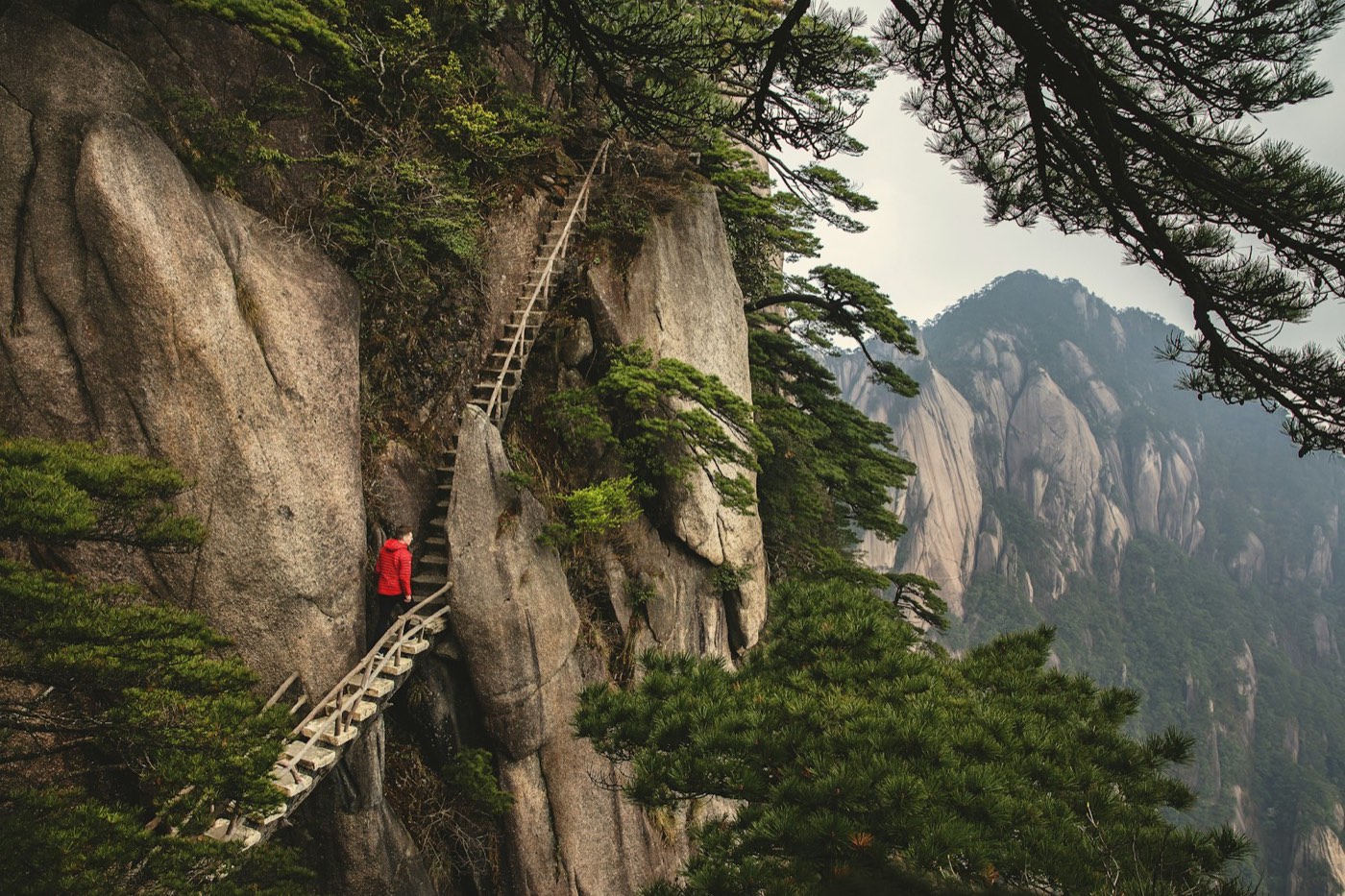
The single most important thing to understand: you do not "hike to the top and back." Mount Huangshan is a ridge-walk between two sides — you go up one cable car, traverse the summit plateau, and come down a different cable car so you never repeat a step. Get the direction right and it's one of the great mountain days of your life. Get it wrong and you waste hours in queues.
Step 1 — the tickets (it's 100% digital now)
| Ticket | Price (peak Mar–Nov) | Price (winter Dec–Feb) |
|---|---|---|
| Mountain entrance | ¥190 | ¥150 |
| Yungu cable car (one-way) | ¥80 | ¥65 |
| Yuping cable car (one-way) | ¥90 | ¥75 |
| Taiping cable car (one-way) | ¥80 | ¥65 |
| Scenic shuttle Tangkou ↔ cable base (one-way) | ¥19 | ¥19 |
Booking — the foreigner-proof way ✓ verified Jun 2026
As of 2026 it's a 100% digital real-name reservation system — no paper ticket windows exist anymore. The official WeChat mini-program is built for Chinese ID cards and routinely rejects foreign passports. So book on Trip.com or Klook (English, handles your passport, often bundles the shuttle) at least a day ahead, more in peak season. Bring your physical passport — you scan it at the gate.
Step 2 — pick your direction (this is the whole game)
The classic, crowd-beating route is up the back, down the front:
- UP via Yungu Cable Car (back mountain). Gentler, and crucially less jammed in the morning rush. It drops you near Begin-to-Believe Peak (始信峰), the Beihai (North Sea) area, and Lion Peak (狮子峰) — your prime sunrise zone.
- Traverse the summit — Bright Summit, the West Sea Grand Canyon, Flying-Over Rock.
- DOWN via Yuping Cable Car (front mountain). This is the side with the Welcoming Pine and the steepest, most dramatic scenery — you want to descend into it, not fight uphill crowds through it.
(The third cable car, Taiping, comes up the remote northwest side — use it only if you're approaching from that direction or want the quietest ascent.)
Step 3 — the timing that makes or breaks the day
The 2026 bottleneck is NOT the mountain — it's the queues
On a peak day the Bright Summit cable lines and the Tangkou shuttle can each eat 1–2 hours. The fix: be at the Tangkou hub by ~5:30 AM for the first shuttles, and ride your up cable car as early as it opens. Cable-car & gate hours run roughly 06:30–07:00 to 16:30–17:00 (earlier on summer weekends/holidays, ~07:20–16:30 in winter).
Prefer to walk it? The honest reality of hiking up
You can skip the cable car and climb the stone stairs — and on the gentler Yungu trail it's a beautiful (if brutal) ~2.5–3 hour ascent. But know what a full foot-traverse of Huangshan actually is: over 10,000 stone steps and ~2,700 m of cumulative climb — 10–12 hours even for fit hikers. Most people cable-car up, walk the summit ridges (where the magic is anyway), and cable-car down. Hike the stairs only on one leg if you want the workout; don't try to do the whole mountain on foot in a day.
The cable car is the smart move, not the lazy one
Forget any guilt about "cheating" with the cable car. A one-way ride is ¥80–90 and saves you 3+ hours of stair-climbing — hours you spend instead on the actual viewpoints where Huangshan earns its name. Even hardcore hikers usually walk just one leg (Yungu up or Yuping down) and ride the other. The summit ridge-walk between peaks is the experience; the stairs up from the car park are just a calf workout with no view.
🌅 Sleeping on the Summit for Sunrise — the thing that makes Huangshan Huangshan
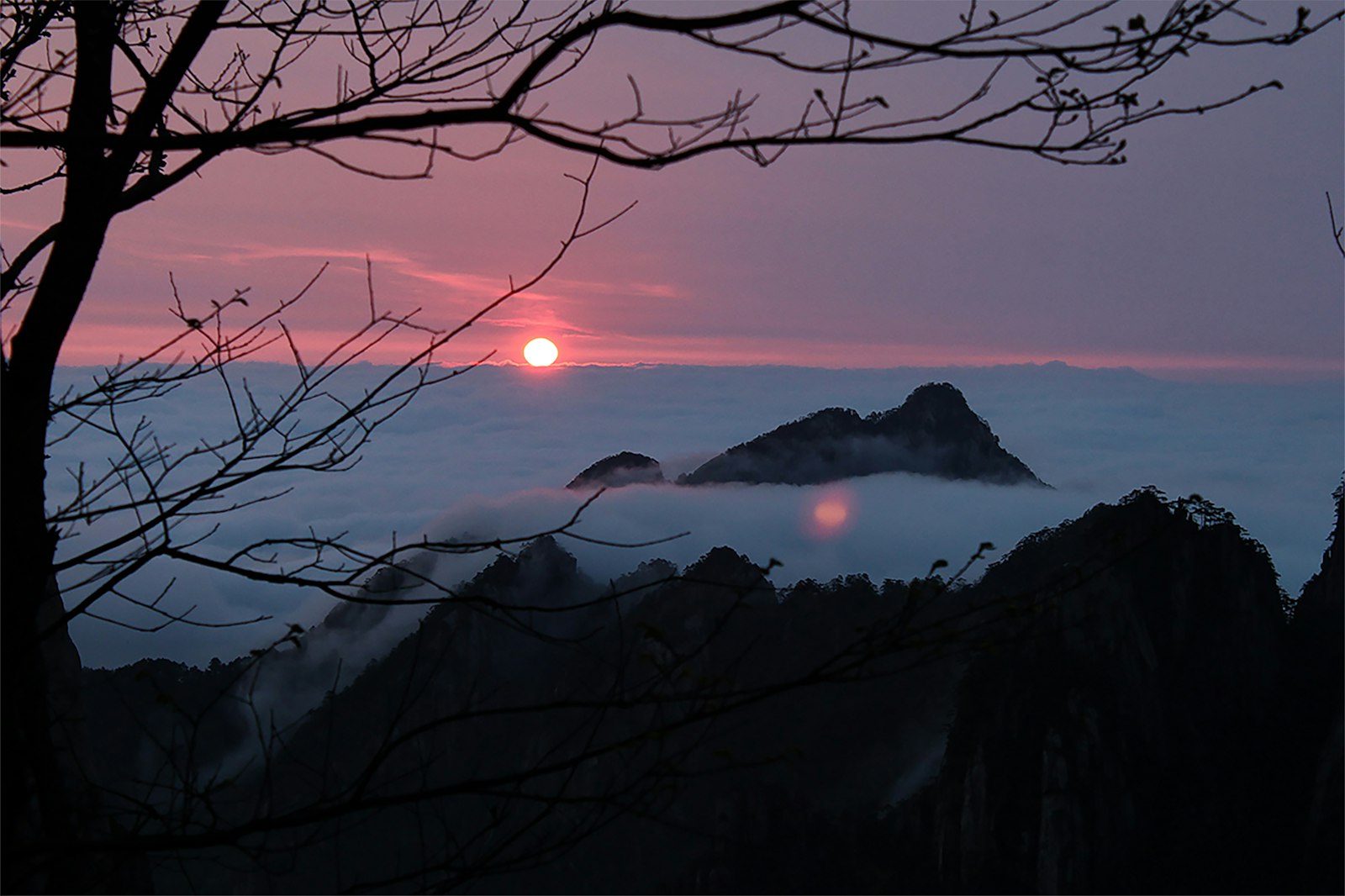
This is the decision that defines your whole trip, so let's be direct: if you can possibly swing it, sleep on the mountain. A day-tripper sees Huangshan in flat midday light with the masses. Someone who overnights on top gets the sunrise over the sea of clouds — peaks turning from grey to gold as cloud pours through the valleys below your feet — and the quiet, near-empty plateau at dusk and dawn. It is, genuinely, a different mountain.
Why overnight (and the catch)
The sunrise and the cloud sea both happen at dawn, and you cannot get up the mountain that early from the bottom — the first shuttle + cable car won't have you at a summit viewpoint in time. Staying on top is the only way to catch it. The catch: summit hotels are expensive, basic for the price, and book out weeks ahead (months for holidays), because everything is carried up by porter and supply is fixed.
Where to sleep on top — the real options
| Hotel | Where / best for | Rough rate (Jun 2026) |
|---|---|---|
| Baiyun Hotel (白云宾馆) | Backs onto Bright Summit — prime sunrise; the upscale pick | from ~$170 (¥1,200+) |
| Guangmingding Hotel (光明顶山庄) | Literally on Bright Summit (光明顶) — roll out of bed to the sunrise spot | from ~$149 |
| WINCLOUD Beihai (北海宾馆) | Beihai / Lion Peak zone (1,630 m) — best for the Lion Peak sunrise | from ~$136 |
| Xihai Hotel (西海饭店) | West Sea area, near the canyon — upmarket, not the budget pick | dorm beds ~¥180–280; private rooms far higher |
Budget travellers — dorm beds exist
Most summit hotels sell bunk-bed dorm rooms at a fraction of the private-room rate — the sane way to still catch the sunrise on a budget. Ask for a "multi-bed room" when booking on Trip.com.
The sunrise playbook
- Book the summit hotel weeks ahead (months for Golden Week / May holiday). Match the hotel to the viewpoint: Bright Summit → Baiyun/Guangmingding; Lion Peak → WINCLOUD Beihai.
- The front desk posts the next morning's sunrise time and which viewpoint is best — check it the night before.
- Set an alarm for ~40 min before sunrise. Wear everything you packed — it's cold and windy at 1,800 m even in summer; hotels lend or rent thick coats.
- Walk to Bright Summit (光明顶), Lion Peak (狮子峰), or Begin-to-Believe Peak (始信峰) — the three big sunrise decks — and stake a spot 20 min early.
The "sea of clouds" is a real forecast — and winter is its prime time
First-timers think the cloud sea (云海 yúnhǎi) is a lucky fluke. It's not — it's a predictable weather event that forms when humid valley air hits the cold peaks, most often November to May and especially right after rain or snow. That's why seasoned visitors deliberately come in winter: the most frequent cloud seas, pines glazed in silver rime, and hotel + ticket prices cut 15–40%. A "bad" drizzly afternoon is often the setup for a flawless cloud-sea dawn the next morning — so don't bail on rain.
Want the whole mountain planned — summit hotel with the right sunrise view, the cable cars and tickets planned (we'll show you how to book them), a guide who knows which ridge the clouds favour that morning? Tell us your dates on WhatsApp.
Ask us →🌲 The Summit Highlights & the West Sea Grand Canyon
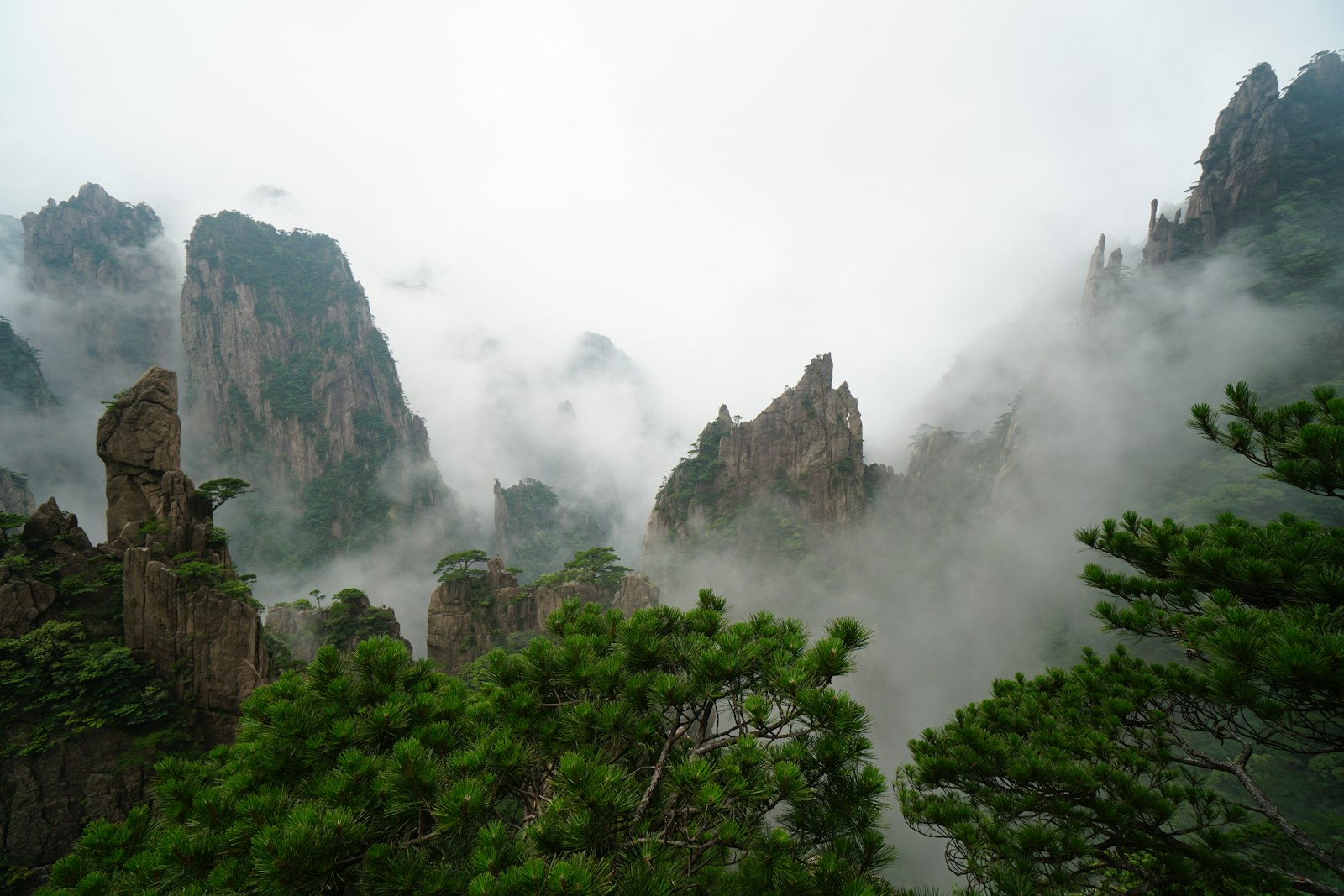
Once you're on the ridge, here's what's worth your steps, roughly in the order the classic Yungu-up route hits them:
- Begin-to-Believe Peak (始信峰) — the first "oh, now I believe the photos" viewpoint, dense with twisted pines and spires. Right by the Yungu top station.
- Lion Peak & Refreshing Terrace (狮子峰 / 清凉台) — the Beihai (North Sea) area's headline sunrise deck; also where you'll see "Monkey Watching the Sea" rock when clouds fill the valley.
- The Welcoming Pine (迎客松 / Yíngkè Sōng) — the 1,000-year-old pine by Yuping that's the symbol of Huangshan (and of Chinese hospitality — it's painted in the Great Hall of the People). One branch reaches out like an arm welcoming guests. Touristy, unmissable, on the Yuping descent route.
- Bright Summit (光明顶, 1,860 m) — the second-highest peak and the central crossroads of the summit; the widest sunrise/cloud-sea panorama, and where the Guangmingding hotel sits.
- Flying-Over Rock (飞来石) — a giant balanced boulder that looks dropped from the sky; a short detour from Bright Summit.
The West Sea Grand Canyon (西海大峡谷) — the best walk on the mountain
If you have the legs and the time, the West Sea Grand Canyon loop is the most spectacular and least-crowded part of Huangshan — a stepped trail plunging into a canyon of spires. Two ways to handle it:
- Hike down and out, or
- Ride the Xihai ground monorail (地轨缆车) back up the steep bit — ¥100 (¥80 winter), a 3-carriage glass funicular climbing ~497 m between Cloud-Dispelling (排云溪) and Heavenly Sea (天海) stations.
The canyon closes in winter
The West Sea Grand Canyon is shut Dec 1 – Mar 31 (snow/ice), and the Xihai monorail with it. If you're chasing winter rime, plan the rest of the summit instead. ✓ verified Jun 2026
🍲 What to Eat in Huangshan: Hui Cuisine (徽菜) — a foreigner's field guide
Huangshan is the home of Hui cuisine (徽菜) — one of China's eight great culinary traditions, built on wild mountain ingredients: bamboo shoots, river fish, cured meats, and a famous love of fermented funk. It's earthy, smoky, and not especially spicy — a complete change of pace from Sichuan or Hunan. Eat it down in Tunxi or the villages, not on the summit (mountain-top food is pricey, porter-carried, and basic).
The dishes to order (and brave)
- Stinky mandarin fish (臭鳜鱼 / chòu guìyú) — the Hui signature. River fish lightly fermented in wooden barrels until it smells pungent, then braised — at which point the aroma flips and the meat turns firm, savory, and delicious. Locals' saying: "smells stinky, tastes amazing." The one dish you have to try here.
- Mao tofu (毛豆腐 / máo dòufu, "hairy tofu") — tofu fermented until it grows a fuzzy white coat, then pan-fried crisp outside, creamy in. Sounds alarming, tastes like a savory cheese. A Tunxi street-stall staple.
- Bamboo-shoot dishes & stewed cured pork (问政山笋 / 火腿炖) — the gentle, crowd-pleasing side of Hui cooking.
- Plum-blossom spareribs & rice-wine cakes — sweet-tangy ribs and a local fermented-rice dessert.
Where to eat on Tunxi Old Street
| Restaurant | Why go | Per person |
|---|---|---|
| Lao Jie Di Yi Lou (老街第一楼) | Classic Hui home cooking near the Memorial Archway (No. 247 Old Street); always packed — reserve | ~¥58 |
| Meishi Renjia (美食人家) | The local-delicacies one-stop: stinky fish, Mao tofu, shuixian buns, cheap | ~¥61 |
| Danfenglou (丹凤楼) | A Hui institution since 1876 — for the heritage as much as the food | mid-range |
A two-person Hui feast — stinky fish included — costs about what one airport sandwich does back home
A signature braised stinky mandarin fish, a plate of crisp Mao tofu, bamboo shoots, rice, and tea for two on Tunxi Old Street lands around ¥120–160 total — roughly $17–23. The food that defines this entire region is its cheapest food, served in century-old wooden shophouses. Skip the summit restaurants (porter-tax pricing) and eat like a Huizhou merchant down in Tunxi for next to nothing.
Sources — Part 3 (verified June 2026)
Tickets & cable cars: chinadiscovery.com Huangshan cable car, travelchinaguide.com (entrance ¥190/¥150; Yungu/Taiping ¥80/¥65, Yuping ¥90/¥75; scenic shuttle ¥19; hours ~06:30–17:00 / winter 07:20–16:30).
Booking system: chinadiscovery.com / ruqintravel.com (100% digital real-name reservation, WeChat rejects foreign passports, use Trip.com/Klook).
Routes & hiking: wanderinchina.com Huangshan hiking 2026 (up Yungu / down Yuping; full traverse 10,000+ steps / ~2,700m / 10–12h; Tangkou hub by 5:30 AM; queue bottlenecks).
Summit hotels & sunrise: huangshantourguide.com summit hotels & trip.com (Baiyun ~$170 / Guangmingding ~$149 / WINCLOUD Beihai ~$136 / Xihai dorms ~¥180–280; coats lent); chinadiscovery.com sunrise (decks: Bright Summit / Lion Peak / Begin-to-Believe).
Sea of clouds / West Sea Canyon: travelchinaguide.com & chinaculturetour.com (cloud sea best Nov–May; winter rime; prices 15–40% lower); chinadiscovery.com / trip.com (Xihai monorail ¥100/¥80; canyon closed Dec 1–Mar 31).
Hui cuisine: chinawondersguide.com (stinky mandarin fish; Tunxi food — Lao Jie Di Yi Lou ~¥58, Meishi Renjia ~¥61), travelchinaguide.com & chinadiscovery.com (Danfenglou est. 1876).
Prices and hours shift on Chinese public holidays and with cable-car maintenance — confirm the load-bearing ones on Trip.com or the official scenic-area channel before you commit.
Day Trips: The Huizhou Villages
Here's what most people miss: the mountain is only half of Huangshan. Spread across the valleys below are the Huizhou ancient villages (徽州古村落) — 500-year-old whitewashed merchant towns with black-tiled roofs and curved "horse-head walls," reflected in still ponds, exactly as they were in the Ming and Qing dynasties. Two are UNESCO World Heritage sites. Give the mountain its days, then give the villages at least one.
🏘️ Hongcun Village (宏村) — the "Crouching Tiger, Hidden Dragon" village
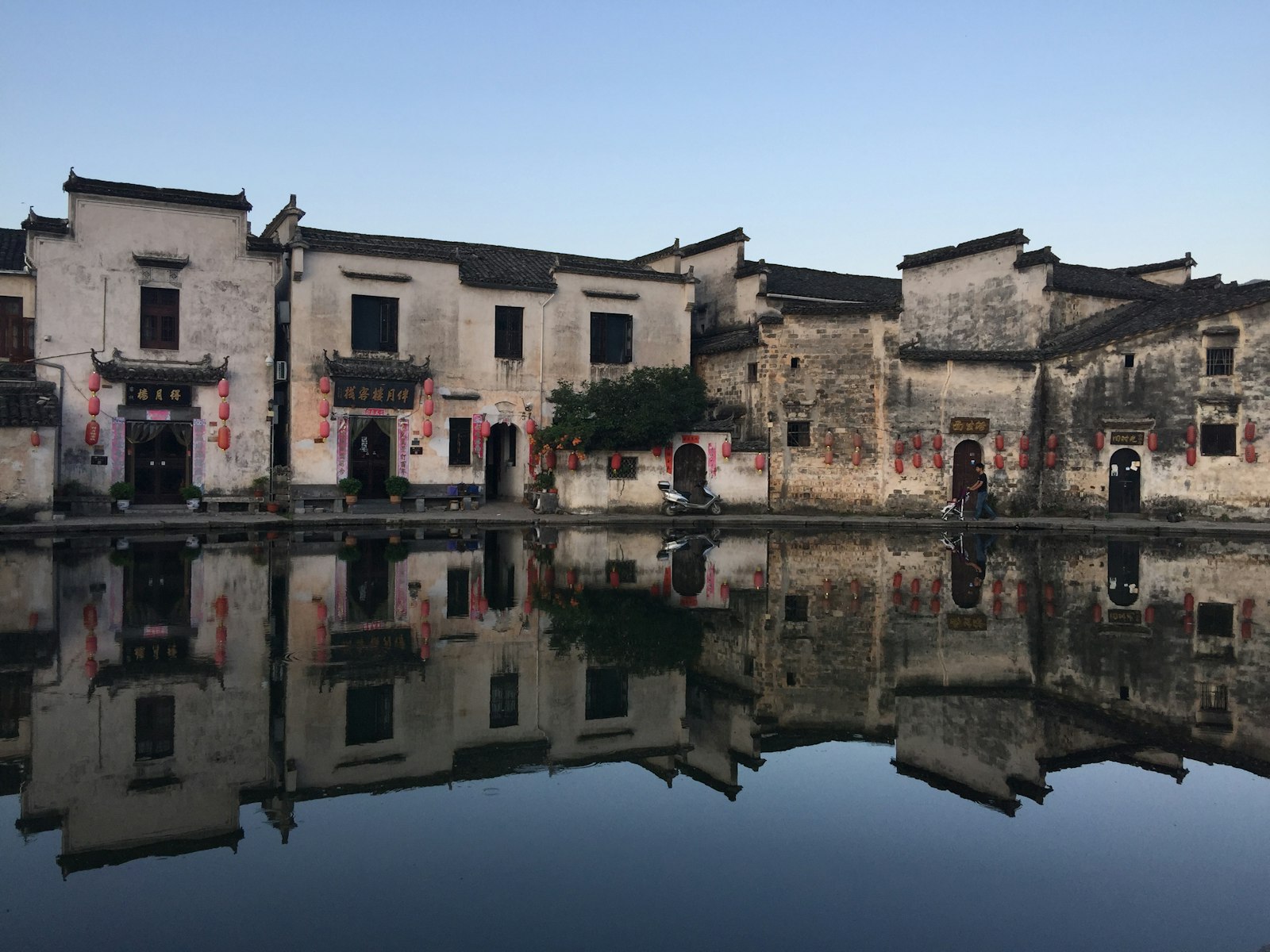
If you do one village, do Hongcun. Laid out in the shape of an ox over 900 years ago, it's built around the Moon Pond (月沼) and South Lake (南湖) — mirror-still water that doubles every white wall and grey roof into a perfect reflection. The opening scene of Ang Lee's Crouching Tiger, Hidden Dragon was filmed here, and at dawn or dusk, with mist on the water and a painter or two at their easels, it's one of the most beautiful places in China.
- Ticket: ¥104 (¥94 booked online), valid 3 days. Open 07:30–17:30.
- Getting there from Tunxi: Tourist bus from Tunxi (Huangshan City) bus station → Hongcun, ~1–1.5 hr, ~¥20–30. Buses also run from Tangkou if you're coming off the mountain.
- Insider: Day-trippers flood in 10:00–16:00. Go early or stay overnight inside the village (there are guesthouses) — at dawn the Moon Pond is empty and glassy, and after the tour buses leave at dusk the lanes are yours.
You can sleep inside a 900-year-old UNESCO village — for the price of a chain motel
Hongcun and Xidi aren't roped-off museums; they're living villages with guesthouses in the old merchant houses. Stay a night and you get the thing day-trippers never see: the Moon Pond at 6 AM with zero people, lantern-lit lanes after the buses leave, breakfast in a courtyard older than most countries. Rooms run ¥150–400 — a fraction of what a "heritage stay" costs anywhere in Europe. This is the move serious photographers make.
🏯 Xidi Village (西递) — the mansions-and-archways one
The other UNESCO village, 40 minutes from Hongcun, Xidi is older, grander, and quieter — a 960-year-old town of 124 preserved Ming and Qing merchant mansions, intricate wood and stone carvings, and a famous stone memorial archway (牌坊) at its entrance. Where Hongcun is about water and reflections, Xidi is about architecture and lineage — the wealth of the Huizhou merchant clans frozen in stone.
- Ticket: ¥104 (¥94 online), valid 24 hours. Open 07:30–17:30.
- Getting there: The Tunxi → Hongcun tourist bus passes Xidi (~1 hr from Tunxi); or hop the Hongcun ↔ Xidi shuttle (~30 min, ~¥8).
- Do both? Yes, if you have a full day — they're only 20 km apart and pair naturally. If you must choose: Hongcun for the iconic water scenery, Xidi for the deeper architectural history.
🍂 Tachuan, Chengkan & the Deeper Cuts (for photographers and the curious)
If you've got more time — or you're here in autumn — these reward the effort:
- Tachuan (塔川) — a tiny village 5 minutes' drive from Hongcun that becomes one of China's most famous autumn-foliage spots in November, when ancient trees blaze red and gold against the white walls. Off-season it's a quiet, pretty add-on to Hongcun.
- Chengkan (呈坎) — ~40 km out, a feng-shui village laid out as a maze of twisting lanes and ancient drainage; far fewer tourists, a real sense of stepping into the past.
- Shexian & the Tangyue Archways (歙县 / 棠樾牌坊群) — Shexian is the "Town of Archways," and the Tangyue cluster of seven memorial arches (Ming–Qing) plus the Bao family garden is the grandest archway ensemble in the region.
How to do the villages without a car
Tourist buses cover Hongcun and Xidi well, but the deeper cuts (Chengkan, Tangyue, Tachuan in one go) are far easier with a hired driver for the day — and in autumn, a driver lets you chase the light between villages. That's exactly the kind of day we set up.
🛍️ Tunxi Old Street (屯溪老街) — your base-town evening
You'll likely sleep in Tunxi at least one night (it's the city, remember — Part 1), and its showpiece is Tunxi Old Street: a free, pedestrian Song-and-Ming-style street of wooden shophouses selling Huizhou crafts, the "Four Treasures of the Study" (ink sticks, ink stones, brushes, paper — this was historically China's ink-making heart), and local snacks.
- Ticket: Free. Shops/stalls ~09:00–22:00.
- What to buy: Huangshan Maofeng (黄山毛峰) green tea and Keemun (祁门) black tea — both world-famous and grown right here — plus a hand-carved ink stone. Watch artisans carve ink sticks in the back lanes.
- Insider: Come after dark when the lanterns light up and the day-trippers have gone — then eat your stinky mandarin fish dinner here (restaurants in Part 3). The perfect low-key evening to bookend a mountain day.
Want a private day through the Huizhou villages — Hongcun at dawn before the crowds, Xidi's mansions, the autumn reds of Tachuan, a driver who knows the back roads? Send us your dates on WhatsApp.
Send dates →Sources — Part 4 (verified June 2026)
Hongcun & Xidi: trip.com & chinahangzhoutour.com Hongcun (¥104 / ¥94 online, valid 3 days, 07:30–17:30; ~1–1.5h tourist bus from Tunxi; Crouching Tiger filming site); trip.com Xidi & travelchinaguide.com (124 Ming-Qing mansions; Hongcun↔Xidi ~30min/¥8).
Tachuan / Chengkan / Shexian: chinadiscovery.com & travelchinaguide.com Huangshan photography & things-to-do (Tachuan 5 min from Hongcun, Nov red leaves; Chengkan ~40km feng-shui maze; Shexian "town of arches," Tangyue seven archways).
Tunxi Old Street: chinahighlights.com & chinadiscovery.com (free, shops ~09:00–22:00; Maofeng & Keemun tea, ink-stone / Four-Treasures craft hub).
Know Before You Go
🧠 Hiking tips, culture, money & health — the fine print
🥾 The Huangshan climbing cheat-sheet (read before the mountain)
- Wear real shoes. Thousands of stone steps, often wet and slick with mist — trainers with grip minimum, no sandals. A walking pole helps knees on the descent (sold cheap at the foot).
- Layer up, even in summer. The summit sits at ~1,800 m and is windy and cold at dawn year-round. Hotels lend/rent thick coats for sunrise; bring a warm layer regardless.
- Pack light, leave the rest. You carry everything you bring up. Left-luggage storage is available at Tangkou and the cable stations — drop the big bag, take a daypack.
- Carry water + snacks from the bottom. Summit prices are porter-inflated (a bottle of water can be several times city price). Buy in Tangkou.
- Beware the monkeys. Wild macaques near some viewpoints will snatch food and unzipped bags — zip up, don't feed.
- Beat the queues: Tangkou hub by ~5:30 AM, ride the up cable car early, go up Yungu / down Yuping.
🤝 Culture shocks & etiquette (the 6 that trip up first-timers)
- No tipping. Anywhere. Restaurants, taxis, hotels, your driver — none of it. Trying to tip causes confusion, not gratitude.
- Carry your own tissues + hand sanitizer. Public restrooms (and many squat toilets, including on the mountain) often have neither paper nor soap.
- You order by scanning a QR code at most restaurants — point your camera at the table sticker, a menu opens, you tap, you pay. (Menus are usually Chinese — Google Translate's camera, on your eSIM, reads them instantly.)
- Tap water is NOT drinkable — locals boil it or drink bottled. Every hotel room has a kettle and free bottles.
- Strangers may ask to photograph you — especially with kids, and especially in the villages where foreign faces are rarer. It's friendly curiosity, not a scam. Smile, say yes or politely wave it off.
- Personal space & volume run differently — closer queuing, louder rooms. Cultural, not rude. Roll with it.
💰 What's dirt-cheap vs. surprisingly pricey
Absurdly cheap (spend freely):
- High-speed rail — Hangzhou→Huangshan in 1.5h is ~¥85–145.
- Village & mountain tickets — ¥104 for a UNESCO village, ¥190 for the whole mountain.
- Hui food down in Tunxi — a signature stinky-fish dinner for two ~¥120–160.
- Local buses & Didi — Tangkou shuttle ¥19; cross-town Didi ¥20–60.
Surprisingly pricey (budget for it):
- Summit hotels — ¥600–1,500+ a room (the porter-economy tax), and the one real splurge of the trip.
- Anything carried up the mountain — water, instant noodles, snacks cost several times city price on the summit.
- Cable cars add up — ¥80–90 each way, ×2, ×people.
- Western food & specialty coffee — scarce here and priced at a premium.
🚑 Emergencies & health (save these before you fly)
- Don't drink the tap water — bottled or boiled only. Your hotel kettle is your friend.
- The mountain's real risks are physical: wet, slippery steps and serious elevation gain. Pace yourself, use handrails, and if you have heart/knee issues, cable-car both ways. Altitude sickness is rare at 1,800 m but the exertion is real.
- Pharmacies (药店) are everywhere in Tunxi, cheap, no prescription for basics — point or show a translated note. Stock blister plasters and painkillers before the climb.
- Travel insurance is strongly worth it for a hiking-heavy trip.
❓ Huangshan FAQ — straight answers to what everyone actually asks
Is Huangshan the mountain or the city — which one do I book?
Both, confusingly. Mount Huangshan is the scenic area with the peaks; its base village is Tangkou. Huangshan City is the administrative city, and its downtown is Tunxi — home to the airport (TXN), the main high-speed station, and Tunxi Old Street, about 65 km / 1.5 hours from the mountain. When a train says "Huangshan North," that's the city (Tunxi area), and you've still got a ~50-min bus to Tangkou for the mountain. Book Tunxi for arrival, old street and villages; Tangkou or the summit for climbing.
Do I need a visa to visit Huangshan in 2026?
Probably not. 50 countries get 30 days visa-free (most of Europe, Australia, NZ, Japan, Korea; UK & Canada since 17 Feb 2026; Singapore, Thailand & Malaysia via mutual-exemption deals). Citizens of the 57 countries on the 240-hour list — including the US — can instead use the 240-hour (10-day) visa-free transit if they meet the policy's conditions, including entry through an approved port and an onward ticket with a confirmed date and itinerary, leaving within 240 hours for a third country or region different from their departure country or region. Huangshan's own TXN airport is an approved Anhui port but has few international flights, so most travellers enter via Shanghai, Hangzhou or Nanjing and train in — the 240-hour window covers the whole Yangtze Delta. Always confirm your nationality on the official en.nia.gov.cn before booking. (Full breakdown: Part 1.)
How many days do I need for Huangshan?
Minimum 2 days — one for the mountain (ideally with a summit overnight for sunrise), one for a Huizhou village. 3–4 days is the sweet spot: a full mountain day plus sunrise, a day for Hongcun and Xidi, and time in Tunxi for the old street and Hui food. Add a day for the deeper villages (Chengkan, Tangyue) or autumn photography at Tachuan.
Should I sleep on top of the mountain, and is it worth the price?
If you can afford it, yes — it's the single best decision of the trip. The sunrise over the sea of clouds only happens at dawn, and you can't get up there early enough from the bottom. Summit hotels are basic-for-the-price and book out weeks ahead (¥600–1,500+ a room; dorm beds are the budget option), because everything's carried up by porter. The payoff — a near-empty plateau at dusk and a golden cloud-sea sunrise — is what separates Huangshan from every other mountain. (Full playbook: Part 3.)
Which cable car should I take up Huangshan?
The classic crowd-beating route is up the Yungu cable car (back mountain — gentler, less morning queue) and down the Yuping cable car (front mountain — Welcoming Pine, steepest scenery). Yungu/Taiping are ¥80 one-way (¥65 winter), Yuping ¥90 (¥75 winter). Taiping comes up the remote northwest side — use it only if you're approaching from there. Don't go up and down the same side; the whole point is the ridge traverse between them.
When is the best time to visit Huangshan, and is rain a problem?
April–May and September–October for the best all-round weather. But the famous sea of clouds is best November–May and forms right after rain or snow, so drizzle isn't a wash-out — it's often the setup for a perfect cloud-sea dawn. Winter (Dec–Feb) brings the most frequent cloud seas, silver rime-frosted pines, and hotel/ticket prices 15–40% lower — just note the West Sea Grand Canyon closes Dec 1 to Mar 31. Avoid Golden Week (1–7 Oct) and the May Day holiday for the crowds. (Full season guide: Part 1.)
Do I need to book Huangshan tickets in advance, and can foreigners use the official site?
Yes, book ahead — as of 2026 it's a 100% digital real-name reservation system with no paper ticket windows. The official WeChat mini-program is built for Chinese IDs and routinely rejects foreign passports, so book on Trip.com or Klook (English, handles your passport, often bundles the shuttle) at least a day out, more in peak season. Bring your physical passport to scan at the gate.
How do I get from Huangshan North station to the mountain?
Exit the station, follow the "Sightseeing Bus" sign, turn right and walk ~200 m to the Huangshan Tourism Hub. Take the bus to Tangkou: ¥27, ~50 min, running 08:00–20:20 (every 30 min in peak season). At Tangkou you transfer to the mandatory scenic shuttle (¥19 one-way, every ~15 min) up to the Yungu/Yuping cable-car base. For Tunxi/Old Street instead, it's a ~35-min bus or ¥40–60 Didi. (Full options: Part 2.)
What food is Huangshan famous for, and is it spicy?
This is the home of Hui cuisine (徽菜) — earthy, smoky, and mostly not spicy. The must-try is stinky mandarin fish (臭鳜鱼), river fish barrel-fermented then braised ("smells stinky, tastes amazing"), plus Mao tofu (fuzzy fermented tofu, pan-fried), bamboo shoots and cured pork. Eat it down in Tunxi or the villages (cheap, traditional), not on the summit (porter-priced). A two-person feast runs ~¥120–160. (Where to eat: Part 3.)
Should I visit Hongcun or Xidi — or both?
Hongcun if you pick one — the ox-shaped village around the mirror-still Moon Pond, the Crouching Tiger, Hidden Dragon filming site, magical at dawn. Xidi is older, grander and quieter — 124 Ming-Qing merchant mansions and a famous archway, more about architecture than water. They're 20 km / 30 min apart (¥8 shuttle) and pair into one easy day; both are ¥104 (¥94 online) — Hongcun's ticket is valid 3 days, Xidi's just 24 hours. With limited time, Hongcun wins on sheer beauty. (Full guide: Part 4.)
Is Huangshan suitable for non-hikers, older travellers or kids?
Yes, with planning. Cable-car both ways (Yungu up, Yuping down) and you skip almost all the stairs — the summit ridge between the top stations still has plenty of relatively flat, paved viewpoint walking. Skip the West Sea Grand Canyon (steep) and you'll see the headline peaks, Welcoming Pine and Bright Summit comfortably. The villages (Hongcun, Xidi, Tunxi Old Street) are flat and easy. The one genuinely hard part is the optional canyon and any stair-hiking — all avoidable.
Is Huangshan safe, including for solo travellers and women?
Extremely. You're far more likely to be robbed in a major Western city than anywhere in China, and small mountain-tourism towns like Tangkou and Tunxi are calmer still — dense CCTV, near-zero street crime, solo travellers catching pre-dawn shuttles without a thought. The real hazards are slippery wet steps and food-snatching monkeys near the summit, not people. Watch your footing and zip your bag near the macaques. (Full context: the safety box in Part 2.)
📣 Plan it with us
Want the whole thing handled?
Bullet trains booked, the right summit hotel for the morning's sunrise, the mountain tickets and cable cars planned (we'll show you how to book them), Hongcun at dawn before the crowds, and a local guide who knows which ridge the clouds favour and which Tunxi kitchen does the best stinky fish. That's exactly what we do — real humans, real local knowledge. Tell us your dates and what you're into, and we'll take it from there.
Plan your Huangshan trip on WhatsApp
All sources (verified June 2026)
Visa & entry: en.nia.gov.cn (National Immigration Administration); chinadiscovery.com 240-hour transit & Huangshan airport. Transport: chinadiscovery.com & travelchinaguide.com (Shanghai/Hangzhou–Huangshan HSR), chinatrain12306.com (stations), chinabusguide.com & huangshan.gov.cn (North→Tangkou bus, scenic shuttle), trip.com/wise.com (Didi). Mountain tickets/cable cars: chinadiscovery.com Huangshan cable car, travelchinaguide.com, ruqintravel.com, trip.com (Xihai monorail). Routes/hotels: wanderinchina.com (hiking routes), huangshantourguide.com & trip.com (summit hotels), chinadiscovery.com (sunrise). Villages: trip.com & chinahangzhoutour.com (Hongcun/Xidi), chinadiscovery.com & travelchinaguide.com (Tachuan/Chengkan/Shexian), chinahighlights.com (Tunxi Old Street). Food: chinawondersguide.com, travelchinaguide.com, chinadiscovery.com. eSIM & payment: unusualnomad.com, traveltomtom.net, cybernews.com, realchinatrip.com, trip.com, Alipay/WeChat help centers. Seasons/climate: travelchinaguide.com, chinaculturetour.com, climate-data.org.
⚠️ Live-confirm before travel: seasonal opening hours, exact fares, summit-hotel rates, and cable-car maintenance windows shift. Mountain tickets/booking → Trip.com or the official scenic-area channel; village tickets → Trip.com; visa → en.nia.gov.cn.