🧭 TL;DR — the honest bottom line
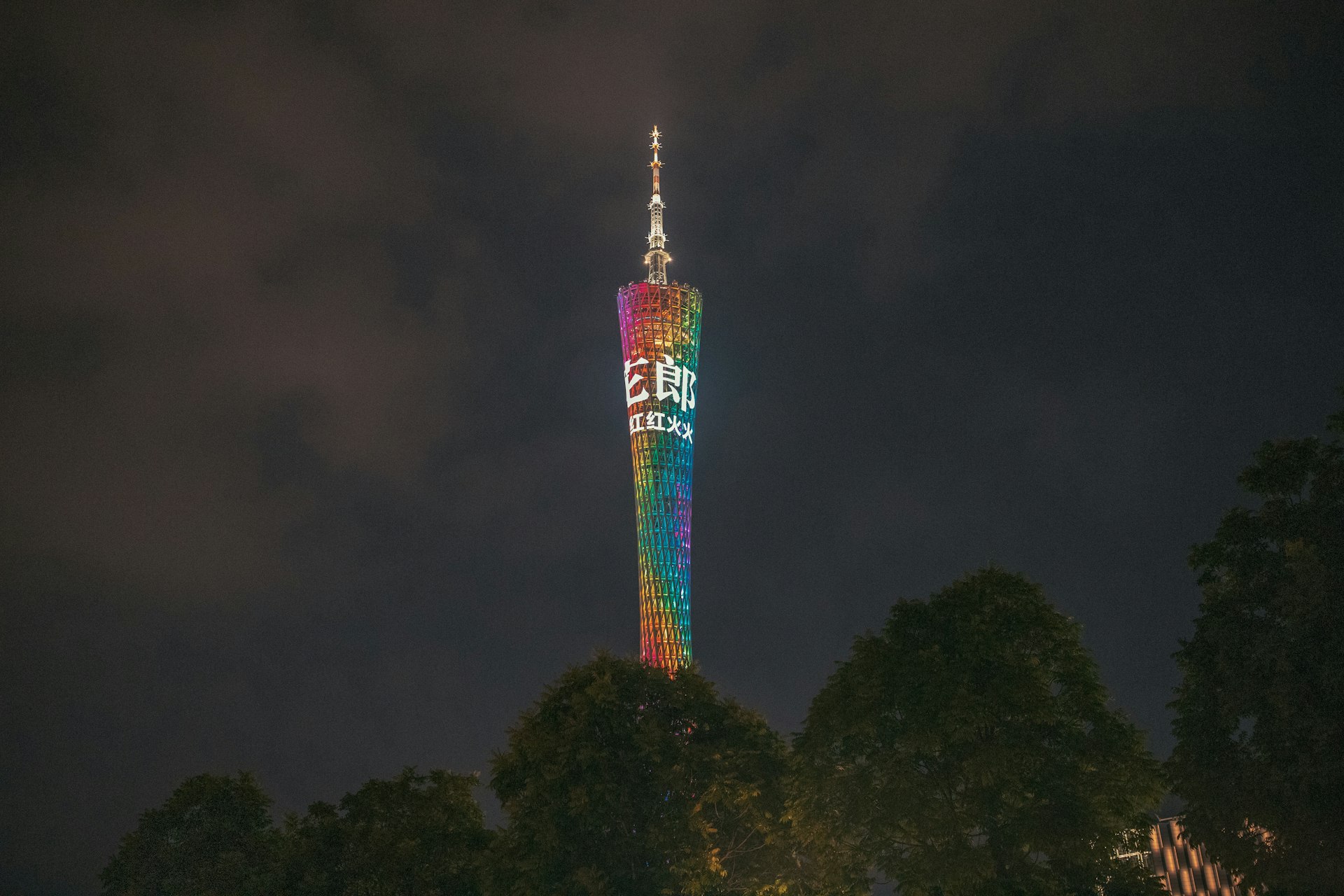
Here's what nobody tells you before you come: forget the "factory city" rumor — Guangzhou is the world capital of dim sum and the easiest base in China. It's a 2,200-year-old trading port with French-colonial islands and granite Gothic cathedrals, where you have a three-hour breakfast of shrimp dumplings, ride a glass lift up the 600m "Slim Waist," cruise the Pearl River past a tower lit like a candy stick, and roll home alone past midnight without a thought. And it's the front door to the Pearl River Delta — kung-fu temples, a sci-fi megacity, and UNESCO watchtowers are all bullet-train-close. Give it 2–3 days (5 with day trips), and check your passport: many now get in visa-free.
Two things to do before you fly: set up an eSIM (so Google and WhatsApp work) and bind a card to Alipay (so you can pay for anything). Sort those two and the rest of this guide is just the fun part.
No time to read all of this? Tell us your dates and we'll build your Guangzhou plan for you — on WhatsApp, real humans. (One message, no obligation.)
Message us →📌 This guide is long because it's complete — use the menu to jump. Everything below is named, priced, and verified June 2026; we flag anything that drifts so you can double-check the load-bearing details.
Before You Go
🛂 Do You Need a Visa for Guangzhou? — Visa-Free Entry Explained
Here's the thing most travel sites get wrong about Guangzhou: there isn't one way in visa-free — there are two, they're completely separate, and picking the wrong one is the single most common way people trip themselves up before they've even packed. Which one is yours comes down to what passport you hold — and, for a big chunk of readers, whether you're flying onward to a third place after.
Good news up top: Guangzhou Baiyun International Airport (CAN) is an officially approved port for both routes. So whichever camp you're in, you can land here.
| Route | Who it's for | Max stay | The catch |
|---|---|---|---|
| 30-day visa-free | 50 countries — most of the EU/Schengen (Czechia and Lithuania aren't on it), plus UK + Canada (both added 17 Feb 2026), Australia, New Zealand, Japan, South Korea, and more | 30 days | Ordinary passport. Tourism / business / visiting family / transit — no onward-ticket rule. |
| 240-hour (10-day) transit | 57 nationalities incl. the USA, UK, Canada, Australia, most of Europe, Japan, Korea, Singapore | 10 days (240h) | You must be transiting — hold a confirmed onward ticket (fixed date) to a third country/region, and enter via an approved port. |
✓ verified Oct 2026 Lists shift often — reconfirm your nationality on the official en.nia.gov.cn before booking. (The 30-day policy runs through 31 Dec 2026 for most countries, per China's Foreign Ministry.)
🇺🇸 Americans, read this carefully — it's the #1 gotcha
You are not on the 30-day visa-free list, but the US is on the 240-hour (10-day) visa-free transit list, and that is enough time to do Guangzhou properly. To use it, you must meet the policy's conditions, including entry through an approved port and a confirmed onward ticket out of mainland China to a third country or region different from your departure country or region, booked before you land. Shenzhen and Foshan sit inside your permitted area (the whole of Guangdong). The official notices say only "a third country or region", and none of the official pages we read names Hong Kong or Macao either way; reading them as qualifying is an inference, not an official rule. If your plan depends on it, ask the National Immigration Administration's 24-hour hotline, +86 12367 (English available), before you book.
Guangzhou Baiyun (CAN) is one of Guangdong's 10 approved ports (65 nationwide since November 2025). And the window isn't a one-province cage anymore: inside your 240 hours you can move between the permitted areas of all 24 participating provinces (some provinces only allow certain cities — check the area table on nia.gov.cn), with Guangdong participating in full. Translation: a Guangzhou → Foshan → Shenzhen swing, or even further afield, is completely fine inside the 10 days.
Two things that quietly sink people
① The 240 hours don't start when you land — they start at 00:00 the next day (GMT+8), so your arrival day is essentially a freebie. ② Your onward country or region must differ from your departure country or region — a US → Guangzhou → back-to-US round-trip does not qualify. Whether Hong Kong or Macao qualifies is an inference, not an explicit rule in the official notices; ask +86 12367 before booking if your plan depends on it.
Policy and country lists shift — always reconfirm your nationality on the official en.nia.gov.cn before you book the flight.
🗓️ Best Time to Visit Guangzhou
Aim for October to December, or February to March — that's the sweet spot, no contest. Moderate temperatures, low rain, and you sidestep both the swelter and the storms. Guangzhou is subtropical, which is a polite way of saying the summers are long, hot, and soaking wet.
| Season | Months | Temp | The real story |
|---|---|---|---|
| 🍂 Autumn (best) | Oct–Dec | ~21–30°C | The golden window. Warm, dry, comfortable — the city exhales. Book ahead, locals travel now too. |
| 🌸 Spring (also great) | Feb–Mar | ~21–28°C | Mild and pleasant, the other sweet spot — just before the rains arrive. |
| 🌧️ Rainy season | Apr–Jun | warm + wet | Heavy rainstorms; roughly 80% of the year's rain falls Apr–Sep. Pack a real rain layer. |
| ⛈️ Typhoon + heat | Jul–Sep | highs to 35°C, 80%+ humidity | Sweltering, sticky, frequent afternoon thunderstorms. Avg 3–5 impactful typhoons/yr (usually short-lived). |
Avoid Chinese public holidays if you possibly can — Labour Day (early May), National Day / Golden Week (1–7 Oct), and Spring Festival (late Jan/Feb) pack out the metro, the dim sum halls, and every ticket queue in the city. Guangzhou empties of locals during Spring Festival in particular (many head home), but the trade-off is some restaurants close — so the shoulder weeks on either side are the real bliss.
✈️ How to Get to Guangzhou: Airport & High-Speed Rail
Guangzhou is one of southern China's great hubs — a massive international airport, and a high-speed rail network that turns the entire Pearl River Delta into a set of day trips.
The airport: Baiyun International (CAN)
Almost all international flights land at Baiyun (CAN), north of the city. One thing to clear up immediately, because the internet muddies it: there is no maglev or airport express train at CAN. The rail links into town are the regular Metro Line 3 (Airport North station, which serves Terminal 2) and the East Ring intercity train (Baiyun Airport East station, which serves Terminal 3). Terminal 3 has no metro station: from the tourist-bus hub on the ground floor of the T3 transport centre (East Coach Station), take the Airport Line 2 branch bus (about 12 min, ¥2) to Gaozeng metro station, then change to Line 3 or 9 into the city. Terminal 1 has been closed to passengers since 7 May 2026, so check the terminal printed on your ticket. (Full airport-to-city breakdown with all the options is in Part 2.)
Onward by high-speed rail — Guangzhou is the Pearl River Delta hub
Two main stations do the heavy lifting (Guangzhou South / 广州南 for most bullet trains, plus Guangzhou East / 广州东), and the reach is absurd:
| To | Time (high-speed) | Why bother |
|---|---|---|
| Foshan | ~17–21 min (2nd class ¥11–15) | Lingnan culture + kung fu — the Ancestral Temple with the Ip Man Hall. Also reachable by direct Guangfo metro. |
| Shenzhen | Check your selected train | China's tech megacity; Futian station drops you in the core. A Shenzhen stop is optional: Guangzhou South and Guangzhou East also have direct high-speed rail connections with Hong Kong West Kowloon. |
| Kaiping | ~30–60 min | UNESCO Diaolou watchtowers — surreal fortified fusion towers (more in Part 4). |
Book trains on the official 12306 website (English version) or at the station with your passport — more in Part 4.
Farther afield, Guangzhou's bullet trains also reach Xiamen (~3h53m) and Wuhan (~4h), and Sanya's beaches on Hainan island are a short flight south.
The big-picture reason to base yourself here
Guangzhou is the launchpad. Inside your visa window — whether that's 30 days or the 240-hour transit clock — Shenzhen and Foshan are easy hops; Hong Kong and Macau mean leaving the mainland (see Part 1), so check how that fits your entry rule with your airline or on en.nia.gov.cn before you book. You're not just visiting a city; you're parked at the front door of the whole Pearl River Delta.
💴 Guangzhou Travel Budget: What It Costs (per day, excluding flights)
Guangzhou is going to feel cheaper than you expect for a city this big and this polished — especially if you eat like a local (and in the world capital of dim sum, you absolutely should). Rough daily budgets:
| Style | Per day (ex-flights) | What that buys you |
|---|---|---|
| 🎒 Backpacker | ¥200–350 (~$28–49) | Clean budget room / hostel, dim sum + noodle shops + street food, metro everywhere |
| 💺 Mid-range (most people) | ¥400–800 (~$56–113) | Comfortable 4★ hotel in a prime spot, sit-down Cantonese meals, Didi when you're lazy, paid sights + a river cruise |
| ✨ Comfort | ¥1,000+ (~$141+) | 5★ international hotel, Canton Tower's open-air deck, private guide, the good seats on the Pearl River cruise |
The biggest budget lever here isn't your hotel — it's how you eat and move. Morning yum cha and the metro keep you living very well firmly inside the mid-range; the only things that really move the needle are 5★ rooms and the premium tower/cruise tickets. (~¥7.1 = $1 as of Jun 2026; rates drift.)
Sources — Part 1 (verified June 2026)
Visa & 240h transit: en.nia.gov.cn (National Immigration Administration — unilateral visa-exemption list updated 17 Feb 2026, 50 countries incl. UK + Canada; 240-hour transit policy (NIA, 20 Aug 2026), 57 nationalities incl. USA, 65 ports nationwide (since Nov 2025) incl. CAN, one of Guangdong's 10, 24 provinces); cross-checked china-briefing.com, chinadiscovery.com, windhorsetour.com & chinasurvivalkit.com 2026 guides. (30-day policy through 31 Dec 2026 for most countries, per China's Foreign Ministry.)
Climate / best time: chinahighlights.com, chinadiscovery.com (best Oct–Dec & Feb–Mar; rainy Apr–Sep ≈80% of annual rain; typhoons Jul–Sep, 3–5/yr; summer highs to 35°C).
Airport & high-speed rail: chinadiscovery.com, sg.trip.com, welcomepickups.com (Baiyun CAN, no maglev — Metro Line 3 ¥7/~45–50 min; Foshan ~17–21 min HSR ¥11–15; Kaiping ~30–60 min).
Budget / where to stay: travelofchina.com, sg.trip.com (chain ¥200–400, 4★ prime ¥400–800, 5★ ¥1,000–2,500).
Arrival & Essentials
The three things that turn China from "intimidating" into "effortless." Do the first two before you fly — fifteen minutes at home saves you a stressful first hour at Baiyun.
📱 Internet & VPN in China: Get an eSIM before you fly
Let's be blunt about the thing everyone whispers about: mainland China blocks Google, Instagram, WhatsApp, Gmail, and most Western apps. Your normal SIM will roam onto a Chinese network and slam straight into that same wall. Guangzhou is no exception — proximity to Hong Kong doesn't help you here, the firewall is the firewall.
The clean, legal, no-drama fix: an international travel eSIM that routes your data through a server outside the mainland — so Google Maps, WhatsApp, Instagram, all of it just works, with no separate VPN to fiddle with. You install it as a second line; your home number stays put for calls and texts.
| eSIM | Best for | VPN? | The honest take |
|---|---|---|---|
| Nomad | Multi-city + Pearl River Delta hopping | No | The most stable one when you're moving between cities — the pick if Guangzhou is one stop on a bigger Guangzhou → Shenzhen → Foshan run. |
| Airalo | One city, budget | No | The most popular, cheapest, dead-simple. Plenty for a city-based Guangzhou trip. |
| Holafly | Heavy data users | No | Unlimited data plans + 24/7 support. Great if you stream / hotspot a lot — just check the fair-use cap. |
| Saily | Privacy-minded | No | By the NordVPN team, strong privacy. Solid for fixed-data plans, less ideal for movement-heavy routes. |
How it actually goes: buy online → you get a QR code by email → scan it to install (takes ~2 min) → leave it off until you land → flip it on as the plane taxis in, and you're online before you reach baggage claim. Only needs an email — no Chinese ID, no registration. Buy it at home on your own Wi-Fi; do not count on installing it after you land, because the activation pages themselves can sit behind the wall.
One phone really does replace everything
Wallet, keys, train tickets, translator, metro fare, bike unlock, dim sum orders, museum and cruise tickets — they all collapse into one phone the moment you're set up. Most people in Guangzhou pay by phone, though cash is still legal tender; you'll watch grandmothers pay for vegetables by QR code. Get your eSIM + Alipay sorted before you fly and you operate exactly like a Cantonese local by day two — right down to scanning your way through the metro gates and ordering har gow off a table QR.
More on this: China Essentials — paying with Alipay & WeChat →💳 How to Pay in China: Alipay & WeChat for Foreigners
Most people pay by phone, but cash is still legal tender: since 1 February 2026, staffed businesses must accept it. Keep some small notes as a backup (is cash accepted in China?). Don't count on foreign cards at small shops; bigger hotels, malls and major sights are more likely to take them. The great news for 2026: Alipay and WeChat Pay both take a foreign Visa / Mastercard directly, no Chinese bank account needed. Do this at home before you fly — identity verification goes smoother on your home connection, and you want it working the second you land at Baiyun.
Set up Alipay (your main wallet)
- Download Alipay from your app store and register with your home mobile number (you'll get an SMS code).
- Open "Cards" → "Add Bank Card" and enter a real Visa or Mastercard. ⚠️ Use a normal physical credit/debit card — prepaid and virtual/online-only cards are frequently rejected. This is the #1 reason setup fails.
- Complete passport verification (photo of passport + a quick selfie). Approval is usually minutes.
- Add a backup: download WeChat Pay and bind a second physical card the same way — doubly handy in Guangzhou because WeChat also hosts the DiDi ride-hailing mini-program (more below), so one setup unlocks two things.
The limits & fees you need to know ✓ verified Jun 2026
| Figure | |
|---|---|
| Payments under ¥200 | Fee-free (0%) |
| Payments over ¥200 | ~3% service fee |
Alipay and WeChat Pay set spending limits for foreign cards — see Essentials. Check your current limit in the app.
The practical read: the under-¥200 fee-free rule covers the overwhelming majority of what you'll spend in Guangzhou — dim sum, metro, coffee, taxis, snacks, street roast goose. The ~3% only bites on bigger hits like a hotel night or a blow-out seafood dinner. Still, carry some cash and a second physical card as a fallback — rare, but cards do occasionally get declined and you don't want to be the one who can't pay at the table.
🚕 Getting Around Guangzhou: Metro, Didi & Airport Transfer
Guangzhou's metro is clean, fast, fully English-signed, and absurdly cheap — and for 2026 it pulled ahead of most Chinese cities on one front that matters to foreigners (more on that in a second). Didi (China's Uber) fills every gap. Here's how to get from the gate to your hotel, ranked.
From Baiyun Airport (CAN) into town
| Option | Route / detail | Time | Cost | When to pick it |
|---|---|---|---|---|
| Metro Line 3 (default) | Airport North (Terminal 2) → city; transfer at Tiyu Xilu / Tianhe for the CBD, or Line 2 for Beijing Road & Guangzhou East. Terminal 3 has no metro station: from the tourist-bus hub on the ground floor of the T3 transport centre (East Coach Station), take the Airport Line 2 branch bus (about 12 min, ¥2) to Gaozeng, then Line 3 or 9 into the city. Airport South (Terminal 1) has not stopped trains since 7 May 2026 | ~45–50 min to Tiyu Xilu (from Terminal 2) | ¥7 | Default. Fast, dirt-cheap, beats traffic. |
| Taxi | ~36 km to Tianhe District center | ~30–40 min | ~¥120–150 | Late arrival, heavy bags, or a hotel far from a metro stop. |
| Didi (ride-hailing) | English interface via the DiDi app or the DiDi mini-program inside WeChat — no Chinese SIM needed | similar to taxi | metered — check in-app | Same comfort as a taxi, with an upfront price estimate and translated driver chat. |
✓ verified Jun 2026 Airport metro runs ~06:00–23:15 (T2). Didi fares are dynamic app estimates — confirm in-app.
One honest warning
Metro Line 3 gets very crowded at peak — roughly 08:00–09:30 and 17:30–19:00. If you're landing with a mountain of luggage, either avoid those windows or just take a taxi/Didi; you do not want to wrestle two suitcases onto a packed Line 3 carriage.
Riding the metro around town — two ways, and the second is the 2026 upgrade
- The QR way (works for everyone): open Alipay → "Transport" → select "Guangzhou" → generate the Guangzhou Metro Pass QR → scan at the gate (watch for the yellow/blue scanner light). It auto-charges by distance. No physical card to buy. There are also 1-day and 3-day unlimited passes if you're sprinting between sights.
- The tap-your-card way (Guangzhou's edge): as of March 2026, Guangzhou metro gates take foreign bank cards directly — full coverage of UnionPay, Visa, Mastercard, JCB and Amex. Just tap your physical card at the gate (this even works on the APM line). No app, no QR, no fuss — a genuinely rare convenience that not every Chinese city offers yet.
Using Didi (set it up before you fly — ~10 min): Didi has a full English app ("DiDi-Rider"), or you can run the DiDi mini-program right inside WeChat — no separate download. You register with your home phone number (no Chinese SIM needed), link a foreign card to WeChat Pay, and the driver chat auto-translates both ways. Uber doesn't operate here — Didi is the app.
- At the airport and big stations, walk to the signed 网约车 (wǎngyuē chē) ride-hailing pickup zone before you book — the app shows you the way and expect a small platform/pickup fee on top of the fare.
- When the driver arrives they'll confirm it's you (typically the last digits of your registered number) — just show them your screen. The fare estimate shows before you confirm.
"Wait — Guangzhou is THIS safe at night?"
Guangzhou ranks the #4 safest city in China for solo female travelers (4.4/5), and violent crime against tourists is vanishingly rare. Women routinely walk home alone late; with dense CCTV, opportunistic street crime barely registers. The real risks here aren't violence — they're petty pickpocketing in crowded metros and markets, and the odd taxi over-charge. So: keep a hand on your bag on a packed Line 3, use Didi (metered, tracked) over flagging unknown cabs, and otherwise enjoy an 11pm bowl of wonton noodles or a midnight stroll along the Pearl River with zero drama.
Sources — Part 2 (verified June 2026)
eSIM: cross-referenced China eSIM tests 2026 (all route offshore / no separate VPN; Nomad most stable for multi-city, Airalo cheapest single-city). Confirm current plan sizes/prices on each provider before buying.
Alipay limits & fees: realchinatrip.com, trip.com (<¥200 fee-free · ~3% above; prepaid/virtual cards often rejected; confirm limits in-app).
Metro & Didi: wanderinchina.com, babagoeschina.com, chinadiscovery.com, sg.trip.com (Alipay "Guangzhou" metro QR; foreign Visa/MC/UnionPay/JCB/Amex tap at gates incl. APM since Mar 2026; Line 3 peak-crowding warning; DiDi app or WeChat mini-program, English, no Chinese SIM).
Safety: travelsafe-abroad.com, travelladies.app (Guangzhou #4 safest in China for solo female travelers, 4.4/5; real risks = petty theft + taxi over-charging; 0.3/100k violent-incident figure single-source, treat as indicative).
Things to Do in Guangzhou
A three-hour breakfast of shrimp dumplings, a glass lift up the "Slim Waist," a Pearl River cruise past a candy-stick tower, French-colonial islands and granite Gothic cathedrals, and craft beer on a riverfront where nobody hassles you. Everything below is named, priced, and verified June 2026 — walk in and do it, no second tab needed.
🗼 Canton Tower Tickets, Hours & How to Visit — the Slim Waist
This is the postcard, and at 600 m it's worth the lift — but which deck you pay for matters. Locals nicknamed it the "Slim Waist" (小蛮腰 / xiǎo mán yāo) for its pinched, hourglass twist, and at night it cycles through a slow rainbow that you'll see from half the city. Here's how to do it without overpaying for a deck you didn't want.
The basics
- Hours: 09:30–22:30 (ticketing stops ~22:00; the Bubble Tram & Sky Drop run ~10:00–22:30).
- Where: Haizhu District, south bank of the Pearl River (West Yuejiang Rd). Redeem tickets at the West Ticket Hall.
- Getting there: Metro Line 3 → "Canton Tower" station, Exit A. Also reachable on the APM line (the short automated line to the tower / Chigang Pagoda area).
The tickets, decoded — pick the experience, not the highest number
| Tier | What you get | Price |
|---|---|---|
| Cloud + Star decks (107F/108F) | The standard indoor/outdoor observation floors — the one most people actually want | ¥150 adult / ¥75 child (1.2–1.5 m) |
| 488 Lookout | Open-air deck at 488 m — the world's highest outdoor observation deck | combo ¥328 adult / ¥164 child |
| Sky Drop | A thrill drop ride near the top | ¥180 standalone / ¥298 combo |
| Bubble Tram | Ferris-wheel-style glass pods that crawl around the roof | ¥150 standalone / ¥268 combo |
Kids under 1.2 m go free. ✓ verified Jun 2026
Booking — do it online, bring your passport
- Buy a discounted ticket on Trip.com / Klook / GetYourGuide (entry-level tiers from ~US$16.5).
- You'll get a redemption/verification code — screenshot it.
- At the tower, go to the West Ticket Hall, show the code + your valid passport, collect your physical ticket.
Insider call: the Cloud/Star decks (¥150) are plenty for the view — pay up for the 488 Lookout only if standing in open air at the literal top is your thing. And go at dusk: you ride up in daylight, watch the city switch on, and come down into the night-cruise hour right at the tower's feet (see the Pearl River cruise below — they're walking distance).
Want the Canton Tower + Pearl River cruise planned as one smooth evening — the timing lined up so you ride down into the night cruise, and how to book both? Tell us your dates on WhatsApp.
Ask us →🥟 Best Dim Sum in Guangzhou: Yum Cha & Where to Eat — the morning-tea ritual
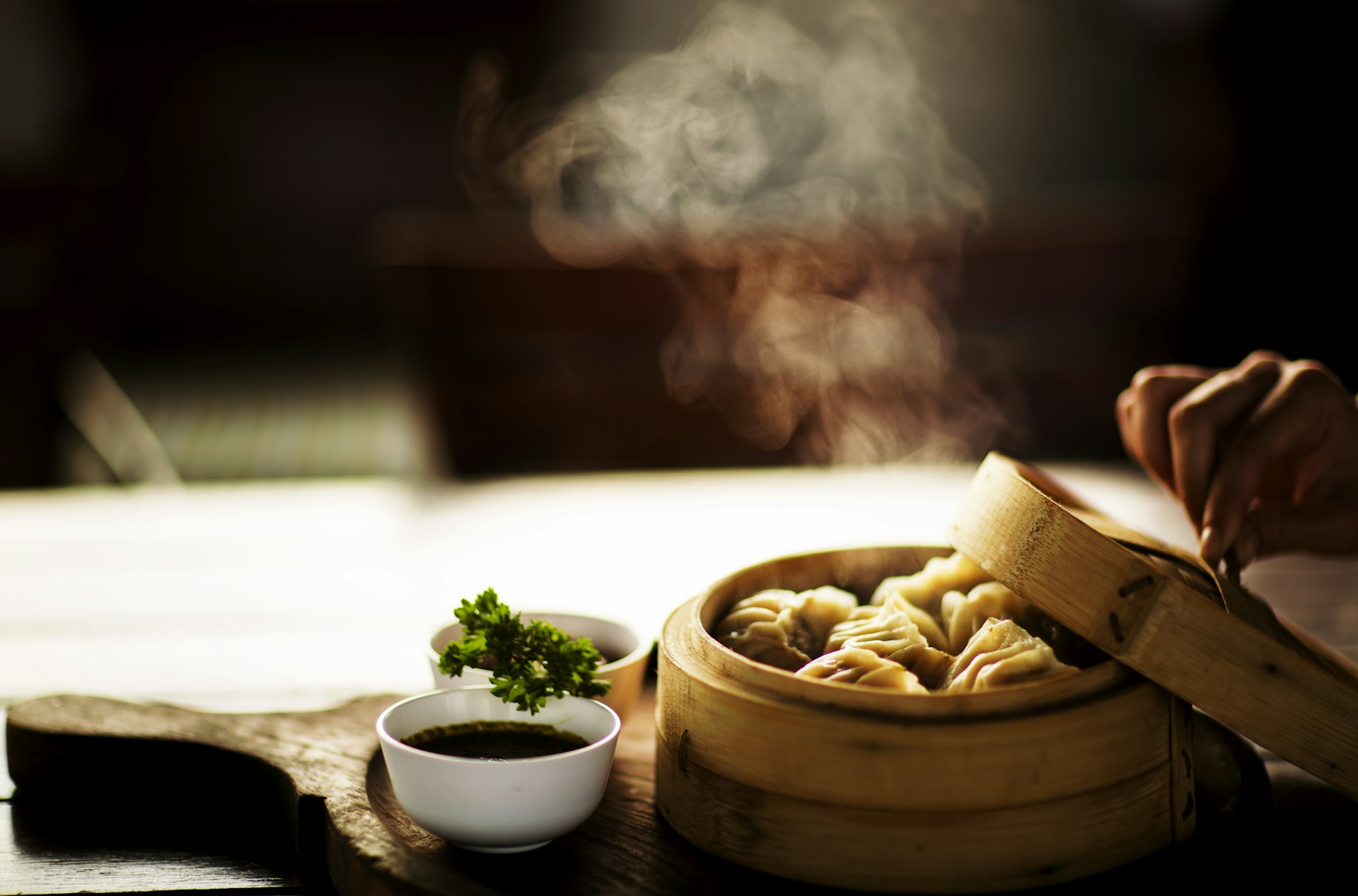
You did not come to Guangzhou to not eat dim sum — this is the planet's birthplace of it. Cantonese cuisine (粤菜 / yuè cài) is the gentle, fresh, subtle end of Chinese food — no numbing chili here, just clean flavors and obsessive technique — and its signature ritual is yum cha (饮茶), "drinking tea": a long, leisurely morning (or all-day) graze of small steamer baskets washed down with pot after pot of tea. Get this one thing right and your trip is made.
The four names worth your appetite
| Restaurant | Why go | Per person |
|---|---|---|
| Tao Tao Ju (陶陶居) | Est. 1880, in the old Liwan district; listed in the Michelin Guide and the gold standard for morning tea — go for the har gow (shrimp dumplings), pineapple buns and egg tarts | ~¥60–120 |
| Guangzhou Restaurant (广州酒家) | Est. 1935, the grande dame — long billed the "No. 1 Place to Eat in Guangzhou"; famous for its shrimp dumplings and beef balls | mid-range (~¥40–120 pp) |
| Panxi (泮溪酒家) | China's largest garden restaurant, set around Liwan Lake — the move for a slow, scenic breakfast among ponds and pavilions | mid-range |
| Dian Dou De (点都德) | All-day yum cha, Xiguan-style, with ~108 types of dim sum — the reliable, fun, no-reservation-needed pick | mid-range |
Per-person figures genuinely vary by source (¥60 to ¥120 for the classic spots) — treat them as a range and confirm on the spot.
How to order yum cha without looking lost (the 4 dishes + the teapot trick)
The non-negotiable order (point at these — every cart and menu has them):
- Har gow (虾饺 / xiā jiǎo) — translucent steamed shrimp dumplings. The benchmark dish; judge a place by these.
- Siu mai (烧卖 / shāo mài) — open-topped pork-and-shrimp dumplings.
- Char siu bao (叉烧包 / chā shāo bāo) — fluffy steamed BBQ-pork buns.
- Cheung fun (肠粉 / cháng fěn) — silky steamed rice-noodle rolls, usually with shrimp or BBQ pork, doused in sweet soy. (Also a legendary cheap breakfast on its own — see street food below.)
- Dan tat (蛋挞 / dàn tā) — the egg tart, for the finish.
The teapot trick every local does:
- Tap two fingers on the table when someone refills your tea — it's the silent Cantonese "thank you," and you'll look like you've done this your whole life.
- Want a refill yourself? Leave the teapot lid tilted open or balanced ajar — that's the universal signal for staff to come top up the hot water. No need to flag anyone.
- Tea costs a small per-head charge (茶位费) at most yum cha houses — totally normal, not a scam.
Pay by scanning the table QR with Alipay/WeChat, or say "mǎi dān / 买单" for a human.
🍗 What to Eat in Guangzhou: Cantonese Food Beyond Dim Sum
Cantonese food runs far past the steamer basket. This is roast-meat country and the home of the "eat everything" philosophy — and the best of it is street-stall cheap.
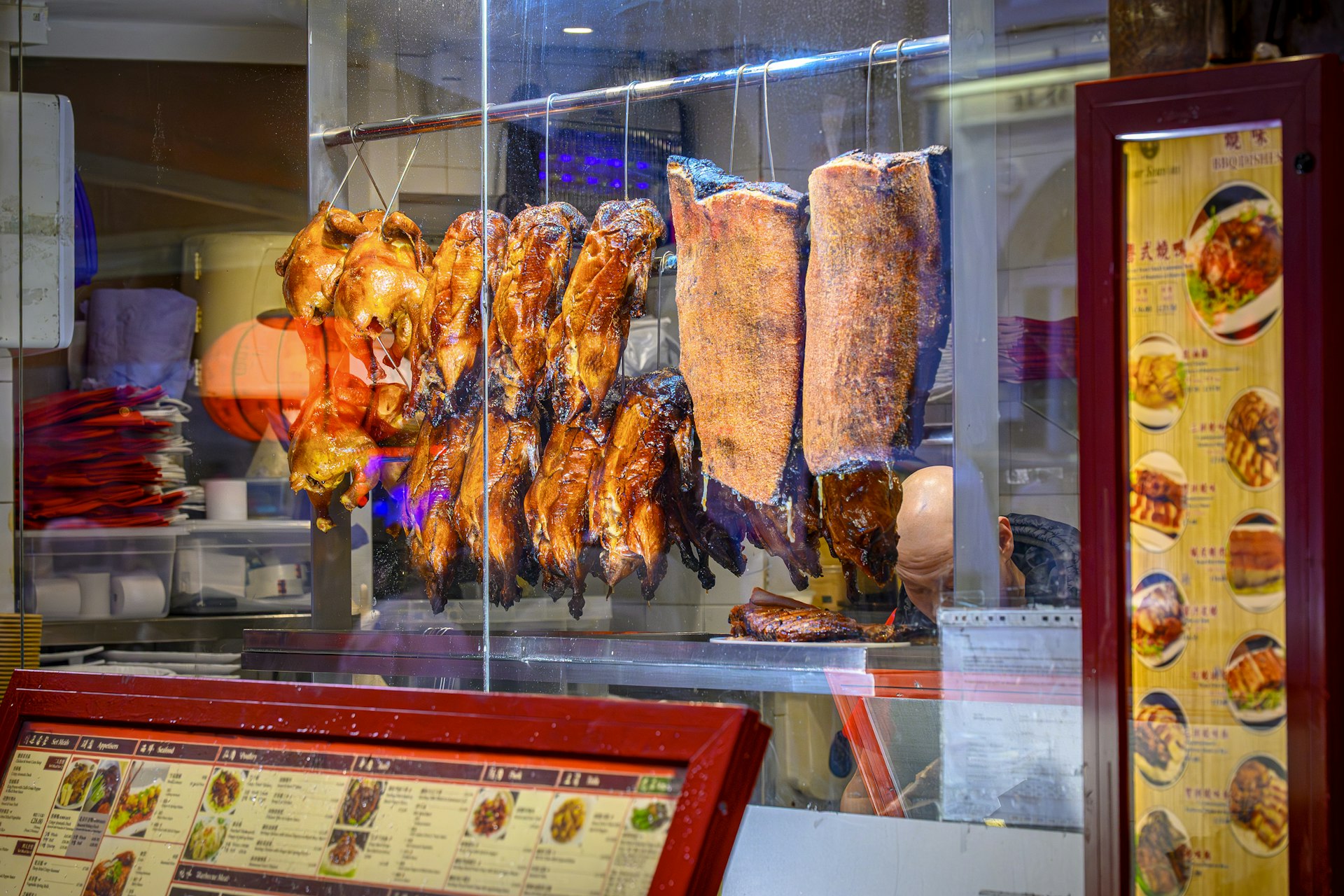
- Roast meats (烧味 / siu mei) — the glass-cabinet trinity: char siu (叉烧, glazed BBQ pork), crispy roast pork (烧肉), and the king of them all, roast goose (烧鹅 / shāo é). For goose, locals point to Yu Kee (裕记) in the old Xiguan district — a 70-year institution. Add soy-sauce chicken (豉油鸡) to round it out.
- Wonton noodles (云吞面 / yún tūn miàn) — springy egg noodles, plump shrimp-and-pork wontons, clear broth. The classic Cantonese quick lunch.
- Cheung fun (肠粉) — those silky rice-noodle rolls, eaten as a street breakfast for a few yuan.
- Cantonese congee (粥 / zhōu) — silky rice porridge, often with fish, pork or "thousand-year egg"; a hangover and breakfast staple.
- Claypot rice (煲仔饭 / bāo zǎi fàn) — rice cooked in a clay pot with sausage/chicken/etc. until the bottom forms a prized crispy crust (锅巴). A cold-weather favorite.
What it costs (2026): a simple noodle or congee meal runs ¥15–45; a roast-meat plate or claypot ¥35–100 per person.
You will eat some of the best food on earth for the price of a coffee back home
A bowl of wonton noodles is ¥15–45. A plate of roast goose — Cantonese comfort food at its peak — tops out around ¥100. A full yum cha blowout for two rarely cracks ¥240 total, and that's at a Michelin-listed house. Guangzhou is the world capital of Cantonese cuisine, and its greatest hits are its cheapest. You could eat like an emperor here for a week on what one fancy dinner costs at home.
⛪ Best Things to Do in Guangzhou: Old City, Temples & Parks — the free anchors
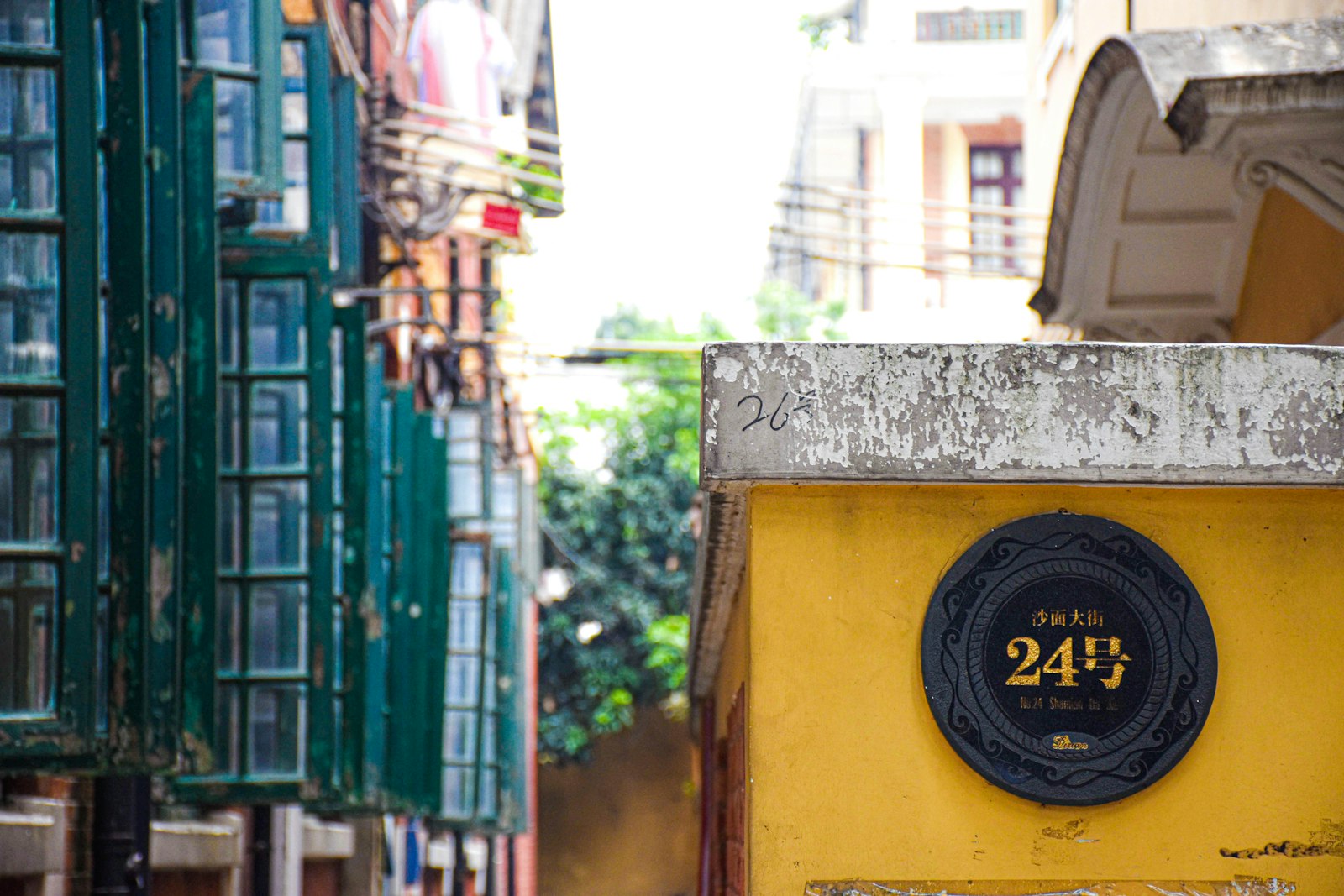
Beyond the tower and the food, Guangzhou's "must-sees" are mostly old, atmospheric, and free or near-free. Here's each one with the ticket, the hours, the exact metro exit, and the one thing worth your time.
Shamian Island (沙面) — free
A tiny river island of 150+ European-style colonial buildings — the former British/French concession, carved out in 1861. Leafy boulevards, pastel mansions, banyan trees, and locals doing tai chi where gunboats once moored. It's the most relaxing hour in the city.
- Ticket: Free, open-air, all day (no gate). Liwan District.
- Don't miss: Our Lady of Lourdes Church (1890, French Gothic) and Shamian Park.
- Metro: Line 1 or Line 6 → Huangsha station, Exit F, then walk across the overpass onto the island.
- Insider: Pair it with the Qingping market lanes just over the bridge, and go late afternoon when the light hits the pastel facades.
Chen Clan Ancestral Hall (陈家祠) — ¥10
The single most jaw-dropping piece of Lingnan (southern-Chinese) folk craft in the city — a 19th-century clan temple crusted with intricate roof-ridge ceramic figurines, wood and stone carving. Now the Guangdong Folk Art Museum.
- Ticket: ¥10. Buy at the entrance or online; show your passport for any senior/student discount rate.
- Hours: 09:00–17:30, closed Tuesdays (last tickets 17:00).
- Metro: Line 1 → Chen Clan Ancestral Hall station, Exit D (or Line 8, Exit E).
- Insider: Look up — the famous roof ridges packed with hundreds of tiny ceramic opera figures are the whole point. Give it 60–90 min.
Sacred Heart Cathedral (石室圣心大教堂) — free
A jaw-dropping all-granite Gothic Revival cathedral nicknamed the "Stone House (石室)" or the "Notre-Dame of the East" — one of the very few all-stone Gothic churches in Asia, and a working Catholic church.
- Ticket: Free. No. 56 Yide Rd, Yuexiu District.
- Hours: Tue–Fri 08:30–11:30 & 14:30–17:30; Sat–Sun 08:30–17:30; closed Mondays — and also closed on the Sunday of the 3rd week of each month.
- Mass: active church; regular Sunday Mass in Mandarin, Cantonese and English — the exact English Mass time isn't published online, so call the cathedral to confirm: +86-20-83336737.
- Insider: Those split hours catch people out — it shuts at 11:30 most mornings and again Monday. Aim for an afternoon Tue–Fri or anytime on the weekend.
Yuexiu Park (越秀公园) & the Five Rams Statue — free
The city's largest and oldest park (~690,000 m²) and home to its founding myth. The Five Rams Statue (五羊石像) — five rams ridden by immortals — is the emblem of Guangzhou itself (legend says five immortals brought rice to the city, hence its nickname, the "City of Rams 羊城").
- Ticket: Park is free, open daily 06:00–22:00.
- Inside: Zhenhai Tower (镇海楼), now the Guangzhou Museum — a separate ¥10 ticket, Tue–Sun 09:00–17:30, closed Mon.
- Metro: Line 2 → Yuexiu Park station.
- Insider: Grab the obligatory photo with the Five Rams (it's the "I was in Guangzhou" shot), then climb to Zhenhai Tower for an old-city view.
Beijing Road (北京路) — free
Guangzhou's commercial spine for 2,200+ years (since 214 BC) and still its buzziest pedestrian shopping street — neon, snacks, and night-market energy.
- Ticket: Free, open street.
- Don't miss: the Ancient Road Ruins under glass in the middle of the street — exposed layers of road from the Tang → Song (blue bricks) → Ming (stone railings) → Republic eras, stacked like a time-section.
- Insider: This is your evening street-food-and-stroll. The Tianzi Pier (for the Pearl River cruise, below) is right nearby — chain them.
Baiyun Mountain (白云山) — ¥5
The city's green lung — "White Cloud Mountain" — for a half-day of fresh air, trails and a cable car over the canopy, with downtown views from the top.
- Ticket: ¥5 entry. Cable car (South Gate ↔ Moxing Ridge): ¥25 up / ¥20 down.
- Hours: scenic area daily ~06:00–22:00 (last entry 22:00); cable car 09:00–18:00 (last ascent ~17:30).
- Metro: Line 11 → Yuntai Garden station (~15–20 min from downtown), or Line 3 → Meihuayuan (Exit B) / Line 6 → Baiyun Culture Square (Exit C) + a short taxi/bus.
Want the old city done right — Shamian, Chen Clan Hall and the Stone House cathedral in one walking day with a local who knows the back lanes? Message us on WhatsApp.
Message us →🚢 Pearl River Night Cruise: Tickets & Which Pier — the skyline from the water
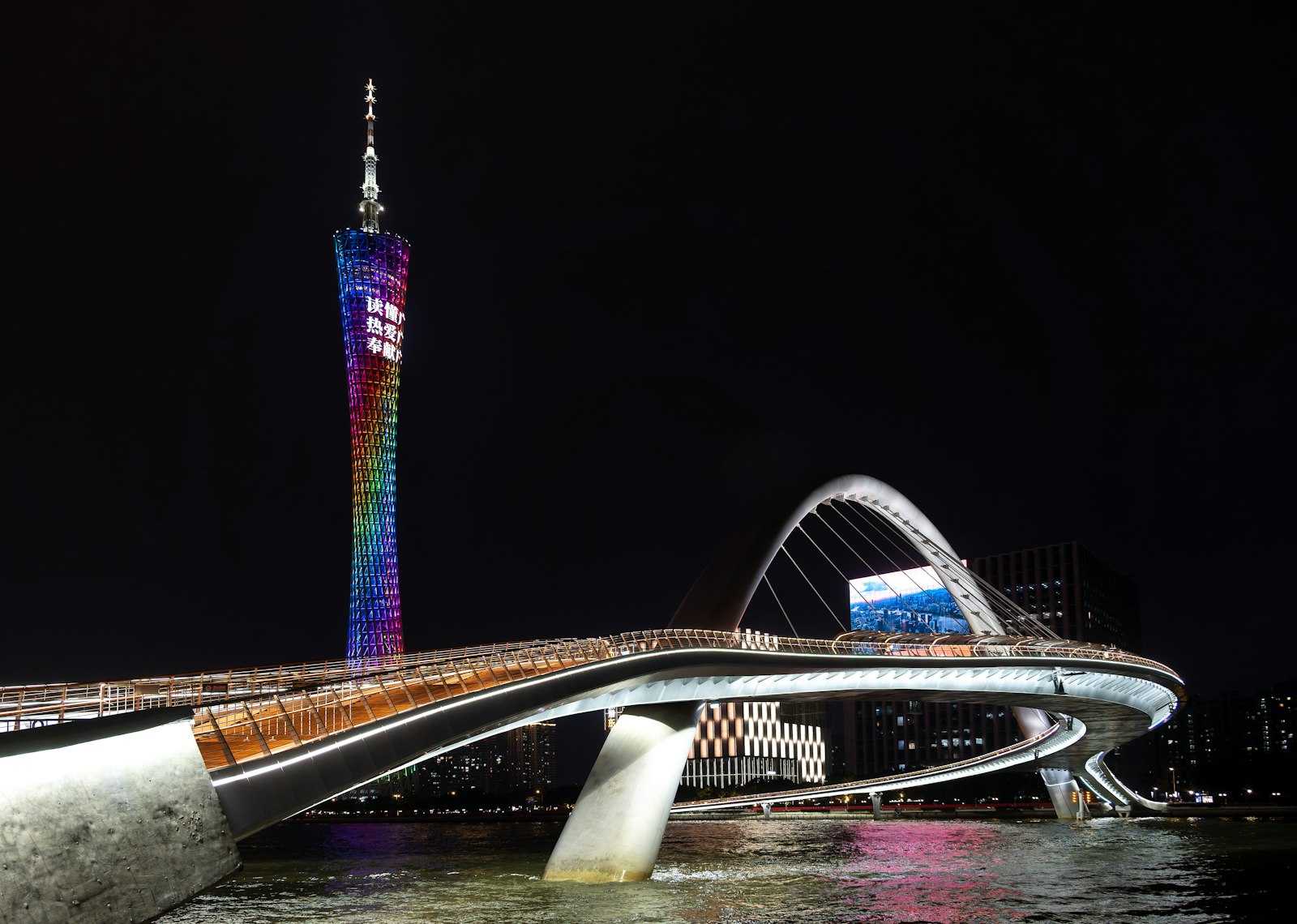
The single best hour after dark, and stupidly easy to do. Guangzhou's skyline was built to be seen from the river at night — the Canton Tower, the LED-clad bridges, the Twin Towers of Zhujiang New Town all light up and reflect on the black water. A one-hour cruise costs less than a cocktail.
The basics
- When: boats run roughly 18:40–22:10, with departures 18:40–21:40; each cruise is about 60 minutes.
- Most convenient pier: Tianzi Pier (天字码头), right by Beijing Road.
- Metro: Line 2 or 6 → Haizhu Square station, Exit A.
- The route: glides past Haiyin Bridge, Xinghai Concert Hall, Ersha Island, the Canton Tower and Haixinsha island.
Booking — board with your phone, no paper swap
- Book on Trip.com / Klook / GetYourGuide (entry-level decks from ~US$7).
- Board with the e-ticket — no paper exchange needed at Tianzi Pier.
- Price varies by deck (open-air top deck costs more than the enclosed lower deck). Exact CNY-per-deck isn't pinned publicly — confirm the live price on Trip.com when you book.
Insider call: ride down Canton Tower around 20:00, walk over, and catch a ~20:30 cruise — you'll have done the city's two best night views back-to-back. Sit on the open top deck if it's a clear night; that's the whole point.
🌃 Guangzhou Nightlife: Bars, Craft Beer & Where to Go After Dark
Here's what nobody tells first-timers: Guangzhou after dark is genuinely fun, foreigner-friendly, and far cheaper than Hong Kong an hour away. You don't need to "tough it out" in a sketchy bar district — the main strip is a redeveloped riverfront brewery with English menus and security on the doors. Pick your scene:
Party Pier (琶醍)
A former brewery reborn as the city's most international, expat-friendly strip — craft-beer halls, cocktail lounges, beer gardens on the river.
Beer ¥30–60Zhujiang New Town
The gleaming CBD — rooftop lounges and polished cocktail bars among the skyscrapers, with skyline views.
Cocktails ¥60–120Getting home
Didi runs 24/7. The metro stops ~23:00, so for the late exit, Didi is your friend — order in English in the app.
Didi meteredThe scenes, in detail
- Party Pier (琶醍 / Pà-tí) — a former brewery on the Haizhu-side riverfront, reborn as the city's most international, expat-friendly nightlife strip: craft-beer halls, cocktail lounges, sports bars, live music, and outdoor beer gardens right on the Pearl River. English menus are common — this is the easy first night. Named venues: Zapfler German Craft Brewery and Bravo Brewery for proper craft beer. Considered one of the safer nightlife districts — heavy foot traffic and a visible security presence.
- Zhujiang New Town (珠江新城) — the gleaming CBD is where the sleek end of the night lives: rooftop lounges and polished cocktail bars among the skyscrapers, with skyline views. Go here for a dressed-up cocktail night rather than a beer-garden crawl.
The practical bits
Prices: beer ¥30–60, cocktails ¥60–120 — pricier than a hole-in-the-wall local bar, but far cheaper than Hong Kong, Singapore or any Western city. Getting home: Didi runs 24/7; the metro stops ~23:00, so for the late exit, Didi is your friend — order it in English in the app or via the WeChat mini-program.
A craft-beer night on the river costs a fraction of one across the border in Hong Kong
Cross the bay to Hong Kong and a pint can run HK$80–100. At Party Pier you're drinking craft beer for ¥30–60 and cocktails for ¥60–120 on a lit-up riverfront — and it's one of the safest nightlife strips in the city, with women heading home alone past midnight without a second thought. The "China is expensive / sketchy after dark" assumption is just wrong here — Guangzhou is fun, cheap, and safe after midnight.
Want a local to take you out in Guangzhou — Party Pier craft beer or a Zhujiang rooftop, the real spots not the tourist traps? Ask us on WhatsApp.
Ask us →Sources — Part 3 (verified June 2026)
Attractions & tickets: travelchinaguide.com (Canton Tower prices, Line 3 Exit A; Yuexiu Park metro) · trip.com (Canton Tower passport+code, Chen Clan Hall, Sacred Heart Cathedral, Pearl River cruise / Tianzi Pier, Baiyun Mountain) · klook.com & intotravelchina.com (Shamian Island) · chinahighlights.com (Sacred Heart Cathedral) · chinafootprints.com (Beijing Road, Baiyun Mountain) · chinadiscovery.com (Yuexiu Park / Zhenhai Tower).
Dim sum & food: guide.michelin.com (Tao Tao Ju) · scmp.com (best Guangzhou restaurants) · itimaker.com (dim sum guide) · chinadiscovery.com (Cantonese cuisine & prices) · asiaodysseytravel.com (Cantonese food).
Nightlife: visitcanton.net & jojosriverside.com (Party Pier, Zhujiang New Town, prices, safety).
Prices and hours shift on Chinese public holidays — confirm the load-bearing ones (cruise deck price, dim-sum per-head, cathedral English Mass time) on Trip.com or the official page before you commit.
Day Trips from Guangzhou
Guangzhou isn't just a city, it's the front door to the Pearl River Delta (Greater Bay Area) — Foshan's kung-fu temples, Shenzhen's sci-fi skyline, and a valley of UNESCO watchtowers that look like Italian castles dropped into a rice paddy, all closer to your hotel than the airport is. And thanks to the visa-free transit rules (Part 1), you can roam all of Guangdong (and the permitted areas of 23 more provinces) without a visa — so these day trips aren't just convenient, they're free of red tape.
🚄 First, the train logic (read this once, it unlocks the whole Delta)
Most day trips below leave from Guangzhou South Railway Station (广州南站 / Guangzhou Nan) — the big high-speed hub, on Metro Lines 2, 7 & 22, ~30–45 min from the Tianhe CBD. A handful run from Guangzhou East. The booking app sorts which station for you.
How to actually get a ticket (the foreigner-proof version)
- Book on Trip.com (smoothest for non-Chinese IDs, English UI, takes foreign cards) or the official 12306 app (source of truth, slightly cheaper).
- For Foshan and Shenzhen, check your selected train's departure station, journey time and fare before booking. For Kaiping (fewer departures), book 1 day ahead, especially on weekends.
- Bring your physical passport — it is your ticket. Tap it at the foreigner-marked gate; if the auto-gate balks, the staffed side window waves you through in ten seconds.
- Arrive 25–30 min early. Guangzhou South is one of Asia's largest stations — security plus finding your platform eats real time.
A bullet train to the next city costs less than your airport coffee
Guangzhou→Foshan is 17–21 minutes at 300 km/h for ¥11–15 — roughly US$1.50–2. For Shenzhen, check your selected train's journey time before booking. The Pearl River Delta is wired together by high-speed rail, and your passport is the only paperwork you need.
More on this: China Essentials — getting around (rail, metro, Didi) →🥋 Foshan Day Trip — kung-fu pilgrimage 20 minutes away (Ip Man, Wing Chun, lion dances)
Bottom line: the single best half-day from Guangzhou — and a must if you've ever loved a Bruce Lee or Ip Man film. Foshan (佛山) is the spiritual home of Wing Chun (咏春) kung fu and Cantonese lion dance, and it's so close you can be there before your coffee goes cold.
The heart of it is Foshan Ancestral Temple (祖庙 / Zumiao) — a gorgeous 900-year-old Lingnan temple complex that houses the Ip Man Hall (memorial to Yip Man, the Wing Chun master who trained Bruce Lee) and the Huang Feihong (Wong Fei-hung) Hall, dedicated to the legendary folk hero. On a good day you'll catch a Wing Chun demonstration or a lion-dance performance right in the courtyard — drums, cymbals, the works.
Getting there (two easy ways)
- Metro (zero-planning option): the Guangfo Line (广佛线) is a direct subway that runs from Guangzhou straight into central Foshan — no train ticket, just tap in. ~1 hour, city-fare cheap.
- High-speed rail (fastest): Guangzhou South → Foshan West, 17–21 min, second class ¥11–15.
Tickets & hours: Foshan Ancestral Temple ¥20–30, open 09:00–17:00. Show your passport at the window. ✓ Jun 2026 — confirm the exact gate price on Trip.com
For the hardcore fans: the Bruce Lee Ancestral House sits out in Shunde (顺德), ~60 km from central Foshan — a detour for true pilgrims, not a casual add-on. And while you're in Shunde: it's quietly regarded as one of the best food districts in all of Cantonese cooking (this whole region is the cuisine you've been eating downtown).
Insider play: do Foshan as a morning. Take the 09:00-ish train, hit the temple right at opening when the courtyards are calm and the first lion-dance/Wing Chun show runs, and you're back in Guangzhou for a proper Cantonese lunch by early afternoon. Half a day, maximum payoff.
🌆 Shenzhen Day Trip — China's Silicon Valley
Bottom line: the easiest "see a second megacity" add-on, and a genuine jaw-dropper if you like the future. Shenzhen (深圳) went from a fishing village to a 17-million-person tech metropolis in about 40 years — it's all neon towers, electronics megamalls, drone shows, and a skyline that feels like a film set.
Getting there: by high-speed rail; check your selected train's departure station, arrival station, journey time and fare before booking.
Who it's for: day-trip Shenzhen if you're into tech, modern architecture, theme parks, or shopping. You don't need a Shenzhen stop to reach Hong Kong: high-speed trains run between Hong Kong West Kowloon station and Guangzhou South and Guangzhou East with no change of train (MTR; see our Hong Kong–Shenzhen border guide). Skip it if your heart is set on old-China atmosphere — Guangzhou and Foshan have far more history. Budget a full day door-to-door.
💡 Border note: Shenzhen sits on the Hong Kong border. Crossing into Hong Kong is a separate immigration jurisdiction with its own entry rules — possible, but it's a real border, not a day-trip stroll. If Hong Kong's on your list, plan it deliberately (and check your visa-free transit conditions in Part 1 first).
🏰 Kaiping Diaolou Day Trip — UNESCO watchtowers in the rice fields (the "where IS this?" one)
Bottom line: the most surreal, least-touristed day trip on this list — and the one that makes your photos look like nowhere else in China. The Kaiping Diaolou (开平碉楼) are hundreds of fortified, multi-storey watchtowers scattered through farmland southwest of Guangzhou — a wild mash-up of Greek columns, Roman domes, Gothic turrets and Chinese detailing, built in the early 1900s by returning overseas Chinese to guard against bandits and floods. It's a UNESCO World Heritage Site, and it looks like absolutely nothing else.
Getting there
- Train: Guangzhou South → Kaiping South (开平南), ~30–60 min on the high-speed line.
- Station → scenic villages: ~20–40 min by taxi — the towers are spread across rural village clusters (Zili Village and Majianglong are the famous ones), so a taxi or a booked car is the practical way to reach and hop between them.
Tickets: scenic-area entry fee was not pinned to a verified 2026 figure in our research — buy on-site or check Trip.com, and confirm locally before you go.
The honest trade-off: Kaiping is a half-day-to-full-day commitment — it's further out and rural, so it eats more travel time than Foshan. But that's exactly why it's empty and magical. Pick it if you've got 4–5 days, love photography and offbeat heritage, and want a day with almost no other foreign faces. Skip it if your time is tight — Foshan delivers more per hour.
An American with no China visa can still spend 10 days roaming the whole Delta
Not on the 30-day visa-free list? Doesn't matter. The 240-hour (10-day) visa-free transit lets nationals of 57 countries — USA included — enter at Guangzhou Baiyun (CAN, one of Guangdong's 10 approved ports), then move freely across all of Guangdong (and the permitted areas of 23 more provinces), as long as you hold an onward ticket to a third country/region. Foshan, Shenzhen, Kaiping — all fair game inside the window.
More on this: China Essentials — visa-free & 240-hour transit →🗓️ Guangzhou Itinerary: 2, 3 & 5 Days — the points actually strung together
These plug straight into Part 3 (Canton Tower, dim sum, Shamian Island, the Pearl River cruise, nightlife) and Part 4 above. Times assume a central base (Zhujiang New Town or Beijing Road). Tap a day to open the hour-by-hour plan.
⏱️ 2 Days — the essential Guangzhou
Day 1 Old Guangzhou: temples, colonial lanes & morning tea
- 08:30Yum cha (早茶) done right. Roll into Tao Tao Ju 陶陶居 (est. 1880, Michelin-listed) or Guangzhou Restaurant 广州酒家 for shrimp dumplings, pineapple buns, egg tarts. ~¥60–120 pp. (Full dim-sum playbook: Part 3.)
- 10:00Metro Line 1 to Chen Clan Ancestral Hall 陈家祠 (Exit D). The finest folk-art building in the city — wood carving, ceramics, the lot. ¥10, closed Tuesdays.
- 11:30Hop to Shamian Island 沙面 (Line 1/6 → Huangsha, Exit F). Free, open-air; wander 150+ colonial-era buildings and Our Lady of Lourdes Church. Coffee on a leafy lane.
- 13:30Lunch: roast goose / wonton noodles in the old Xiguan (西关) lanes nearby.
- 15:00Sacred Heart Cathedral 石室圣心大教堂 ("the Stone House") — granite Gothic, free, stunning. (Closed Mondays + the 3rd-week Sunday — check Part 3.)
- 17:00Beijing Road 北京路 pedestrian street: 2,200 years of commerce, the glass-covered Ancient Road Ruins, street snacks as the lights come on.
- 19:30Dinner + a stroll to Tianzi Pier for the Pearl River night cruise (board ~18:40–21:40, ~60 min) — Canton Tower lit up from the water. (Booking: Part 3.)
Day 2 Canton Tower, the river city & a night out
- 09:30Yuexiu Park 越秀公园 (free, opens 06:00): the Five Rams Statue (the city's emblem) and optional Zhenhai Tower museum (¥10).
- 11:30Lunch, then reset at the hotel.
- 14:00Canton Tower 广州塔 (Line 3 → Canton Tower, Exit A). Go up the Cloud + Star decks (¥150); thrill-seekers add the Sky Drop or Bubble Tram. Buy discounted on Trip.com/Klook — bring your passport + the redemption code to the West Ticket Hall. (Full ticket breakdown: Part 3.)
- 17:30Wander Zhujiang New Town 珠江新城 — the CBD: opera house, library, the Canton Tower glowing across the river at dusk.
- 20:00Nightlife. First-timers: head to Party Pier 琶醍 (Pà-tí) — riverside craft-beer halls (Zapfler, Bravo), English menus, beer ¥30–60. One of the safer, livelier strips in town. (Full nightlife guide: Part 3.)
⏱️ 3 Days — the sweet spot (add Foshan kung fu)
Days 1–2 As above
Run the 2-day plan exactly, but breathe — linger longer over morning tea, and slot in a slow afternoon along the river.
Day 3 Foshan: Ip Man, Wing Chun & lion dances
- 09:00Guangfo Line subway (or HSR to Foshan West, 17–21 min) straight into central Foshan.
- 10:00–12:30Foshan Ancestral Temple 祖庙: the Ip Man Hall, the Huang Feihong Hall, and the courtyard Wing Chun / lion-dance show. ¥20–30.
- 13:00Cantonese lunch in Foshan (you're in the homeland of the cuisine).
- 15:00Back to Guangzhou. Easy evening — a foot-massage and a final dim-sum dinner, or one more lap of Beijing Road.
⏱️ 5 Days — the full Pearl River Delta
Days 1–3 The 3-day plan above
City essentials + Foshan, unrushed.
Day 4 Baiyun Mountain + a slow river afternoon
- 09:00Baiyun Mountain 白云山 (Metro Line 11 → Yuntai Garden, ~15–20 min from downtown). Entry ¥5; ride the cable car ¥25 up / ¥20 down to the ridge for the city panorama.
- 13:00Back downtown for lunch.
- 15:00A pure drift afternoon: tea at a garden restaurant like Panxi 泮溪酒家 by Liwan Lake, or coffee on Shamian. This is how locals actually spend a day off.
- 19:30Rooftop cocktails in Zhujiang New Town, or a quieter craft-beer night.
Day 5 Pick your flavor: Shenzhen future OR Kaiping castles
Option A (the future): Shenzhen day trip — HSR to Futian, tech megamalls, modern skyline, theme parks. Great if you like cities-of-tomorrow.
Option B (the surreal): Kaiping Diaolou — HSR to Kaiping South (~30–60 min) + taxi to the watchtower villages. UNESCO heritage, almost no crowds, the most unique photos of your whole trip. A half-to-full-day commitment — start early.
Want this turned into a real plan — trains pre-booked, Canton Tower timed (we'll show you how to book it), a guide who knows which dim-sum house and which lion-dance show? Send us your dates on WhatsApp.
Send dates →🛏️ Where to Stay in Guangzhou: Best Areas — with real price bands
No booking links, no commission — just where each type of traveler should sleep and what you'll actually pay. Rough nightly bands below; rates spike around the twice-yearly Canton Fair (广交会) and national holidays, so confirm live on your booking app.
| Area | Best for | Why here | Rough nightly band |
|---|---|---|---|
| 🏙️ Zhujiang New Town 珠江新城 (Tianhe) | First-timers & business | The modern CBD: English-speaking staff, direct metro to ~80% of the sights, international dining, the smoothest landing in town. Where I'd put a first-timer. Pricier, but you pay for zero friction. | Solid chains (e.g. Atour ~$70); 4★ prime ¥400–800; 5★ ¥1,000–2,500 |
| 🏮 Beijing Road 北京路 (Yuexiu) | Sightseers, mid-range & budget | The most walkable base for old-city sights — temples, Shamian, the cathedral, the pedestrian street at your door. Roughly 40% cheaper than Zhujiang for similar convenience. | Clean chain hotels ¥200–400; 4★ ¥400–800 |
My honest pick: First trip, money no object? Zhujiang New Town — the CBD polish and direct metro make everything effortless, and the Canton Tower view across the river is a nightly bonus. Watching your budget or here mainly for old Guangzhou? Beijing Road — you'll walk to half the sights and pay noticeably less. Either way you're a tap-and-go metro ride from the rest.
A 5-star international hotel in a megacity for the price of a mid-range room back home
Guangzhou's room math is wild: a clean, central chain hotel runs ¥200–400 (~$28–55) a night, and even a 5-star international tops out around ¥1,000–2,500 (~$140–345) — a fraction of what the same brand charges in Hong Kong, Singapore, or a Western capital an hour's flight away. "Central megacity" and "affordable" simply aren't a trade-off here.
Sources — Part 4 (verified June 2026)
Trains/fares & Delta planning: chinadiscovery.com (Greater Bay Area trip planning; Guangzhou→Foshan trains), chinahighlights.com (Kaiping Diaolou and Villages), Trip.com / 12306.
Foshan / kung-fu heritage: Wikipedia (Foshan Ancestral Temple — Ip Man Hall, Huang Feihong Hall), chinadiscovery.com.
Hotels / price bands: travelofchina.com (where to stay in Guangzhou), Trip.com (chain ¥200–400, 4★ ¥400–800, 5★ ¥1,000–2,500).
⚠️ Live-confirm before travel: seasonal hours, exact fares, nightly hotel rates, and the Kaiping Diaolou scenic-area entry fee (not pinned to a verified 2026 figure) all shift. Tickets/hours → the attraction's official channel or Trip.com.
Know Before You Go
🧠 Culture, money & health — the fine print
🤝 Culture shocks & etiquette (the 6 that trip up first-timers)
- No tipping. Anywhere. Restaurants, taxis, hotels — none of it. In Cantonese dining culture especially, trying to tip causes confusion, not gratitude. Keep your change.
- Yum cha has its own rhythm. At morning tea, you'll often pick dishes off a roving cart or a tick-box order sheet, not a waiter's recommendation. Two quiet local customs worth knowing: tap two fingers on the table to silently say "thank you" when someone pours your tea, and flip the teapot lid up when you want a refill.
- You order by scanning a QR code at most restaurants — point your camera at the table sticker, a menu opens, you tap, you pay, food arrives. (Menu's often Chinese — Google Translate's camera, running on your eSIM, reads it instantly.)
- Tap water is NOT drinkable — locals boil it or drink bottled. Every hotel room has a kettle and free bottles; restaurants serve hot water or tea by default.
- Carry your own tissues + hand sanitizer. Public restrooms (and many squat toilets) often have neither paper nor soap. A pack of tissues is the most useful thing in your bag.
- Personal space & volume run differently — expect closer queuing, louder restaurants, and a lot of energetic Cantonese conversation. It's cultural, not rude. Roll with it.
💰 What's dirt-cheap vs. surprisingly pricey
Absurdly cheap (spend freely):
- The metro — most rides ¥2–10, signs and announcements in English, foreign cards now tap straight in (since March 2026).
- High-speed rail across the Delta — Guangzhou→Foshan is ¥11–15; the whole region is a few yuan away.
- Cantonese food — a great noodle or congee meal ¥15–45; roast meat / claypot ¥35–100 pp; full dim-sum spread ¥40–120 pp.
- Canton Tower & sights — observation deck ¥150, Chen Clan Hall and Zhenhai Tower ¥10 each, Baiyun Mountain ¥5, Shamian Island and Beijing Road free.
Surprisingly pricey (budget for it):
- Big-club bottle service & imported spirits — beer's ¥30–60 and cocktails ¥60–120 (still cheaper than Hong Kong), but a club table is not.
- Imported goods & Western groceries — familiar shampoo, cheese, branded snacks carry a premium.
- Western food & brunch — a "normal" Western breakfast can cost more than three local meals.
- Canton Fair season hotels — rooms spike hard during the twice-yearly trade fair; book early or you'll overpay.
🚑 Emergencies & health (save these before you fly)
- Don't drink the tap water — bottled or boiled only. Your hotel kettle is your friend; ice in proper restaurants/cafés is fine, street stalls use your judgment.
- Summer is the real adversary, not the food. Guangzhou summers (May–Sep) hit 35°C (95°F) with 80%+ humidity — pace yourself, hydrate hard, duck into air-con, and don't plan an all-day outdoor marathon at noon. Typhoon season is July–September (3–5 impactful storms a year, usually short) — if one's forecast, check whether ferries/outdoor sights are paused.
- Pharmacies (药店) are everywhere, well-stocked, cheap, and no prescription needed for basics — point to the problem or show a translated note.
- Major hospitals have international/VIP desks for foreigners. Travel insurance is still strongly worth having.
❓ FAQ — straight answers to what everyone actually asks
Do I need a visa to visit Guangzhou in 2026?
Probably not — but which path depends on your passport. Nationals of 50 listed countries (most of Europe, Australia, NZ, Japan, Korea; UK & Canada both added 17 Feb 2026) get 30 days visa-free. US citizens are not on the 30-day visa-free list, but are eligible for 240-hour visa-free transit if they meet the policy's conditions, including entry through an approved port and an onward ticket with a confirmed date and itinerary, leaving within 240 hours for a third country or region different from their departure country or region (e.g. Seoul or Bangkok; whether Hong Kong or Macao counts is our inference, not an official rule, so confirm with your airline or the immigration hotline, +86 12367, before you book). Guangzhou Baiyun (CAN) is an approved port for both. Always confirm against the official en.nia.gov.cn before booking. (Full breakdown: Part 1.)
I'm American — can I really visit Guangzhou without a visa?
Yes — via the 240-hour transit route, not the 30-day one. The US isn't on the 30-day visa-free list, but it is one of the 57 nationalities eligible for 240-hour (10-day) visa-free transit through Guangzhou Baiyun (CAN). The one hard rule: you must be transiting — you need a confirmed onward ticket to a third country or region (departure country ≠ destination country). You cannot use it to fly round-trip straight back to the US. Inside the 10 days you can roam all of Guangdong and the permitted areas of the other 23 provinces. (Step-by-step: Part 1.)
Will Google, WhatsApp, and Instagram work in Guangzhou?
Not on local WiFi/SIM — but there's a clean fix. China blocks Google, WhatsApp, Instagram, etc. The simple workaround: install an international travel eSIM (Airalo, Nomad, Holafly, Saily) before you fly — it routes your data offshore, so all your apps just work, no separate VPN needed. Set it up at home; it activates the moment you land. (eSIM comparison: Part 2.)
Can I really pay everywhere with just my foreign card?
Yes — easier in Guangzhou than almost anywhere. Two ways: (1) bind your Visa/Mastercard inside Alipay or WeChat Pay and scan-to-pay almost everywhere, from dim-sum halls to street stalls to taxis; and (2) as of March 2026, the Guangzhou Metro takes foreign cards directly — tap your UnionPay, Visa, Mastercard, JCB or Amex at any gate (the APM line included). Keep some cash as backup for tiny vendors. Alipay and WeChat Pay set spending limits for foreign cards — see Essentials. Expect a ~3% fee above ¥200. (Setup steps: Part 2.)
How do I get from Guangzhou Baiyun Airport (CAN) into the city?
Three options — and no, there's no maglev; it's the metro. Cheapest and most reliable: Metro Line 3 from Airport North (Terminal 2), ~45–50 min to Tiyu Xilu (CBD) for ¥7 (running ~06:00 to ~23:15). Terminal 3 has no metro station: from the tourist-bus hub on the ground floor of the T3 transport centre (East Coach Station), take the Airport Line 2 branch bus (about 12 min, ¥2) to Gaozeng metro station, then change to Line 3 or 9 into the city, or board the East Ring intercity train at Baiyun Airport East station. Terminal 1 has been closed to passengers since 7 May 2026, and the Airport South metro station no longer stops trains, so check the terminal printed on your ticket. Door-to-door: taxi ~¥120–150, 30–40 min to Tianhe. Or Didi via the DiDi app or its WeChat mini-program — English interface, no Chinese SIM needed, metered (confirm the live fare in-app). ⚠️ Heads-up: Line 3 is one of the world's most crowded at peak (08:00–09:30, 17:30–19:00) — if you're loaded with luggage, time it off-peak or take a car. (Full options: Part 2.)
Is the Guangzhou Metro easy for foreigners — and how do I pay?
Very easy. Signs, announcements and ticket machines are all in English, and staff speak basic English. To pay, either tap a foreign bank card straight at the gate (full UnionPay/Visa/Mastercard/JCB/Amex coverage since March 2026, APM line included) or open Alipay → Transport → Guangzhou to generate a metro QR code and scan in. 1-day and 3-day unlimited passes exist if you're riding a lot. Single rides are mostly ¥2–10.
How do I book Canton Tower tickets, and which deck is worth it?
Buy discounted on Trip.com / Klook / GetYourGuide (from ~US$16.5) and bring your passport + the redemption code to redeem at the West Ticket Hall (Metro Line 3 → Canton Tower, Exit A). The standard Cloud + Star observation decks (107F/108F) are ¥150 and plenty for most people. Thrill-seekers add the Sky Drop (¥180) or the rooftop Bubble Tram (¥150); the open-air 488 Lookout (world's highest outdoor deck) comes in combo packages (~¥328). Open 09:30–22:30. (Full breakdown: Part 3.)
How many days do I need in Guangzhou?
2–3 days for the city itself (dim sum, Canton Tower, Shamian Island, the cathedral, the Pearl River cruise, a night out). 3 days lets you add Foshan for kung-fu history. 5 days opens up the wider Pearl River Delta — Baiyun Mountain, plus Shenzhen (the future) or Kaiping Diaolou (UNESCO watchtowers). (Itineraries above.)
When's the best time of year to visit Guangzhou?
October–December and February–March — moderate temps (daytime ~21–30°C), low rain, the most comfortable months by far. Avoid mid-April to September if you can: that's the rainy season (~80% of annual rainfall), with heavy storms April–June and typhoons July–September, and summer highs that hit 35°C at 80%+ humidity. Winter is mild and a perfectly good time to come. (Full season guide: Part 1.)
Is Guangzhou safe — especially for solo women and at night?
Yes — it's rated the #4 safest big city in China for solo female travelers (4.4/5). Violent crime against tourists is exceptionally rare; the real risks are petty theft / pickpocketing in crowded metros, markets and shopping streets, plus the occasional scam or taxi over-charge — not violence. Keep your bag zipped and in front of you on a packed Line 3, use Didi or metered taxis, and you're fine walking busy areas late. Party Pier and Zhujiang New Town are among the better-lit, higher-traffic nightlife zones. (Full context: the safety box in Part 2.)
Where should I eat dim sum in Guangzhou — and how much does it cost?
You're in the world capital of dim sum, so it's hard to go wrong. The classics: Tao Tao Ju 陶陶居 (est. 1880, Michelin-listed, the gold standard for morning tea), Guangzhou Restaurant 广州酒家 (est. 1935, famous shrimp dumplings and beef balls), Panxi 泮溪酒家 (China's largest garden restaurant, scenic by Liwan Lake), and Dian Dou De 点都德 (all-day yum cha, ~108 types). Expect roughly ¥40–120 per person depending on how hard you go. Go early for morning tea (早茶) — it's the real ritual. (Full food guide: Part 3.)
Can I do day trips to Hong Kong, Shenzhen or Foshan from Guangzhou?
Foshan and Shenzhen, easily. Hong Kong, with planning. Foshan is a 17–21 min bullet train (¥11–15) or a direct Guangfo subway — an effortless half-day. For Shenzhen, check your selected train's journey time before booking. Hong Kong is a direct train ride: high-speed trains run between Hong Kong West Kowloon station and Guangzhou South and Guangzhou East with no change of train (MTR; our Hong Kong–Shenzhen border guide has the details), but it's a separate immigration jurisdiction with its own entry rules — doable, but plan it deliberately and check how it interacts with your visa-free transit window (Part 1). (Day trips above.)
What's the one day trip to pick if I only have time for one?
Foshan. Highest impact per hour: 17–21 minutes each way, the Ip Man / Wing Chun / Huang Feihong kung-fu heritage at Foshan Ancestral Temple, often with a live lion-dance or martial-arts show — all doable as a relaxed half-day. Kaiping Diaolou is the surreal, crowd-free pick if you love offbeat heritage and have a full day; Shenzhen is the choice if you want a glimpse of China's high-tech future.
📣 Plan it with us
Want the whole thing handled?
Flights, trusted hotels in the right neighborhood, pre-booked bullet trains across the Delta, Canton Tower planned (we'll show you how to book it), and a local guide who knows which dim-sum house, which lion-dance show, and which riverside bar. That's exactly what we do — real humans, real local knowledge. Tell us your dates and what you're into, and we'll take it from there.
Plan your Guangzhou trip on WhatsApp
All sources (verified June 2026)
Visa & entry: en.nia.gov.cn (National Immigration Administration), china-briefing.com, chinadiscovery.com, windhorsetour.com, chinasurvivalkit.com. Transport: chinadiscovery.com, sg.trip.com, welcomepickups.com, wanderinchina.com, babagoeschina.com, Trip.com / 12306. Attractions/tickets: travelchinaguide.com, trip.com, klook.com, intotravelchina.com, chinahighlights.com, chinafootprints.com, Wikipedia (Foshan Ancestral Temple). Food & nightlife: guide.michelin.com, scmp.com, itimaker.com, chinadiscovery.com, asiaodysseytravel.com, visitcanton.net, jojosriverside.com. eSIM & payment: cross-referenced China eSIM tests 2026, realchinatrip.com, trip.com, Alipay/WeChat help centers. Hotels: travelofchina.com, sg.trip.com. Safety: travelsafe-abroad.com, travelladies.app.
⚠️ Live-confirm before travel: seasonal opening hours, exact fares, nightly hotel rates, and the Kaiping Diaolou scenic-area entry fee all shift or weren't pinned to a verified 2026 figure. Tickets/hours → the attraction's official channel or Trip.com; the Didi airport fare and Pearl River cruise deck prices → confirm live in-app / on Trip.com; visa → en.nia.gov.cn.