🧭 TL;DR — the honest bottom line
Here's what nobody tells you before you come: Harbin is the strangest, most spectacular winter trip in China — and getting in is the easy part; surviving the cold is the adventure. Each winter this far-north Russian-built railway city cuts hundreds of thousands of blocks of ice from the frozen Songhua River and builds the largest ice-and-snow theme park on the planet — illuminated castles you slide down after dark. Add a Byzantine cathedral in the snow, a cobblestone boulevard of European facades, locals eating ice cream outdoors at −20°C, and China's oldest beer. Give it 3–4 days (more with a ski day) and bring serious layers.
Two things to do before you fly: set up an eSIM (so Google and WhatsApp work) and bind a card to Alipay (so you can pay for anything). Then pack like your trip depends on it — because at −25°C, it does.
No time to read all of this? Tell us your dates and we'll build your Harbin winter plan for you — on WhatsApp, real humans. (One message, no obligation.)
Message us →📌 This guide is long because it's complete — use the menu to jump. Everything below is named, priced, and verified June 2026; the Ice Festival's exact dates and prices shift each season, so we flag the load-bearing ones to double-check before you book.
Before You Go
🛂 Do You Need a Visa for Harbin? — Visa-Free Entry Explained
Here's the good news before you even pack a thermal: getting into Harbin is far easier than surviving its weather. Two routes cover almost everyone, and which one you use comes down to one thing — what color your passport is.
| Route | Who it's for | Max stay | The catch |
|---|---|---|---|
| 30-day visa-free | 50 countries — most of Europe, Australia, NZ, Japan, Korea, and UK + Canada (added 17 Feb 2026); Singapore, Thailand & Malaysia get 30 days via mutual exemption | 30 days | Ordinary passport valid for your whole stay (airlines often ask for 6 months). Tourism/business/visiting friends — no onward-ticket rule. |
| 240-hour (10-day) transit | 57 countries incl. the USA, Brazil, Mexico, Indonesia, Russia | 10 days | You must hold an onward ticket to a third country/region and enter via an approved port. |
The detail that matters for Harbin specifically: Harbin Taiping International Airport (HRB) is the only approved 240-hour port in Heilongjiang. You can also enter elsewhere (e.g. Beijing) and continue to Harbin within your 240 hours. In Heilongjiang, the permitted area is Harbin city only.
✓ verified Oct 2026 Lists shift often — reconfirm your nationality on the official site before booking.
"Wait — Americans can do this visa-free?"
Yes, but only through the 240-hour transit route, and it trips people up. US citizens are not on the 30-day visa-free list, but they are on the 240-hour visa-free transit list. To use it, you must meet the policy's conditions, including entry through an approved port and a confirmed onward ticket to a third country or region different from your departure country or region. The trick is the word transit: China has to believe you're passing through to somewhere else, so you need an onward flight out of mainland China to a third country/region before you land. From Harbin the natural onward hops are Seoul, Tokyo or Vladivostok. The official notices say only "a third country or region", and none of the official pages we read names Hong Kong or Macao either way; reading them as qualifying is an inference, not an official rule. If your plan depends on it, confirm with your airline or the National Immigration Administration's 24-hour hotline, +86 12367 (English available), before you book. The 240 hours don't start when you land — they start at 00:00 the next day (GMT+8), so arrival day is a freebie. Always reconfirm on the official en.nia.gov.cn before booking the flight.
Source: en.nia.gov.cn →🗓️ Best Time to Visit Harbin — Winter Is the Whole Point
Let's be honest about why you're coming: the cold. Harbin in summer is a pleasant, leafy river city — but nobody flies to the far northeast of China in July. You come for winter, when the Songhua River freezes solid and the city builds the largest ice-sculpture theme park on earth. The single best window is late December through February.
| Season | Months | Temp | The real story |
|---|---|---|---|
| ❄️ Deep winter (THE reason) | late Dec–Feb | −15 to −25°C (can hit −38°C) | Ice & Snow World, frozen-river ice slides, snow sculptures, ice lanterns — all running. Brutally cold but dry and often sunny. This is the trip. |
| 🌸 Spring | Apr–May | 5–20°C | Thaw and blossoms, no ice festival. Pleasant, but you've missed the show. |
| ☀️ Summer | Jun–Aug | 18–28°C | Harbin's other identity — a cool escape from China's southern heat, riverside beer gardens, green Sun Island. Lovely, but not why most foreigners come. |
| 🍂 Autumn | Sep–Oct | 5–20°C | Crisp, gold, quiet. A sleeper season before the freeze. |
The festival timing, decoded. The Ice & Snow World and major venues typically open in mid-to-late December, the grand opening ceremony lands around January 5, and everything runs until late February — when, as happened in 2026, an early warm spell can melt the sculptures and close the park ahead of schedule (the 2025–26 edition shut on Feb 21). Official 2026–27 dates aren't published until autumn — so if you're targeting late February, build in a buffer and confirm on the official channel before you lock flights.
−25°C sounds insane — but it's a dry cold you can actually handle
Here's the counter-intuitive bit: Harbin's −20 to −25°C feels more bearable than a damp +2°C in London, because it's dry and usually windless and sunny. Locals push prams and eat ice cream outside in it. With the right layers — and Harbin rents full snowsuits to tourists — you'll be comfortable for hours. The cold is the spectacle, not the enemy. The one real rule: cover every inch of exposed skin, because at −25°C frostbite on a bare nose or ears is a genuine 20-minute risk. Full gear checklist is in Part 2.
Source: how to dress for Harbin →Targeting the Ice Festival but unsure which week? Tell us your travel window and we'll tell you the smartest dates — peak spectacle vs. post-New-Year calm. On WhatsApp.
Plan my dates →✈️ How to Get to Harbin: Airport & High-Speed Rail
Harbin is well-connected for somewhere this far north — one international airport plus a high-speed rail line that puts Beijing within easy reach, which is exactly how most foreigners arrive: fly into Beijing, then bullet-train or short-hop flight up to the ice.
- Harbin Taiping International Airport (HRB) — ~37 km southwest of the city. Direct international flights are limited (Seoul, some seasonal); most travelers connect via Beijing, Shanghai, or Guangzhou. It's the gateway airport for the whole Ice Festival.
- High-speed rail — Harbin is the northern terminus of the Beijing–Harbin high-speed line. From Beijing it's roughly 4.5–6 hours by bullet train, or a ~2-hour flight. A Beijing-then-Harbin winter combo (Great Wall in the snow, then the ice city) is one of the most popular itineraries foreigners build.
Getting from HRB airport into the city
There's no metro to the airport (despite Harbin having a subway), so it's bus or car:
| Option | Time | Cost | When to pick it |
|---|---|---|---|
| Airport shuttle bus (Lines 1/2/3 + express serve downtown) | ~1 hr | ¥20 | Default if you're not loaded with bags. Drops near Central Street / main hotels. |
| Taxi / Didi to your hotel | 40–60 min | ¥110–150 | Late arrival, heavy luggage, or a group — and after a long-haul in deep winter, worth it. |
✓ verified Jun 2026 HRB shuttle ¥20/~1hr; taxi ¥110–150; no airport metro. Beijing–Harbin HSR ~4.5–6h.
💴 Harbin Travel Budget: What It Costs (per day, excluding flights)
Harbin runs a touch pricier than southern China in peak ice season — hotels spike hard in January–February and the marquee tickets aren't cheap (the ice park alone is ~¥330). Outside the big-ticket attractions, though, food and transport stay very affordable.
| Style | Per day (ex-flights) | What that buys you |
|---|---|---|
| 🎒 Backpacker | ¥300–500 (~$42–70) | Hostel/budget room, dumplings + street food, metro & bus, one paid sight |
| 💺 Mid-range (most people) | ¥500–900 (~$70–126) | Comfortable 3–4★ near Central Street, sit-down Northeast meals, Didi when it's −25°C, Ice & Snow World ticket |
| ✨ Comfort | ¥1,200+ (~$168+) | 4–5★ hotel, private driver/guide for the cold logistics, a Yabuli ski day, VIP ice-park ticket |
The single biggest budget swing is when you come. Christmas-to-Chinese-New-Year is peak: hotels near Central Street can double, and the ice park sells out. Mid-to-late February (post-CNY, sculptures still pristine) is the value sweet spot. (~¥7.1 = $1 as of Jun 2026; rates drift.)
Sources — Part 1 (verified June 2026)
Visa & 240h transit: en.nia.gov.cn (National Immigration Administration — 57-country 240-hour transit list incl. USA (NIA, 20 Aug 2026); Harbin Taiping the sole approved port in Heilongjiang; permitted area Harbin city only); cross-checked chinadiscovery.com & china-briefing.com 2026 guides.
Airport & rail: chinadiscovery.com, travelchinaguide.com (HRB shuttle ¥20/~1hr; taxi ¥110–150; no airport metro); Beijing–Harbin HSR ~4.5–6h.
Climate & festival timing: chinahighlights.com, chinadiscovery.com, trip.com (Jan −12 to −24°C, extremes to −38°C; venues open mid-late Dec, ceremony ~Jan 5, run to late Feb; 2025–26 edition closed Feb 21 after early thaw).
Budget: numbeo & aggregated Harbin hotel/price data, 2026.
Arrival & Essentials
The three things that turn China from "intimidating" into "effortless" — plus the one extra layer Harbin adds: surviving the cold without it ruining your day. Do the first two before you fly; fifteen warm minutes at home saves you a frozen-fingered hour at the airport.
📱 Internet & VPN in China: Get an eSIM before you fly
Let's be blunt about the thing everyone whispers about: mainland China blocks Google, Instagram, WhatsApp, Gmail, and most Western apps. Your normal SIM will roam onto a Chinese network and hit that same wall.
The clean, legal, no-drama fix: an international travel eSIM that routes your data through a server outside the mainland — so Google Maps, WhatsApp, Instagram all just work, with no separate VPN to fiddle with. You install it as a second line; your home number stays for calls and texts.
| eSIM | Best for | VPN? | The honest take |
|---|---|---|---|
| Nomad | Multi-city + the Beijing→Harbin rail leg | No | Most stable when you're moving — survives tunnels and train Wi-Fi gaps. Top pick if Harbin is one stop on a bigger China trip. |
| Airalo | One or two cities, budget | No | Most popular, cheapest, dead-simple. Plenty for a city-based Harbin trip. |
| Holafly | Heavy data users | No | Unlimited plans + 24/7 support. Good if you stream/hotspot — check the fair-use cap. |
| Saily | Privacy-minded | No | By the NordVPN team, strong privacy. Solid for fixed-data plans. |
How it actually goes: buy online → you get a QR code by email → scan to install (2 min) → leave it off until you land → flip it on as the plane taxis in. Only needs an email — no Chinese ID. Buy it at home on your own Wi-Fi; do not count on installing it after you land, because activation pages can themselves sit behind the wall.
One phone really does replace everything — and the cold is its enemy
Wallet, train tickets, translator, metro card, taxi, dinner orders, ice-park entry QR — all collapse into one phone the moment you're set up. Most people pay by phone these days, though cash is still legal tender. The Harbin twist: at −25°C a dead battery is a real risk (cold murders phone batteries), so this convenience is also your one point of failure — keep it warm and carry a power bank. Get your eSIM + Alipay sorted and you operate like a Harbin native by day two.
More on this: China Essentials — paying with Alipay & WeChat →💳 How to Pay in China: Alipay & WeChat for Foreigners
Most people pay by phone, but cash is still legal tender: since 1 February 2026, staffed businesses must accept it. Keep some small notes as a backup (is cash accepted in China?). Don't count on foreign cards at small shops; bigger hotels, malls and major sights are more likely to take them. The great news for 2026: Alipay and WeChat Pay both take a foreign Visa/Mastercard directly, no Chinese bank account needed. Do this at home before you fly — verification is smoother on your home connection, and you want it live the second you land.
Set up Alipay (your main wallet)
- Download Alipay and register with your home mobile number (you'll get an SMS code).
- Open "Cards" → "Add Bank Card" and enter a real Visa or Mastercard. ⚠️ Use a normal physical credit/debit card — prepaid and virtual/online-only cards are frequently rejected. This is the #1 reason setup fails.
- Complete passport verification (photo + a quick selfie). Approval is usually minutes.
- Add a backup: download WeChat Pay and bind a second physical card the same way — handy if one ever gets declined.
The limits & fees you need to know ✓ verified Jun 2026
| Figure | |
|---|---|
| Payments under ¥200 | Fee-free (0%) |
| Payments over ¥200 | ~3% service fee |
Alipay and WeChat Pay set spending limits for foreign cards — see Essentials. Check your current limit in the app.
The under-¥200 rule covers nearly everything you'll buy day to day — dumplings, metro, ice cream, taxis. The ~3% only bites on a hotel or a big dinner. Still, carry some cash and a second physical card as a fallback — rare, but cards do occasionally get declined.
🚕 Getting Around Harbin: Metro, Didi & Surviving the Cold
Harbin has a clean three-line metro (¥2–7, runs ~06:00–22:30) — and critically, it's warm, which makes it the local favorite in deep winter. Didi (China's Uber) fills every gap. But the real skill here isn't navigation — it's not freezing while you wait.
Riding the metro: open Alipay → search the "Metro" / 乘车码 mini-program → scan the QR at the gate (auto-charges by distance). No physical card needed. The catch: Harbin's metro does not reach the airport and its network is smaller than Beijing's or Shanghai's — it covers the core, but you'll still lean on Didi and buses for some sights (the Siberian Tiger Park and Sun Island, for instance).
Using Didi (set it up before you fly — ~10 min): full English app, takes foreign Visa/Mastercard (or link Alipay), register with your home phone number. At the airport and big stations, walk to the signed 网约车 (wǎngyuē chē) ride-hailing pickup zone rather than booking from inside; expect a small ¥5–15 platform fee. The in-chat English↔Chinese translator handles the language; the driver confirms you by the last 4 digits of your phone number.
The cold is the one thing that can wreck a Harbin day — here's the survival kit
This is Harbin's version of the safety box, and it's not optional. At −20 to −30°C, three things go wrong fast and all are preventable:
① Frostbite on exposed skin in ~20 minutes. Cover everything — a balaclava or face mask, a hat over the ears, no bare wrists. Outdoor ice-park evenings are the danger zone.
② Your phone dies instantly. Batteries can drop from 80% to dead in minutes. Keep the phone in an inner pocket against your body, slap a disposable heat pack on the back of it, and carry a power bank. Since your phone is your wallet, map and taxi, a dead phone strands you.
③ Layer like a local — and you can rent it all. Base thermal + fleece mid + down/snow jacket; snow boots one size up for thick wool socks + heated insoles; disposable heat packs (暖宝宝) in gloves and pockets, sold at every convenience store for a few yuan. Harbin even rents full winter outfits to tourists. And brace for the ~40°C indoor-outdoor swing — peel layers the second you step inside or you'll sweat, then freeze when you head back out.
Bitterly cold — but remarkably safe, even at midnight
You are 2×+ more likely to be robbed in San Francisco or Chicago than in a major Chinese city, and Harbin is no exception — well-lit and blanketed in CCTV, so opportunistic street crime barely exists. Women routinely walk home alone late. Honestly, in Harbin the thing that'll get you isn't a person — it's the temperature. Mind the ice underfoot, keep warm, and a 2am Didi back from Central Street is completely normal.
Sources — Part 2 (verified June 2026)
eSIM: unusualnomad.com, traveltomtom.net, cybernews.com (China eSIM tests 2026 — route offshore / no separate VPN).
Alipay limits & fees: realchinatrip.com, trip.com, ltl-school.com (<¥200 fee-free · ~3% above; prepaid/virtual cards often rejected).
Metro, Didi & cold-weather: trip.com, travelchinaguide.com, chinaodysseytours.com (Harbin metro ¥2–7, ~06:00–22:30, no airport line); chinadiscovery.com, anywherechina.com (what to wear; frostbite ~20 min; phone-battery cold drain; heat packs 暖宝宝; ~40°C indoor-outdoor swing; tourist gear rental).
Things to Do in Harbin
Illuminated ice castles you slide down, a Byzantine cathedral in the snow, a cobblestone Russian boulevard, a frozen river you walk across, sweet-and-sour pork born in this city, and ice-cold Harbin beer at −25°C. Everything below is named, priced, and verified June 2026 — bundle up and go.
🏰 Harbin Ice and Snow World: Tickets, Best Time & How to Visit — the reason you came
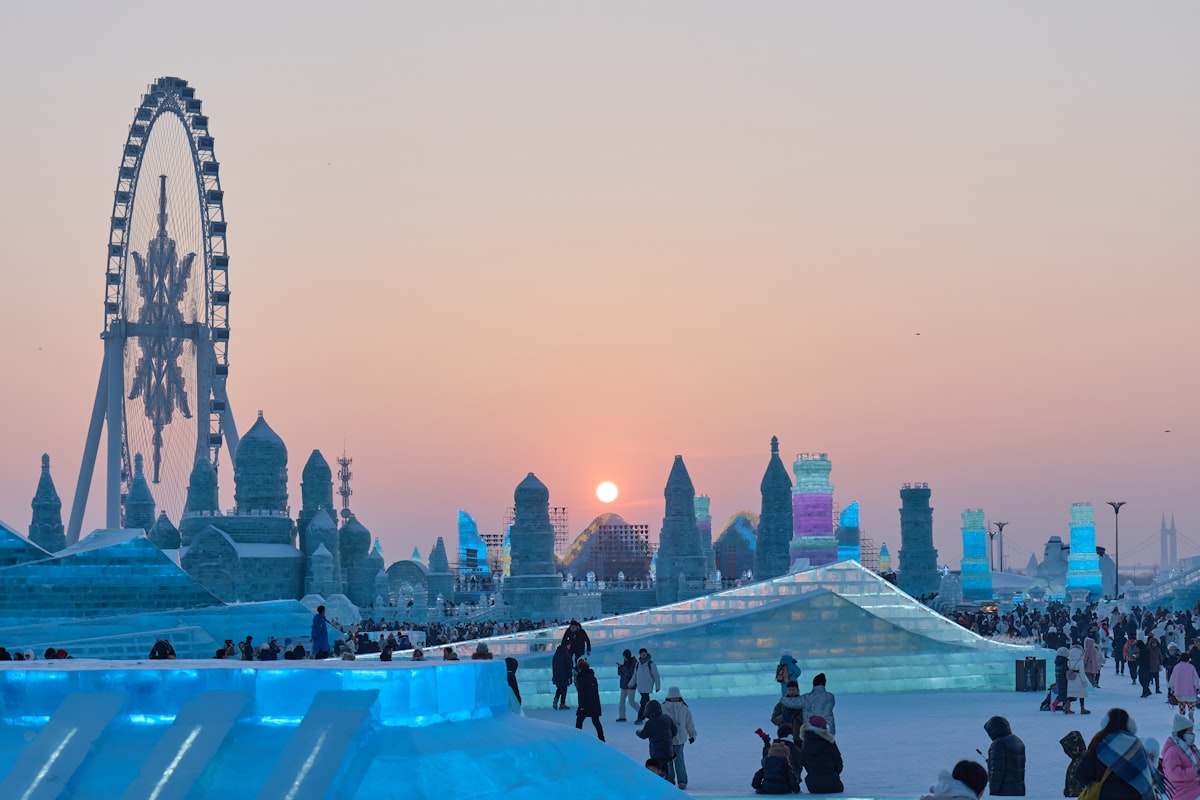
This is the largest ice-and-snow theme park on the planet, and it is genuinely unlike anything else on earth. Each winter, builders cut hundreds of thousands of cubic meters of ice straight from the frozen Songhua River and stack it into full-scale castles, towers, and a slide hundreds of meters long — then light the whole thing from inside with millions of LEDs. By day it's an impressive white city; after dark it becomes a neon dreamscape, every block of ice glowing from within. You don't tour it, you play in it: ice slides, a Ferris wheel, ice-bicycles, an ice bar.
The single most important decision: go for the night session. The sculptures are built to be lit, and they're spectacular only after dusk. Here's how to get it right.
The plan, step by step
- Arrive around 15:30–16:00, in the late-afternoon shoulder. You catch the last daylight and the magical moment the lights flick on at dusk — instead of paying full price and seeing only one or the other.
- Book ahead on Trip.com (smoothest for foreign passports) or the official WeChat account ≥2–3 days out in peak season — it sells out, and scalpers charge 1.5–2×. Your passport is required to enter.
- Go straight for the giant main ice slide first, before the queue builds — it's the signature thrill and the line gets long after dark.
- Pace yourself against the cold. Evenings here run −20 to −30°C and you're outside for hours. Duck into a heated rest hall or the ice bar to thaw, rotate heat packs, keep the phone warm.
Tickets & hours — confirm the current season ✓ verified Jun 2026
The 2025–26 (27th) edition charged ¥330 standard / ¥800 VIP (VIP skips the lines for the ice slides, Ferris wheel and ice show), open roughly 11:00–21:30 daily, on Sun Island West, Songbei District (north bank of the Songhua). It ran mid-Dec 2025 to Feb 21, 2026 — closing early when an unseasonal thaw melted the sculptures. The 2026–27 dates and prices aren't published until autumn 2026, and prior seasons have crept up in price — so confirm the current ticket and opening dates on the official channel (harbinice.com / Trip.com) before you build a trip around it.
They build a city the size of dozens of football pitches — and melt it every spring
The scale is hard to believe until you're standing in it: a typical edition uses well over 100,000 m³ of ice and snow cut from the river, raised by thousands of workers in weeks, then left to melt back into the Songhua when spring comes. Nothing is permanent. The park you walk through this winter has never existed before and never will again — which is exactly why the "I'll go next year" crowd keeps missing the version everyone raved about. ✓ Jun 2026, harbinice.com.
Want the ice park done right — the dusk timing planned and how to book your tickets, a warm car waiting outside at the exact dusk hour, a guide who knows which slides to hit first? Tell us your dates on WhatsApp.
Ask us →⛪ Saint Sophia Cathedral — Harbin's Byzantine postcard
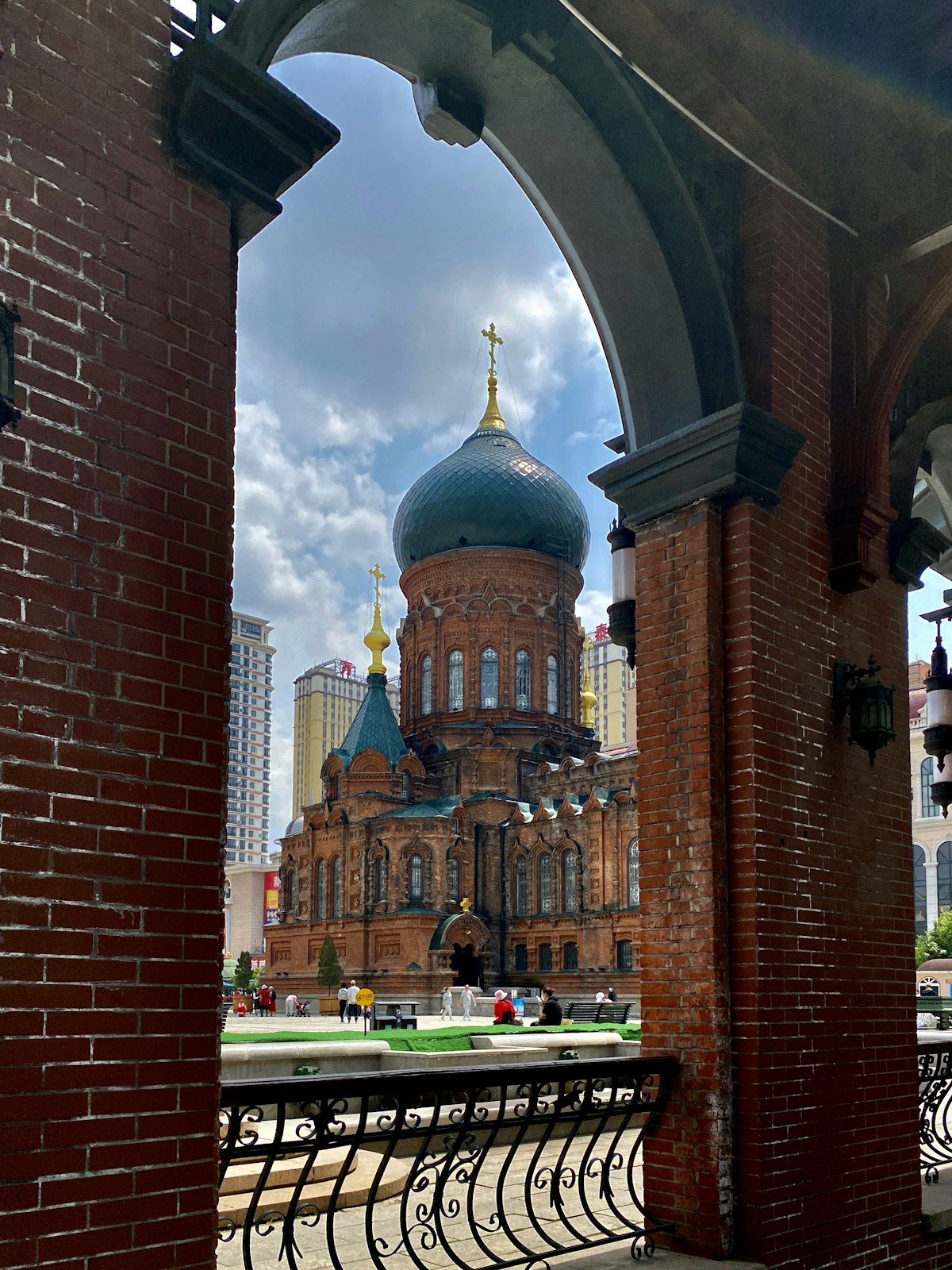
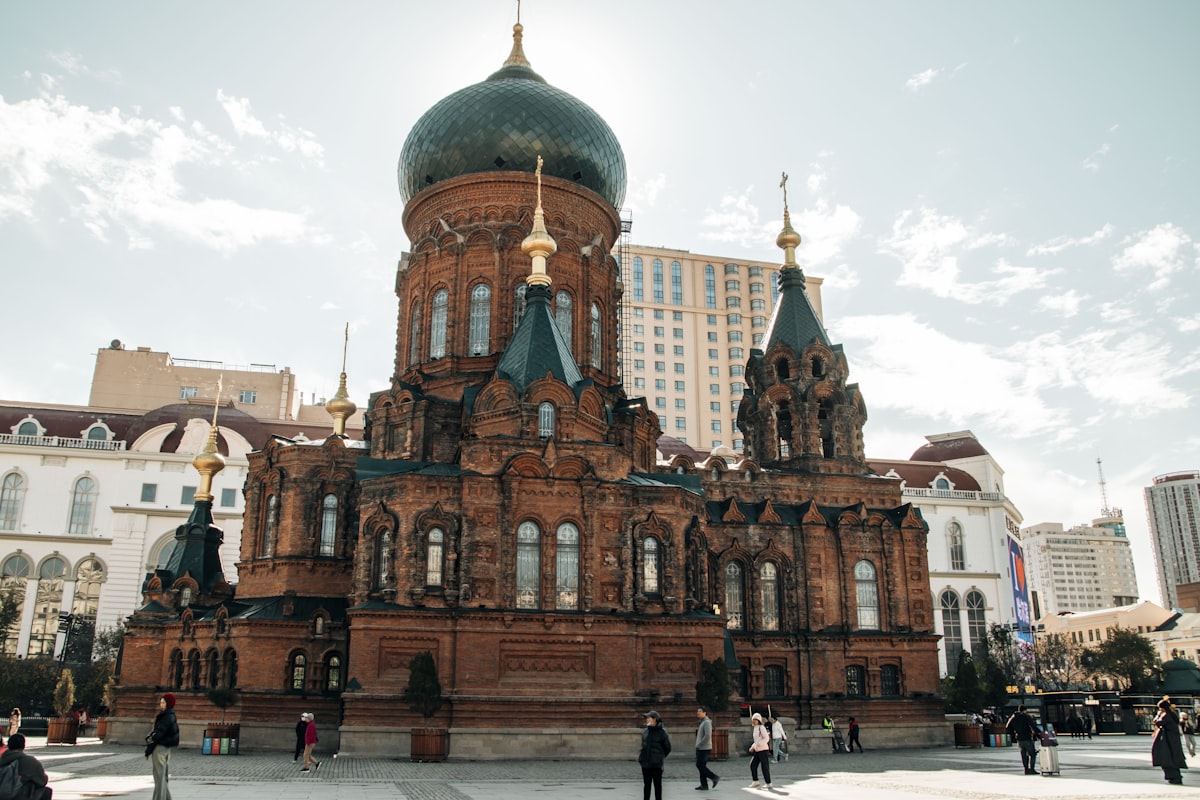
The most photographed building in the northeast, and rightly so. Built by Russians in 1907 (rebuilt to its current grand form in 1932), Saint Sophia is a Byzantine-style Russian Orthodox cathedral — a soaring red-brick mass topped by a green onion dome, dusted in snow and ringed by pigeons. It's the clearest reminder that Harbin grew up as a Russian railway town, and it photographs like a fairy tale in winter light.
- Ticket: ¥15–25 to go inside (free to admire and photograph the exterior, which is what most people come for). Inside is now the Harbin Architecture & Art Museum — old photos of the city's Russian era — not a working church.
- Hours: roughly 08:30–17:00 (later in peak season); closed for occasional events. ✓ verified Jun 2026, Trip.com / chinadiscovery.com.
- Insider: The exterior is the experience — go at dusk when the floodlights kick on against the blue hour, or just after fresh snow. The square out front is small; the classic shot is from the southwest corner. Pair it with Central Street, a 5-minute walk away.
🍦 Central Street (Zhongyang Dajie): Madie'er Ice Cream & Russian Architecture
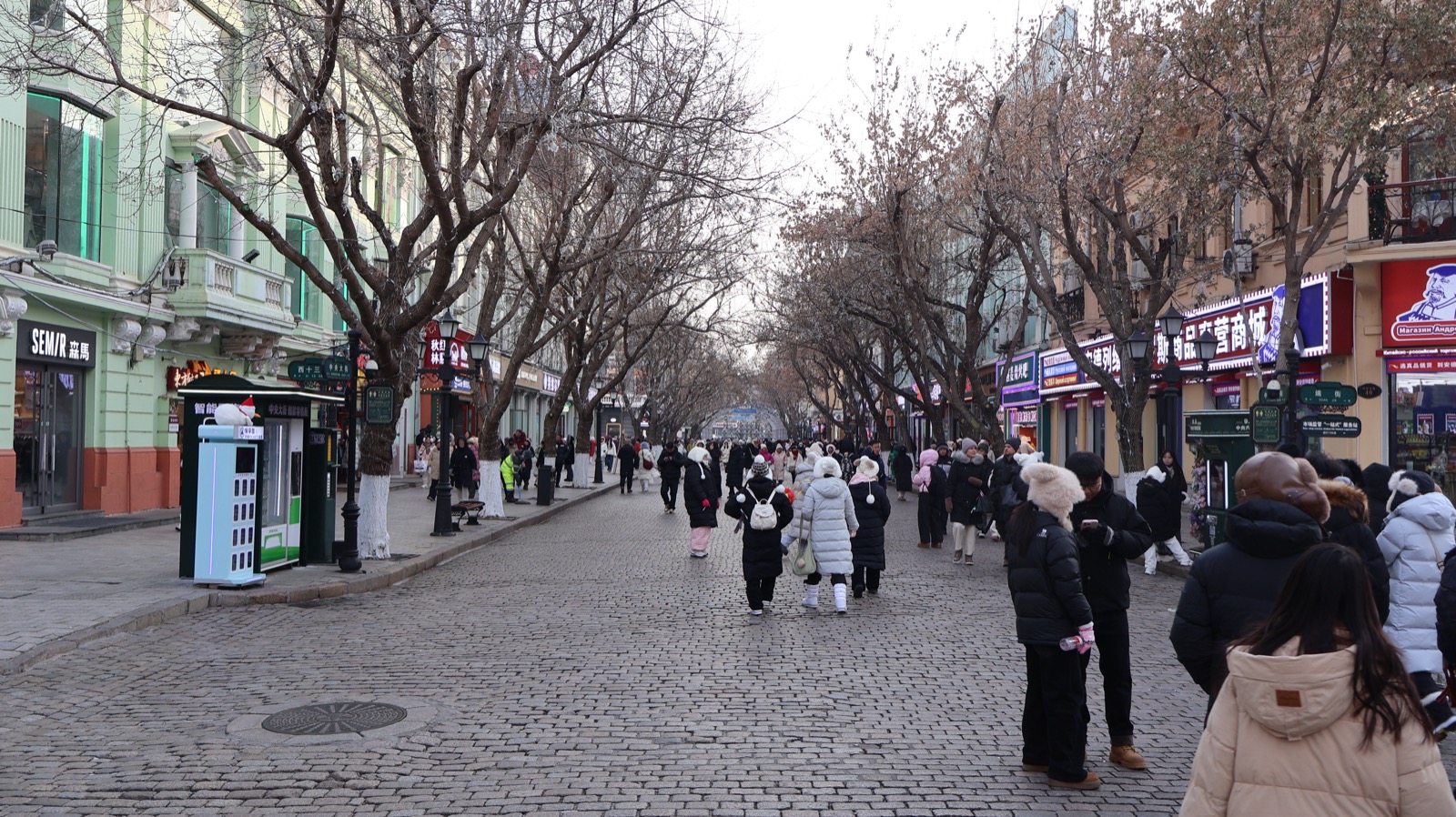
This is Harbin's living room, and your warm-up base camp between sights. Central Street is a 1.4 km cobblestone pedestrian boulevard laid by Russians in 1898, lined with 70+ European buildings — Art Nouveau, Baroque, Renaissance facades that make you forget you're in China. In winter it's strung with lights, dotted with snow and ice sculptures, and lined with food stalls. You don't "do" Central Street; you drift down it, ducking into shops to thaw.
The two rituals here
- 🍦 Eat a Madie'er ice cream — outdoors, in the freezing cold. This is the city's most beloved bit of theater. The Madie'er (马迭尔) ice cream bar, served from the century-old Modern Hotel at No. 89 Central Street (founded 1906), costs about ¥5 for a popsicle — and locals devour them standing in the −20°C street, because somehow eating ice cream in the cold is the whole joke and the whole delight. Do it. You'll get it instantly.
- 🌭 Buy Harbin red sausage (红肠). The smoky, garlicky Russian-style sausage that defines the city. The famous name is Qiulin (秋林里道斯), the century-old original, with a counter at No. 120 Central Street — buy a stick to gnaw as you walk, or a vacuum pack to take home.
Ticket: Free, open 24h (shops ~10:00–22:00). Metro Line 2 → Central Avenue (Zhongyang Dajie) station.
☀️ Sun Island & the Snow Sculpture Expo — snow as fine art
Across the frozen river from downtown, Sun Island (太阳岛) is a summer park that transforms each winter into the International Snow Sculpture Art Expo (雪博会) — the snow counterpart to the ice park. Where Ice & Snow World is about scale and neon, this is about craft: enormous, intricately carved snow sculptures, some the size of buildings, best seen in daylight when the carving detail and shadows pop.
- Ticket: ¥128–198 depending on date; open roughly 09:00–17:00 (last entry ~16:30). ✓ verified Jun 2026, Trip.com / chinadiscovery.com — confirm current-season price.
- Insider: Do this one by day (it's daylight art) and the Ice & Snow World by night — they're on the same north bank, so a classic full day is Sun Island in the afternoon, warm up, then the ice park at dusk. Budget 2–3 hours here.
The third venue — Zhaolin Park Ice Lanterns (兆麟公园冰灯). Back downtown near Central Street, Zhaolin is the historic birthplace of Harbin's ice-lantern art — smaller, more old-school and intimate than the mega-park, glowing with traditional carved-ice lanterns after dark. Entry is modest (around ¥100–150 in festival season; confirm locally). A gentle, central, lower-commitment ice fix if the big park feels like a lot.
🌊 Walk on the Frozen Songhua River — the ice highway
Here's the surreal one: in deep winter the Songhua River freezes thick enough to drive trucks on, and the ice becomes a free public playground right below Central Street and the Flood Control Monument. Locals and tourists pour onto it for ice slides, horse- and dog-sleds, ice-bikes, sleighs, and spinning tops — most rides a few yuan to ¥30, haggled on the spot. It's chaotic, cheap, and one of the most purely fun free things in the city.
- Where: Walk to the river end of Central Street (the Flood Control Monument / 防洪纪念塔), step down onto the ice. Free to walk; activities are pay-per-ride.
- Safety: Stick to the busy, marked activity zones where the ice is managed and thick — don't wander to empty edges. Watch your footing; it's literally ice.
🍲 What to Eat in Harbin: Northeast Cuisine & Russian Heritage Food
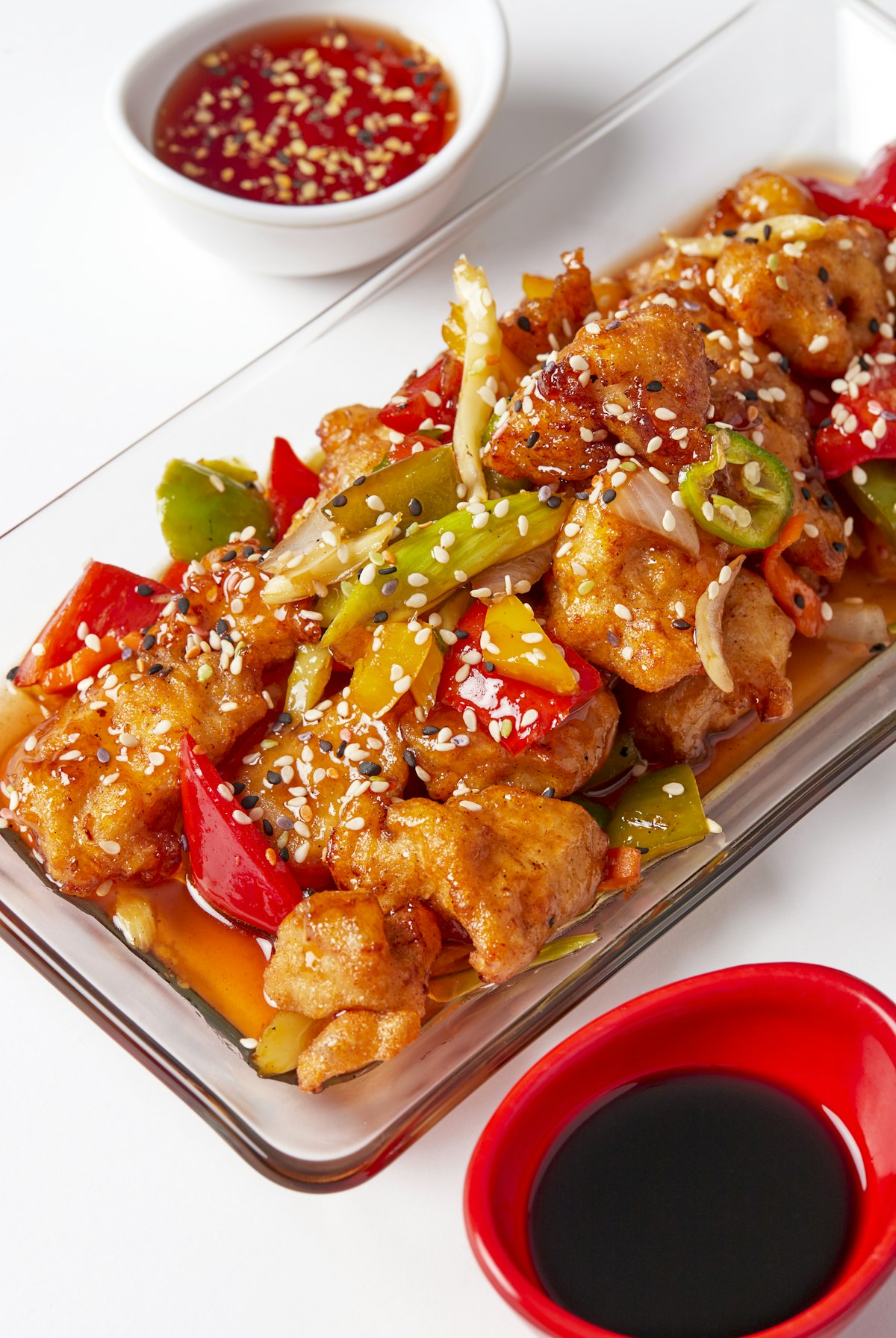
Harbin food is hearty, warming, and unlike anywhere else in China — a fusion of Dongbei (Northeast) comfort cooking and a century of Russian influence. This is the food you crave at −25°C: fried, sweet-and-sour, stewed, and washed down with beer. You'll eat well and cheaply (the marquee tickets are the splurge, not the meals).
The dishes to hunt down
- 🥘 Guō bāo ròu (锅包肉) — the Harbin dish: pork loin battered, deep-fried crisp, then glazed in a bright sweet-and-sour sauce. Invented in this city around 1907. Try it at Lao Chu Jia (老厨家), which claims to be the birthplace, or Lao Da Guo Bao Rou on Central Street (~¥58/dish).
- 🌭 Harbin red sausage (红肠 / hóngcháng) — smoky, garlicky, Russian-derived; Qiulin at No. 120 Central Street is the golden-standard brand.
- 🍞 Dà liè bā (大列巴) — a giant round Russian-style sourdough loaf, a wheel of bread the size of a dinner plate. Also a Qiulin specialty. A novelty souvenir and genuinely good.
- 🍲 Iron-pot stew (铁锅炖) — a huge iron cauldron of chicken or fish stewed with mushrooms, potatoes and cornbread stuck to the rim. The ultimate cold-weather group feast: Shan He Tun (山河屯) does a giant pot that feeds ~4 for ~¥120.
- 🥩 Killing-pig stew (杀猪菜 / shā zhū cài) — a rustic Dongbei classic of pork, blood sausage and pickled cabbage in a rich broth. Peak winter farmhouse comfort.
Budget reality: a sit-down Northeast classic (guo bao rou, braised pork, a stew) runs ~¥50–130 per person; street snacks on Central Street are a few yuan each. ✓ verified Jun 2026 — chinadiscovery.com, chinatour101.com, chinahighlights.com.
How not to look lost: most places have picture menus or a QR-code menu on the table (point your phone, Google Translate's camera reads it). Pay by scanning the table QR. Portions are large — Dongbei dishes are built for sharing, so over-order at your peril.
🍺 Harbin Nightlife: Beer, Bars & Russian Warmth — after dark in the Ice City
Here's what nobody tells you: Harbin is China's brewing capital, and its bar scene is a warm refuge with a Russian streak. This city is home to Harbin Beer (哈尔滨啤酒) — China's oldest brewery, founded in 1900 by Russians and Poles, decades before the rest of the country had a beer culture. After a day in the cold, the move is simple: get somewhere heated, order a cold Harbin lager (yes, ice-cold beer in winter — it's tradition), and thaw.
Where to go
- Central Street bars — the densest, most atmospheric strip after dark, the European facades glowing. Qiu Shan Whisky & Cocktail (丘山, Central Street branch) pours 20+ local craft beers on tap (~¥80/person); good first stop.
- The Red Lion Pub (British-style, inside the Wanda Holiday Inn, No. 90 Jingwei St, Daoli) — open 15:00–02:00, a warm expat-friendly anchor. Local draft from ~¥20–30; imported pints up to ~¥50.
- An "ice bar" — a bar built of ice, walls and glasses and all, on/near Central Street. A gimmick worth one drink (~¥30) for the photo — then somewhere heated.
The practical bits
Drink prices: local beer ¥20–30, craft/import ¥40–50, cocktails ¥60–90. Dress code: non-existent — you'll be in your snow jacket, and so is everyone. Getting home: Didi runs late (metro stops ~22:30), ¥15–40 across town — and you'll be very glad of a warm car at midnight.
China's oldest beer is from Harbin — and a great night out costs less than two cocktails back home
Harbin Beer has brewed since 1900, making this the unlikely birthplace of Chinese beer culture — a direct legacy of the Russian railway builders. And the night is cheap: a ¥25 local draft, a ¥30 ice-bar photo op, craft taps around ¥80 a head, and a ¥30 warm Didi home at 2am with zero safety worry. The "China is pricey / sketchy after dark" assumption is just wrong — and in Harbin the bar is also your heated sanctuary from −25°C.
Want a local to take you bar-hopping along Central Street — the warm spots, the best Harbin draft, no tourist traps? Ask us on WhatsApp.
Ask us →Sources — Part 3 (verified June 2026)
Attractions & tickets: harbinice.com, chinadiscovery.com, Trip.com, chinahighlights.com (Ice & Snow World ¥330/¥800, ~11:00–21:30, Sun Island West, ran mid-Dec 2025–Feb 21 2026; Saint Sophia ¥15–25, ~08:30–17:00, now architecture museum; Sun Island Snow Expo ¥128–198, 09:00–17:00; Zhaolin Park ice lanterns; Songhua frozen-river activities).
Food: chinadiscovery.com, chinatour101.com, chinahighlights.com, dolphinunion.com (guo bao rou origin & Lao Chu Jia / Lao Da ~¥58; Qiulin red sausage & dà liè bā, No. 120 Central Street; Shan He Tun iron-pot ~¥120/4; Madie'er ice cream ~¥5, Modern Hotel No. 89).
Nightlife: trip.com (Top Bars Harbin), icefestivalharbin.com, harbinice.com (Qiu Shan craft taps ~$12/pp; Red Lion No. 90 Jingwei, 15:00–02:00; ice-bar & beer prices ¥20–50; Harbin Beer est. 1900).
Prices and hours shift on Chinese public holidays and between festival editions — confirm the load-bearing ones on Trip.com or the official channel before you commit.
Day Trips from Harbin
Harbin is the gateway to the two great winter escapes of the northeast: China's biggest ski resort, and the snow-buried village that looks like a Christmas card came to life. Both are doable from the city, though each rewards an overnight more than a rushed day.
🚄 First, the train logic
Most foreigners reach these on the Harbin–Yabuli high-speed line. Book on Trip.com or the official 12306 website (both have English versions), bring your physical passport (it's your ticket — tap it at the gate), and arrive 30 min early for airport-style security. Trains run from Harbin West / Harbin Station; the booking app tells you which.
⛷️ Yabuli Ski Resort Day Trip — China's biggest ski area
Bottom line: the most accessible serious skiing in China, and a great day out even if you don't ski. Yabuli (亚布力) is the country's largest and most established ski resort, a former national-team training base with long groomed runs, a famous alpine toboggan, and proper mountain scenery — all about 90 minutes from Harbin by bullet train.
Getting there
- High-speed train: Harbin → Yabuli West (亚布力西), ~1 to 1.5 hours, 2nd class ¥76 / 1st class ¥121, ~12–17 trains daily (first around 07:08). The clear best option.
- By car: ~239 km, ~3 hours — only worth it for a private door-to-door group.
On the mountain ✓ verified Jun 2026: lift passes run ¥140 / 2 hours, ¥280 / 4 hours, ¥380 / full day (higher on weekends and holidays); gear rental and lessons are extra and available on-site. For non-skiers, the long alpine toboggan and the snow scenery make it a fun day regardless.
The honest trade-off
As a pure day trip Yabuli is tight but doable — early train out, ski/play, late train back. But the resort has hotels, and if you want a full ski day plus the toboggan without clock-watching, stay a night — especially if you're also continuing to Snow Town (below), which is only ~83 km onward from Yabuli.
🏘️ China Snow Town (Xuexiang) — the storybook village
Bottom line: the most photogenic place in the northeast — but it's a commitment, best as an overnight, not a true day trip. China Snow Town (中国雪乡 / Xuexiang) is a tiny mountain hamlet that gets so much snowfall the wooden cabins wear thick, rounded snow caps a meter deep, and at night red lanterns glow against all that white. It's the postcard image of "winter in China." It's also genuinely remote and unabashedly touristy.
Getting there & the reality
- It's ~83 km from Yabuli (about 1.5 hours by the direct shuttle bus, running roughly every few hours) and several hours from Harbin overall — there's no fast direct train to the village itself.
- A same-day Harbin → Snow Town → Harbin round trip is not realistic — travel times eat the day. Almost everyone does it as a 2-day trip, very often combined with Yabuli (Harbin → Yabuli ski day → overnight → Snow Town), or books an organized 2-day tour that handles the fiddly transfers.
- 240-hour transit travelers, read this: Snow Town is in Mudanjiang, outside Harbin city — the 240-hour zone in Heilongjiang covers Harbin city only, so transit-only travelers can't go. (Yabuli is within Harbin's own territory.) Confirm on en.nia.gov.cn before you book.
- Heads-up on cost: Snow Town is known for peak-season price hikes — village guesthouse beds and meals jump sharply in January–February. Confirm prices and book lodging ahead; this is not a budget add-on in peak weeks.
✓ verified Jun 2026 — chinadiscovery.com, asiaodysseytravel.com (Yabuli–Snow Town ~83 km / direct shuttle; no fast direct rail; overnight recommended).
Snow Town gets so much snow the roofs become the attraction
Xuexiang sits in a snow-belt valley that piles up some of the deepest snowfall in China — meters of it — and the famous sight isn't a monument but the "snow mushrooms": ordinary cabin roofs buried under fat, rounded white caps that look frosted on by hand. It's why the village shows up in every Chinese winter ad. Just go in clear-eyed: it's remote, popular, and priced for it — the magic is real, the logistics are not casual.
Yabuli, Snow Town, or both? The transfers up here are the tricky part — frozen roads, shuttle timings, where to overnight. Tell us your dates and we'll sort the whole northern loop on WhatsApp.
Send dates →Sources — Part 4 (verified June 2026)
Yabuli: travelchinaguide.com, chinahighlights.com, chinadiscovery.com (Harbin–Yabuli West HSR ~1–1.5h, 2nd class ¥76 / 1st ¥121, ~12–17 trains/day; lift ¥140/2h, ¥280/4h, ¥380/day; ~239 km / ~3h by car).
China Snow Town: chinadiscovery.com, asiaodysseytravel.com, tour-beijing.com (Yabuli–Snow Town ~83 km, direct shuttle ~1.5h; no fast direct rail; 2-day/overnight recommended; peak-season price hikes).
Know Before You Go
🧠 Cold survival, culture & health — the fine print
🥶 Extreme-cold survival cheat-sheet (read this one)
The cold is the single biggest risk to a Harbin trip — more than any scam or wrong turn. The essentials:
- Cover every inch of skin. At −20 to −30°C, exposed skin can frostbite in ~20 minutes. Balaclava/face mask, hat over the ears, no bare wrists or ankles.
- Layer, don't bulk: thermal base + fleece mid + down/snow jacket; snow boots one size up for thick wool socks + heated insoles; warm gloves and thin liner gloves so you can use your phone.
- Heat packs (暖宝宝) are everywhere — convenience stores, a few yuan. Stash them in gloves, pockets, and on the back of your phone.
- Save your phone: cold drains batteries fast and your phone is your wallet/map/taxi. Keep it in an inner pocket against your body; carry a power bank.
- Mind the indoor-outdoor swing (~40°C). Peel layers the instant you go inside or you'll sweat, then freeze outside. Don't leave the hotel with damp hair.
- Rent gear if you're from a warm climate — Harbin has outfitters renting full snowsuits and boots; no need to buy −30°C kit you'll use once.
- Watch your footing — packed snow and river ice are slippery; walk flat-footed and slow.
🤝 Culture shocks & etiquette (the ones that trip up first-timers)
- No tipping. Anywhere. Restaurants, taxis, hotels — none of it. Trying to tip causes confusion, not gratitude.
- Carry your own tissues + hand sanitizer. Public restrooms (and many squat toilets) often have neither paper nor soap.
- You order by scanning a QR code at most restaurants — point your camera at the table sticker, a menu opens, you tap and pay. (Menu's usually Chinese — Google Translate's camera, on your eSIM, reads it instantly.)
- Tap water is NOT drinkable — locals boil it or drink bottled. Every hotel room has a kettle and free bottles.
- Strangers may ask for a photo with you — genuine friendly curiosity, not a scam. Smile, say yes or wave it off.
- Portions are huge and meals are shared — Dongbei food is built for the table, not the individual. Over-ordering is the rookie mistake.
💰 What's cheap vs. surprisingly pricey in Harbin
Cheap (spend freely): Northeast food (a great stew or guo bao rou ¥50–130), street snacks and Madie'er ice cream (a few yuan), metro & bus (¥2–7), Didi across town (¥15–40), frozen-river ice rides (a few yuan to ¥30).
Surprisingly pricey (budget for it): the marquee ice tickets (Ice & Snow World ~¥330, Sun Island ¥128–198), peak-season hotels near Central Street (they can double Dec–Feb), Snow Town lodging in peak weeks, and imported/Western food and drink.
🛏️ Where to stay in Harbin (with real price bands)
No booking links, no commission — just where to sleep. Stay in Daoli District around Central Street (中央大街): you can walk to Saint Sophia, the frozen river, Zhaolin Park, the best food and bars, and it's your warm base between cold sights. Rough nightly bands for a clean 3–4★ double:
- Off-peak / shoulder: 3★ ~¥350–550 ($50–72), 4★ ~¥600–750 ($85–100).
- Peak (Dec–Feb, esp. around Chinese New Year): prices double or more, and Central Street hotels sell out — book 2–3 months ahead. Weekend averages near Central Avenue run ~$100+/night in season.
- Budget: hostels and simple rooms from ~¥120 ($17) off-peak.
✓ verified Jun 2026 — Trip.com, Booking, Expedia Harbin price data; bands shift hard with season.
🚑 Emergencies & health (save these before you fly)
- Frostbite & hypothermia are the real Harbin risks — cover skin, warm up indoors regularly, and if skin goes white/numb get inside and re-warm gently (no rubbing).
- Don't drink the tap water — bottled or boiled only; your hotel kettle is your friend.
- Pharmacies (药店) are everywhere, cheap, no prescription for basics — point or show a translated note.
- Major hospitals have international/VIP desks. Travel insurance is strongly worth having for a winter trip this remote.
❓ FAQ — straight answers to what everyone actually asks
Do I need a visa to visit Harbin in 2026?
Probably not. 50 countries get 30 days visa-free (most of Europe, Australia, NZ, Japan, Korea; UK & Canada since 17 Feb 2026; Singapore, Thailand & Malaysia via mutual-exemption deals). Citizens of the 57 countries on the 240-hour list — including the US — can instead use the 240-hour (10-day) visa-free transit if they meet the policy's conditions, including entry through an approved port and an onward ticket with a confirmed date and itinerary, leaving within 240 hours for a third country or region different from their departure country or region (e.g. Seoul or Tokyo; whether Hong Kong or Macao counts is our inference, not an official rule, so confirm with your airline or the immigration hotline, +86 12367, before you book). Harbin Taiping Airport (HRB) is Heilongjiang's only 240-hour port, but you can also enter at any other approved port (e.g. Beijing) and travel on to Harbin — just note that in Heilongjiang only Harbin city is inside the permitted area. Always confirm on the official en.nia.gov.cn before booking. (Full breakdown: Part 1.)
When is the Harbin Ice Festival 2026–2027 and how cold is it?
The big venues (Ice & Snow World, Sun Island) typically open mid-to-late December, the grand opening ceremony is around January 5, and everything runs until late February — though an early thaw can close it sooner (the 2025–26 edition shut on Feb 21). Exact 2026–27 dates aren't published until autumn 2026 — confirm before booking. Expect −15 to −25°C, occasionally −38°C. It's a dry cold, but cover all exposed skin. (Full season guide: Part 1.)
How much is a Harbin Ice and Snow World ticket and how do I book it?
The 2025–26 season was ¥330 standard / ¥800 VIP (VIP skips lines for the slides, Ferris wheel and ice show), open ~11:00–21:30. Book on Trip.com (smoothest for foreign passports) or the official WeChat ≥2–3 days ahead — it sells out and scalpers charge 1.5–2×. Bring your passport to enter. Go for the night session — the ice glows only after dark. Prices creep up yearly, so confirm the current rate on harbinice.com / Trip.com. (Full playbook: Part 3.)
Will Google, WhatsApp, and Instagram work in Harbin?
Not on local WiFi/SIM — but there's a clean fix. China blocks Google, WhatsApp, Instagram, etc. Install an international travel eSIM (Airalo, Nomad, Holafly, Saily) before you fly — it routes your data offshore, so all your apps just work, no separate VPN needed. Set it up at home; it activates the moment you land. And keep the phone warm — Harbin's cold kills batteries fast. (eSIM comparison: Part 2.)
How do I get from Harbin airport to the city?
Airport shuttle bus (Lines 1/2/3 + express to downtown): ~1 hour, ¥20 — the budget default, dropping near Central Street. Taxi/Didi: ~40–60 min, ¥110–150 — worth it with heavy bags or a late, freezing arrival. There's no metro to the airport. Harbin Taiping (HRB) is ~37 km southwest of the city. (Full options: Part 1.)
How many days do I need in Harbin?
3–4 days for the city in winter: a full day for Ice & Snow World (afternoon into night), a day for Saint Sophia + Central Street + the frozen river + Zhaolin lanterns, a day for Sun Island's snow expo and the Siberian Tiger Park. Add 1–2 more for a Yabuli ski day or a Snow Town overnight. Many pair Harbin with Beijing (4.5–6h by bullet train) for a Great-Wall-then-ice combo.
What should I wear and pack for Harbin's winter?
Think layers: thermal base + fleece mid + heavy down/snow jacket; snow boots one size up for thick socks + heated insoles; a hat over the ears, a face mask/balaclava, warm gloves with thin liners (so you can use your phone). Disposable heat packs (暖宝宝) for gloves, pockets and the back of your phone — sold everywhere for a few yuan. Cover all exposed skin (frostbite risk in ~20 min). Coming from a warm climate? Harbin rents full snowsuits to tourists. (Full survival kit: the box in Part 2.)
Is Harbin safe — especially at night and for solo travelers?
Very. Harbin is among the safest big cities anywhere — well-lit, heavy CCTV, near-zero street crime. Women routinely head home alone late. The real hazard in Harbin isn't people — it's the cold and the ice underfoot. Mind your footing, stay warm, and a 2am Didi from Central Street is completely normal.
Can I really pay everywhere with just my foreign card?
Yes — via QR, not the card itself. Bind your Visa/Mastercard inside Alipay or WeChat Pay (do it before you arrive) and scan-to-pay almost everywhere. Don't count on foreign cards at small shops; bigger hotels, malls and major sights are more likely to take them. Keep some cash as backup. Alipay and WeChat Pay set spending limits for foreign cards — see Essentials. Expect a ~3% fee above ¥200. Critically: keep your phone warm so the battery doesn't die — without it you can't pay. (Setup steps: Part 2.)
Is Harbin worth visiting in summer?
Yes, but for a totally different trip. Summer Harbin (18–28°C) is a cool, green escape from China's southern heat — riverside beer gardens, Sun Island's parkland, Russian architecture without the freeze, and the city's famous beer festival. But the ice and snow — the reason most foreigners come — are gone. If winter spectacle is your goal, come December–February. If you want a relaxed river city and to dodge the heat, summer's lovely.
Should I do a day trip to Yabuli or Snow Town?
Yabuli (China's biggest ski resort) is an easy ~1–1.5h bullet train from Harbin — doable as a long day, better with an overnight. Snow Town (Xuexiang), the storybook snow-capped village, is remote (~83 km past Yabuli, no fast direct train) and not realistic as a same-day round trip — do it as a 2-day trip, usually combined with Yabuli, or an organized tour. Both spike in price in peak season; book ahead. On a 240-hour transit, stick to Yabuli: Snow Town is in Mudanjiang, outside Harbin city — the 240-hour zone in Heilongjiang covers Harbin city only, so transit-only travelers can't go. (Full detail: Part 4.)
Can I walk on the frozen Songhua River?
Yes — it's a winter highlight. In deep winter the Songhua freezes thick enough to drive on, and the ice below Central Street (by the Flood Control Monument) becomes a free playground: ice slides, dog- and horse-sleds, ice-bikes and spinning tops, mostly a few yuan to ¥30 a ride. Stick to the busy, marked zones where the ice is managed — don't wander to empty edges — and watch your footing.
📣 Plan it with us
Want the whole Harbin winter handled?
Flights, a warm hotel right on Central Street, Ice & Snow World planned for the perfect dusk slot (we'll show you how to book it), a Yabuli ski day or Snow Town overnight, and a local who knows how to keep you warm and moving at −25°C. That's exactly what we do — real humans, real local knowledge. Tell us your dates and what you're into, and we'll take it from there.
Plan your Harbin trip on WhatsApp
All sources (verified June 2026)
Visa & entry: en.nia.gov.cn (National Immigration Administration), china-briefing.com. Transport: chinadiscovery.com, travelchinaguide.com, trip.com, chinaodysseytours.com, chinahighlights.com (HRB airport, metro, Harbin–Yabuli HSR). Attractions/tickets: harbinice.com, Trip.com guide pages, chinadiscovery.com, chinahighlights.com (Ice & Snow World, Saint Sophia, Sun Island, Zhaolin Park, Siberian Tiger Park, Songhua River). Food & nightlife: chinadiscovery.com, chinatour101.com, dolphinunion.com, icefestivalharbin.com. Weather/packing: chinadiscovery.com, anywherechina.com, chinahighlights.com. eSIM & payment: unusualnomad.com, traveltomtom.net, cybernews.com, realchinatrip.com, trip.com, Alipay/WeChat help centers. Hotels: Trip.com, Booking, Expedia public nightly-rate ranges.
⚠️ Live-confirm before travel: the Ice Festival's exact 2026–27 opening dates and ticket prices (harbinice.com / Trip.com), seasonal opening hours, exact fares, and nightly hotel rates all shift; visa → en.nia.gov.cn.