🧭 TL;DR — the honest bottom line
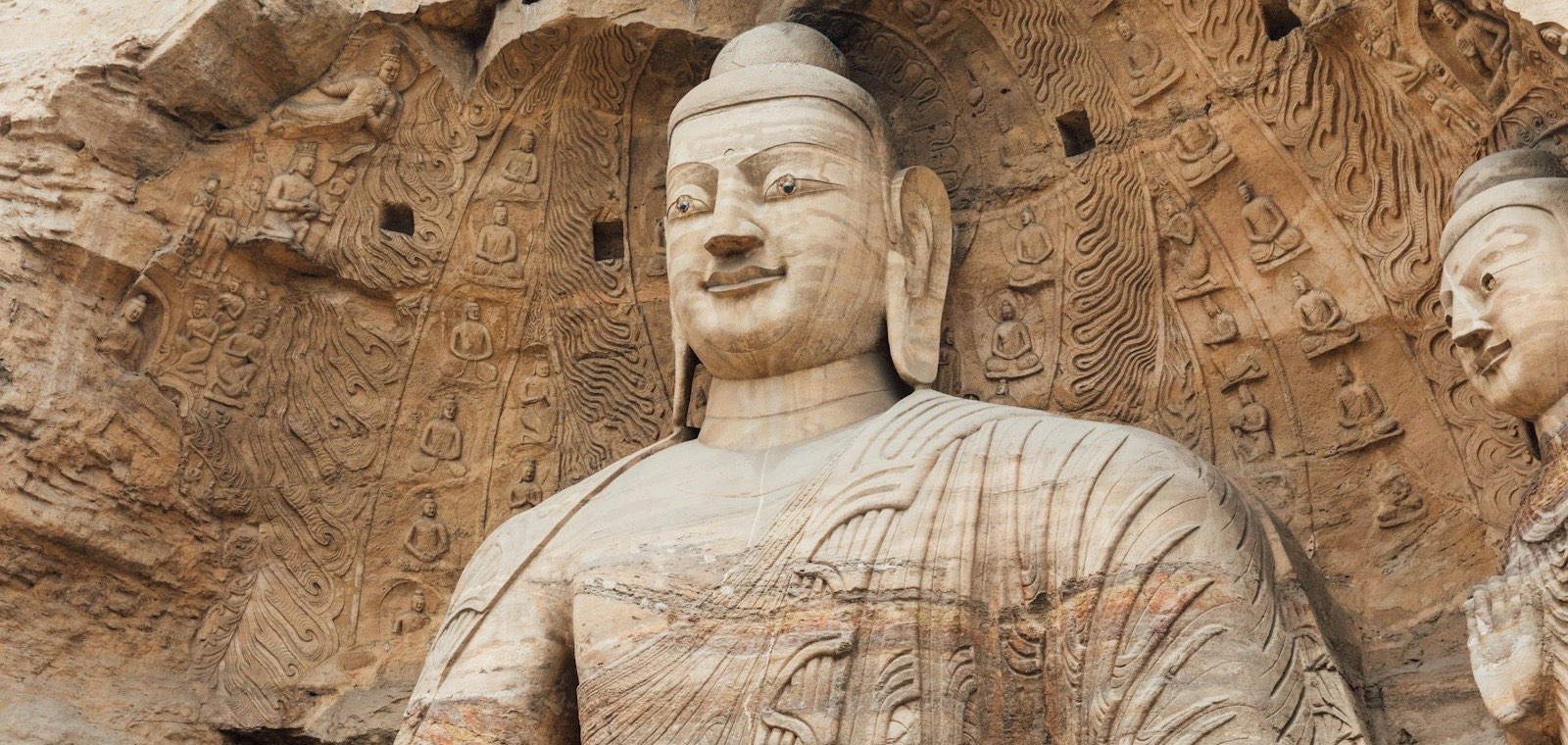
Here's what nobody tells you before you come: Datong is the great history city of China that almost everyone skips. Up on the Shanxi plateau sits an absurdly heavy load of world-class sights — 50,000+ Buddhas carved into a sandstone cliff, a 1,500-year-old monastery bolted to a sheer rock face, the world's tallest wooden pagoda, and a walled old town that lights up like a film set after dark. One catch shapes the whole trip: you can't realistically fly in from abroad — you land in Beijing and ride a bullet train ~1h45 to Datong South. Give it 2–3 days and you'll wonder why it isn't on every itinerary.
Two things to do before you fly: set up an eSIM (so Google and WhatsApp work) and bind a card to Alipay + WeChat (WeChat is handy here — Yungang's official booking runs through it, with Trip.com as the fallback). Sort those and the rest of this guide is just the fun part.
No time to read all of this? Tell us your dates and we'll build your Datong plan for you — Beijing train, Yungang timing (and how to book it), a private driver for the cliff temple. On WhatsApp, real humans. (One message, no obligation.)
Message us →📌 This guide is long because it's complete — use the menu to jump. Everything below is named, priced, and verified June 2026; Datong is a smaller, less-touristed city, so where a price or rule genuinely varies between sources we say "confirm locally" and give you a range rather than a fake-precise number.
Before You Go
🛂 Do You Need a Visa for Datong? — Why You Fly Into Beijing First
Here's the one thing about Datong that trips up nearly everyone, so read it before you book a single flight: you can't realistically fly into Datong from abroad. Datong's airport (DAT, Yungang International Airport) is a small port with only a handful of seasonal international and regional routes (routes to South Korea, Mongolia, Hong Kong and Thailand have been listed, and schedules change season to season), and it is not one of China's approved 240-hour transit ports — so for most travelers it isn't a way in. The move that actually works is dead simple and honestly more scenic: fly into Beijing, then take a bullet train ~1h45 straight to Datong South. Beijing handles the visa; Datong is a short ride away.
So the visa question is really "how do I get into China at all?" — and which route you use comes down to one thing: what color your passport is.
| Route | Who it's for | Max stay | The catch |
|---|---|---|---|
| 30-day visa-free | 50 countries — most of Europe, Australia, NZ, Japan, Korea, and UK + Canada (added 17 Feb 2026) | 30 days | Ordinary passport valid for at least your stay (airlines often ask for 6 months — play it safe). Tourism/business/family — no onward-ticket rule. The scheme currently runs to 31 Dec 2026 for most countries — recheck for 2027 trips. Enter at any open port, then go anywhere on the mainland. |
| 240-hour (10-day) transit | 57 countries incl. the USA, Russia, Brazil | 10 days | You must hold an onward ticket to a third country/region and enter via an approved port. |
✓ verified Oct 2026 Lists shift often — reconfirm your nationality on the official site before booking.
🇺🇸 Americans, read this carefully — Datong is reachable, just not directly
US citizens are not on the 30-day visa-free list, but they are on the 240-hour visa-free transit list. To use it, you must meet the policy's conditions, including entry through an approved port and a confirmed onward ticket to a third country or region different from your departure country or region. The catch is the word transit: China has to believe you're passing through to somewhere else, so you need an onward flight booked out of mainland China to a third country or region before you land (easy third stops: Seoul, Tokyo, Bangkok). The official notices say only "a third country or region", and none of the official pages we read names Hong Kong or Macao either way; reading them as qualifying is an inference, not an official rule. If your plan depends on it, confirm with your airline or the National Immigration Administration's 24-hour hotline, +86 12367 (English available), before you book.
Now the Datong-specific bit, because it's a genuine trap. There is exactly one 240-hour entry port for Shanxi province — Taiyuan Wusu Airport (TYN) — and Datong is NOT a port. You physically cannot start your 240-hour clock at Datong. For US travelers, the practical route is to enter at Beijing (Beijing is a 240-hour port), then bullet-train to Datong. Since the December 2024 relaxation, the 240-hour window lets you cross provinces, so Beijing-in → Datong → back to Beijing → fly onward is well inside the rules.
Two things that quietly sink people
① The 240 hours don't start when you land — they start at 00:00 the next day (GMT+8), so your arrival day is a freebie. ② "Third country" means different from where you came from — a US→China→back-to-US ticket does not qualify.
Country lists and ports shift — reconfirm your nationality and entry port on the official en.nia.gov.cn before you book. If your itinerary is unusual (entering at Taiyuan, an odd onward route), confirm the in-zone rules with the port — they're stricter for Shanxi than for the big coastal hubs.
🗓️ Best Time to Visit Datong
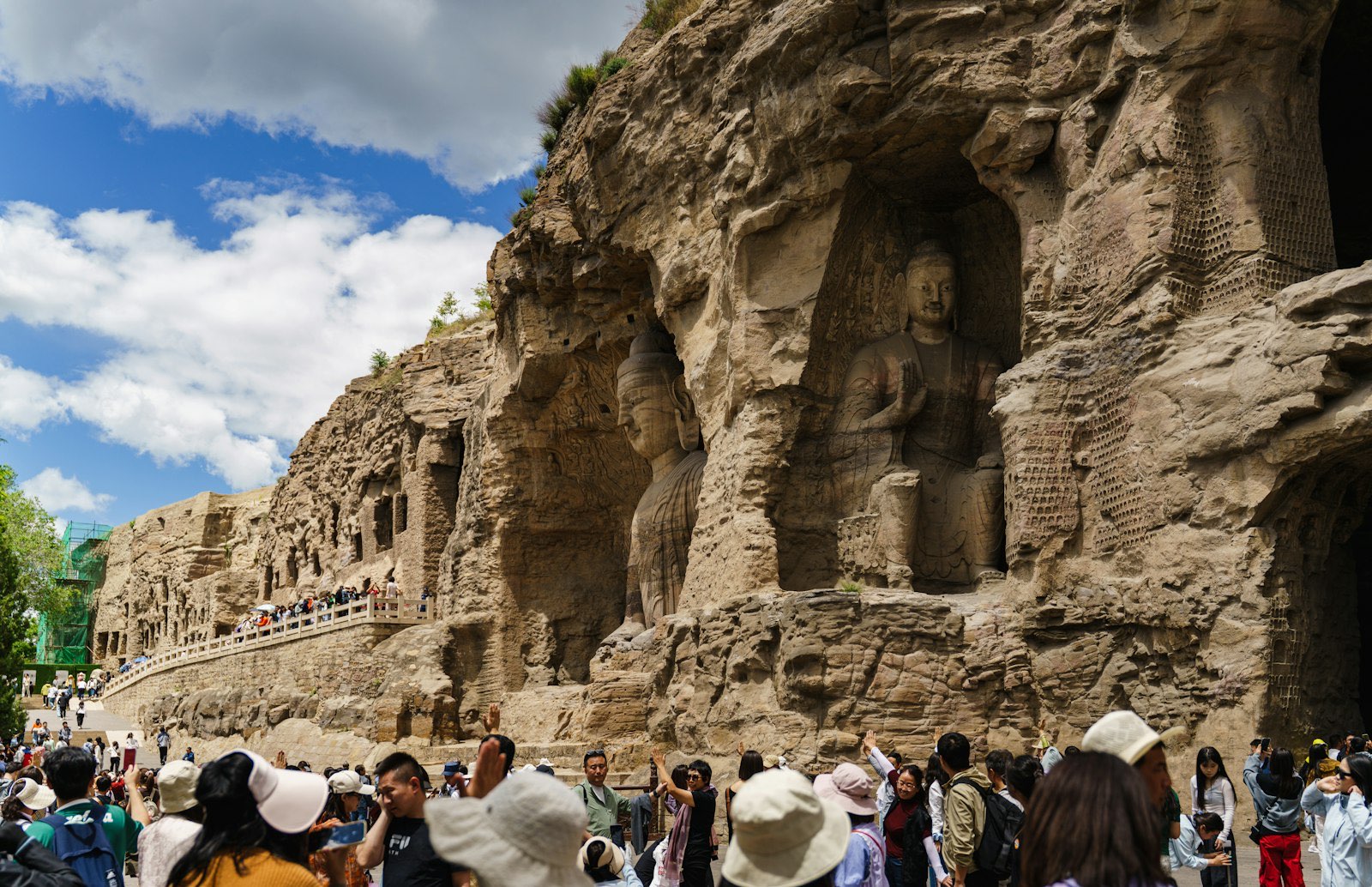
Aim for late April through October — and if you can pick, go in September or early October. That's when the famously thin, clear plateau air turns brilliant blue, which is exactly the light you want raking across the Yungang stone carvings.
| Season | Months | Temp | The real story |
|---|---|---|---|
| 🌤️ Autumn (best) | Sep–early Oct | crisp, blue-sky days | Peak quality. Transparent air, the best light for the grottoes. The window everyone in-the-know aims for. |
| 🌸 Spring | Apr–May | mild but windy | Comfortable but watch for dust storms (see box below). May is lovely between blows. |
| ☀️ Summer | Jun–Aug | ~19–22°C avg | Short, cool, genuinely pleasant — Datong sits ~1,000m up, so it stays cool while the rest of China bakes. May–Sept is the rainy season. |
| ❄️ Winter | Dec–Feb | Jan avg ~−10°C | Properly cold, but far fewer crowds and real discounts on hotels, transport, and some fees (Yungang's off-season ticket is cheaper). Pack a serious coat. |
The plateau plot twist: Datong is cool in summer while the rest of China melts
Most of China in July is a sweatbox. Datong sits over 1,000m up on the Shanxi plateau, so its summer averages just ~19–22°C — sweater-at-night weather while Beijing and Xi'an swelter in the mid-30s. If you're city-hopping and dreading the summer heat, Datong is your cool-down stop. The trade-off is winter: it drops well below freezing (January averages about −10°C), so this is a place where the season genuinely changes the trip.
One reverse-expectation caveat for spring: Datong catches occasional dust storms and blowing sand off the Mongolian plateau, mostly from March into May (the city issued a dust-storm alert as recently as February 2026). On a bad-wind day visibility tanks and the air gets gritty — not dangerous, but not the crisp blue skies the photos promise. If you're coming specifically for the grottoes' light, autumn is the safer bet.
Also dodge Chinese public holidays if you can — Labour Day (early May), National Day / Golden Week (1–7 Oct), and Spring Festival (late Jan/Feb) pack out Yungang and the old city walls. The shoulder weeks on either side are far calmer.
✈️ How to Get to Datong: Beijing Bullet Train & the Local Airport
Because direct international flights are so thin, nearly every foreign visitor arrives the same smart way: Beijing → high-speed train → Datong South. Here's the lay of the land.
🚄 The bullet train from Beijing — your actual way in
G-trains run Beijing → Datong South Railway Station (大同南站) in as little as ~1h45 (services range roughly 1h45 to ~2h30 depending on stops), about ¥145–170 second class depending on the train, topping out at 350 km/h. There are 30+ high-speed trains a day (published counts vary from about 30 to 45 depending on the source), so you rarely need to plan around a timetable; most leave from Beijing North or Qinghe stations. Book on the official 12306 website (English version) or at the station with your passport — more on rail in Part 4.
From Datong South Station into the city
Guides put the station roughly 6–12 km from the center (the figure varies by source and by which point you measure to), but the ride is short either way:
| Option | Time | Cost | When to pick it |
|---|---|---|---|
| Taxi | ~20 min | ~¥20–30 | Default. Cheap, door-to-door, barely longer than the bus. |
| DiDi (ride-hailing) | ~20 min | ~¥20–30 | If you'd rather not deal with a meter or language — English app (see Part 2). |
| City bus (e.g. lines 14, 31, 61, 66 — guides list slightly different sets) | ~30–40 min | ¥1–3, bring cash | Only if you're on a shoestring — and read the bus-payment note in Part 2 first. |
✈️ Datong Yungang International Airport (DAT) — fine for domestic hops, not a 240-hour entry port
If you're already inside China and flying in from another mainland city, DAT sits ~15 km north of the center. It has a few seasonal international and regional routes too (routes to South Korea, Mongolia, Hong Kong and Thailand have been listed, and schedules change season to season), but it is not on the 240-hour transit port list, so US-passport and other 240h travelers can't start their clock here. Into town you have three options. Since 26 February 2025 city bus 67 links the airport with the Datong Comprehensive Transportation Center (Datong South Station) — useful if you're connecting from the bullet train; the city government notice lists it running from the station side 07:00–19:00, with return trips timed to flight arrivals, at the standard air-conditioned bus fare (confirm current times and the fare locally). There is also an airport shuttle to the downtown Datong Hotel that leaves roughly two hours before each departure (reports put it at ~30–40 min and about ¥10 — confirm locally, as we found only one source for the fare). Or take a taxi (~30 min, roughly ¥30–40 by the meter — fares vary by source, so insist on the meter).
💴 Datong Travel Budget: What It Costs (per day, excluding flights)
Datong is noticeably cheaper than China's big coastal cities — a Shanxi plateau town where a famous bowl of knife-sliced noodles runs ¥5–10. Rough daily budgets:
| Style | Per day (ex-transport) | What that buys you |
|---|---|---|
| 🎒 Backpacker | ~¥150–250 (~$22–37) | Budget room (hotels from ~US$11/night), knife-sliced noodles + street food, walk the compact old town |
| 💺 Mid-range (most people) | ~¥300–550 (~$45–82) | Comfortable 3–4★ hotel (~US$40–80), sit-down copper hotpot, DiDi everywhere, grotto + temple tickets |
| ✨ Comfort | ~¥700+ (~$104+) | Upper 4★ courtyard or boutique (US$80+), private car for the Hanging Temple day trip, English-speaking guide |
The single biggest budget lever here isn't your hotel — it's the Hanging Temple day trip. Public transport out there is awkward (only a thin scenic-area shuttle, see Part 4), so most foreigners hire a private car for the day, which is the one chunky line item. Eat noodles, walk the old town, and you'll stay firmly mid-range while living very well. (~¥6.7 = $1 as of late Sep 2026; rates drift.)
Sources — Part 1 (verified June 2026)
Visa & 240h transit: en.nia.gov.cn (National Immigration Administration — unilateral visa-exemption interpretation dated 17 Feb 2026, UK + Canada added, valid through 31 Dec 2026 for most countries); visaforchina.cn 240-hour FAQ (Shanxi limited to Taiyuan + Datong; only Taiyuan Wusu Airport is a port — Datong is not; USA on 240h list); gov.cn cross-province relaxation (Dec 2024).
Getting in (rail + airports): travelchinaguide.com & chinadiscovery.com Beijing↔Datong trains (fastest ~1h45, ~¥145–170 2nd class, Beijing North/Qinghe — re-checked Sep 2026 against travelchinaguide.com, chinaairlinetravel.com and Ctrip listings; daily train counts differ by source, roughly 30–45, so the page says 30+ and gives no first/last times); chinahighlights.com Datong South station (distance quoted as 6–12 km depending on source; taxi ~¥20–30/~20min, buses ¥1–2); Datong Yungang International Airport (Wikipedia: opened 2006, 15.2 km north of the center in Yunzhou District; international route list checked against Wikipedia and changes by season; not on the 240h port list; bus 67 per Datong city government notice of Feb 2025; hotel shuttle fare ¥10 is a single-source figure, taxi ~¥30–40).
240h transit, re-checked Sep 2026: en.nia.gov.cn announcement of 20 Aug 2026 (57 countries, 65 ports in 24 provinces); Shanxi stay area = Taiyuan + Datong, single port Taiyuan Wusu (confirmed against the official NIA port and stay-area table of 20 Aug 2026 on nia.gov.cn, whose footnote lets travelers stay across provinces within the permitted areas of the 24 provinces; earlier cross-checked on visaforchina.cn FAQ and sz.gov.cn); 30-day scheme valid to 31 Dec 2026 for most countries (China MFA visa-free FAQ; consulate notice of 16–17 Feb 2026 on UK + Canada).
Best time / climate: chinadiscovery.com Datong weather & travelchinaguide.com best-time (autumn = peak light; summer ~19–22°C); China Meteorological Administration normals via Wikipedia (January mean about −10°C); dust-storm alert issued by Datong on 21 Feb 2026 (weather.com.cn).
Budget / hotels: chinadiscovery.com where-to-stay, booking.com & tripadvisor.com Datong (budget from ~US$11, mid US$40–80, upper US$80+); tradingeconomics.com USD/CNY (~6.70 on 29 Sep 2026).
Arrival & Essentials
The three things that turn China from "intimidating" into "effortless." Do the first two before you fly into Beijing — fifteen minutes at home saves you a stressful first hour. Datong adds one small local quirk the big cities don't have (city-bus payment) — so read to the end of this Part.
📱 Internet & VPN in China: Get an eSIM before you fly
Let's be blunt about the thing everyone whispers about: mainland China blocks Google, Instagram, WhatsApp, Gmail, and most Western apps. Your normal SIM will roam onto a Chinese network and hit that exact same wall.
The clean, legal, no-drama fix: an international travel eSIM that routes your data through a server outside the mainland — so Google Maps, WhatsApp, Instagram, all of it just works, with no separate VPN to fiddle with. You install it as a second line; your home number stays for calls and texts.
| eSIM | Best for | VPN? | The honest take |
|---|---|---|---|
| Nomad | Beijing + Datong + rail | No | The most stable one when you're moving — survives the Beijing→Datong tunnels and city-hopping. Top pick since Datong is almost always part of a bigger China route. |
| Airalo | Budget, simple | No | The most popular, cheapest, dead-simple. Plenty if Datong is a quick 2–3 day add-on. |
| Holafly | Heavy data users | No | Unlimited data plans + 24/7 support. Great if you stream or hotspot a lot — just check the fair-use cap. |
| Saily | Privacy-minded | No | By the NordVPN team, strong privacy. Solid for fixed-data plans. |
How it actually goes: buy online → you get a QR code by email → scan to install (2 min) → leave it off until you land in Beijing → flip it on as the plane taxis in, and you're online before baggage claim. Only needs an email — no Chinese ID, no registration. Buy it at home on your own Wi-Fi; do not count on installing it after you land, because the activation pages can themselves be behind the wall.
Why this matters extra for Datong: the city's headline sight, the Yungang Grottoes, is pre-booked online — through an official WeChat mini-program or Trip.com (Part 3 explains exactly how) — and you'll want a working connection to do that before you show up. No eSIM, no easy booking.
💳 How to Pay in China: Alipay & WeChat for Foreigners
Most people pay by phone, but cash is still legal tender: since 1 February 2026, staffed businesses must accept it. Keep some small notes as a backup (is cash accepted in China?). Don't count on foreign cards at small shops; bigger hotels, malls and major sights are more likely to take them. The great news for 2026: Alipay and WeChat Pay both take a foreign Visa/Mastercard directly, no Chinese bank account needed. Do this at home before you fly — identity verification is smoother on your home connection, and you want it working the second you land.
Set up Alipay (your main wallet)
- Download Alipay and register with your home mobile number (you'll get an SMS code).
- Open "Cards" → "Add Bank Card" and enter a real Visa or Mastercard. ⚠️ Use a normal physical credit/debit card — prepaid and virtual/online-only cards are frequently rejected. This is the #1 reason setup fails.
- Complete passport verification (photo of passport + a quick selfie). Approval is usually minutes.
- Set up WeChat too. In Datong it's handy — the Yungang Grottoes' official booking runs through a WeChat mini-program (Trip.com is the fallback), so download WeChat and bind a second physical card the same way.
The limits & fees you need to know ✓ verified Jun 2026
| Figure | |
|---|---|
| Payments under ¥200 | Fee-free (0%) |
| Payments over ¥200 | ~3% service fee |
Alipay and WeChat Pay set spending limits for foreign cards — see Essentials. Check your current limit in the app.
The practical read: the under-¥200 fee-free rule covers almost everything you'll buy in Datong — noodles, hotpot, taxis, grotto tickets, snacks. The ~3% only bites on a hotel or a private-car day trip. One Datong wrinkle worth knowing — keep reading, because city buses may still want cash.
🚕 Getting Around Datong: DiDi, Taxis & the City-Bus Cash Catch
Good news first: Datong's old town is compact and genuinely walkable — Huayan Temple, the Nine-Dragon Wall, the Drum Tower food street, and the lit night walls are all within an easy stroll of each other. There's no metro (the city doesn't need one). For everything beyond walking distance, here's how to move, ranked.
- 🚗 DiDi (China's Uber) — your easy default. DiDi is readily available across Datong and is the no-friction option for foreigners: full English app, foreign Visa/Mastercard (or link Alipay/Apple Pay), register with your home phone number — no Chinese SIM or bank needed. The in-chat English↔Chinese translator handles any driver communication; when they arrive they'll confirm the last 4 digits of your phone number — just show your screen. Set it up before you fly (~10 min).
- 🚕 Metered taxi. Flag-fall is about ¥7–8 for the first 3 km, then roughly ¥1.6/km by day, more at night (older guides quote lower numbers, so treat it as a range). Cheap and everywhere — fine if you can show the driver your destination in Chinese characters (let the DiDi/Maps app or a translator do that).
- 🚌 City bus — cheap, but read this first. Buses cost just ¥1–3, but here's the catch (full box below): reports conflict on whether a foreign Alipay/WeChat account can pay the onboard QR code, so bring exact-change cash. Useful for hops like the station-to-center run, but DiDi is the stress-free choice every time.
Phone-first China — except (maybe) Datong's buses, which may still want coins
This is the one place the "just pay by phone" habit may bend. One detailed 2026 guide reports you can't add a Datong bus card to Alipay without a mainland Chinese ID number — so foreigners would have to pay buses in cash, exact change, ¥1 notes, no change given. Other guides say the onboard Alipay/WeChat QR simply works, so reports conflict and we couldn't confirm which applies to a foreign-card account. Everywhere else in the city (taxis, shops, noodle joints) happily takes QR codes, which makes this gotcha easy to forget right up until you're standing on a bus with nothing but a phone. The fix is simple: just take DiDi or a metered taxi — both take your phone, both are cheap, and you'll never touch a coin. Keep a few ¥1 notes only if you're set on buses. Conflicting sources as of Sep 2026 — confirm on your first ride; DiDi is the safe call regardless.
More on this: China Essentials — paying with Alipay & WeChat →One phone really does replace everything (mostly)
Wallet, train tickets, translator, ride-hailing, dinner orders, museum and grotto tickets — almost all of it collapses into one phone the moment you're set up. Most people pay by phone these days, though cash is still legal tender. You'll operate like a Datong native by day two: scan to pay for noodles, DiDi to the old town, book Yungang in WeChat. The one asterisk — and it's a small one — is the city bus above, which may still want coins. Sort your eSIM + Alipay + WeChat before you fly and you're 99% phone-only.
More on this: China Essentials — paying with Alipay & WeChat →Landing in Beijing and want Datong planned end-to-end — bullet-train seats, the Yungang booking explained step by step, a private car for the Hanging Temple? Tell us your dates on WhatsApp, real humans.
Message us →Sources — Part 2 (verified June 2026)
eSIM: unusualnomad.com, traveltomtom.net, cybernews.com (China eSIM tests 2026 — Nomad most stable for multi-city + rail, Airalo cheapest, all route offshore / no separate VPN).
Alipay limits & fees: realchinatrip.com, trip.com, ltl-school.com (<¥200 fee-free · ~3% above; prepaid/virtual cards often rejected; confirm limits in-app).
Getting around / bus payment: babagoeschina.com Datong public transport 2026 (no metro; DiDi readily available; bus card needs mainland ID → foreigners pay cash ¥1–3 — one source; chinahighlights.com says the onboard Alipay/WeChat QR works, so confirm locally); taxi meter re-checked Sep 2026 (chinahighlights.com ¥8/3km then ¥1.6/km day; local listings ¥7/3km); trip.com / wise.com Didi-for-foreigners (English app, foreign cards, home phone number).
Things to Do in Datong
Datong is a small city carrying an absurdly heavy load of world-class history: 50,000+ Buddhas carved into a sandstone cliff, a 1,500-year-old temple bolted to a sheer rock face, the world's tallest wooden pagoda, and a walled old town that lights up like a film set after dark. Everything below is named, priced, and verified June 2026 — with the exact booking move, the right gate, and the one ticket catch (the capped Hanging Temple climb) that can sink your plan if you don't know it.
📌 Datong is a smaller, less touristed city, so a few prices and ticketing rules genuinely vary between sources — where that's true we say "confirm locally" and give you a range instead of a fake-precise number. When a number is load-bearing for your plan, give it a 30-second check on Trip.com or the site's official WeChat mini-program before you commit. Datong's ticket rules also changed several times in 2026 (the Hanging Temple climb quota, the city-wall fees), so treat anything dated before this spring with suspicion.
🗿 Yungang Grottoes Tickets & How to Visit — the 50,000-Buddha headline
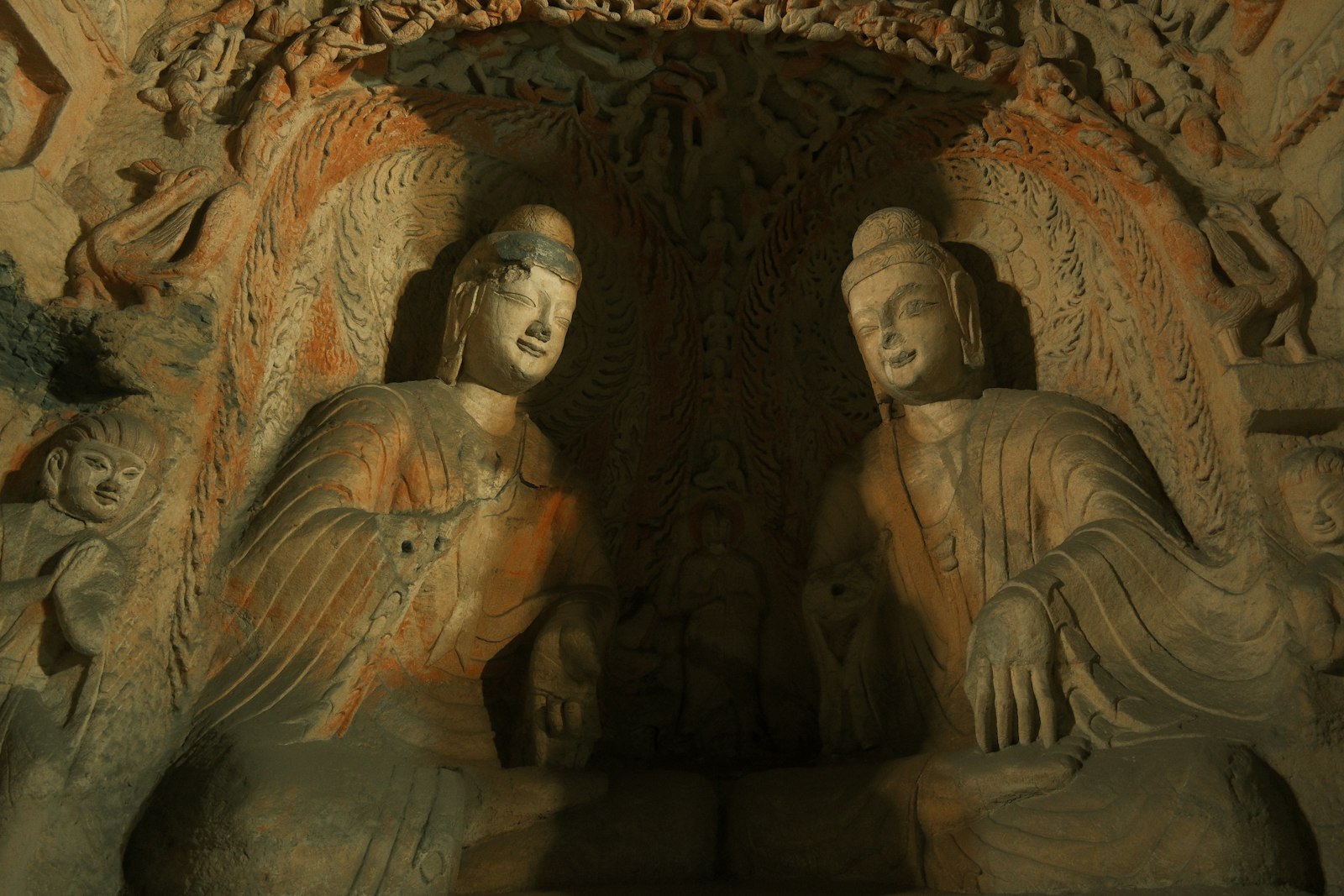
This is why you got on the bullet train. The Yungang Grottoes (云冈石窟) are a UNESCO World Heritage site: 50,000+ Buddhas (UNESCO lists about 51,000 statues; the Yungang Research Academy's newer count is 59,000+ across 254 caves) carved into a kilometer of sandstone cliff from the 5th century on, ranging from thumbnail-sized niches to a serene open-air colossus that dwarfs everyone beneath it. Go in autumn and the famous crisp plateau light pours straight onto the stone — this is the single best photograph you'll take in Datong. Here's how to walk in clean.
Tickets & hours ✓ verified Jun 2026
- Price: ¥120 in peak season (Apr 1–Oct 31), ¥100 off-season (Nov 1–Mar 31). Half-price (¥60 / ¥50) for students and ages 6–18; free for seniors 60+ and kids under 6 or under 1.2 m — bring ID. Seniors still have to reserve a free time-slot ticket online; only the young children are exempt from booking.
- Hours change with the season and get extended in summer and on holidays — for example 08:00–17:00 through September 2026 and 07:30–18:00 from July 11 to August 31, 2026; winter days run shorter. Your booking page shows the hours for your date.
- On-site add-ons: audio guide roughly ¥20–30; official human guides start around ¥180 (English-language guides cost more). Confirm on site.
How foreigners book — read this carefully, it's load-bearing
- Book and pay online in advance through the official Yungang Research Institute (云冈研究院) WeChat mini-program — choose passport as your ID type and pick a time slot. The official notices allow booking up to 7 days ahead (some 2026 guides say up to 15 — check the mini-program).
- Every ticket must carry the visitor's exact passport number + name. A mismatched name or number = admission refused at the gate. Enter them exactly as printed.
- At the gate you just present your passport — no paper ticket needed. Since the on-site ticket windows were closed on 1 January 2025, don't plan on buying anything at the visitor center.
- Can't use WeChat? Trip.com / GetYourGuide also sell Yungang tickets for travelers who can't run the WeChat flow.
Don't count on walking up
Yungang went online-reservation-only on 1 January 2025, and since 15 March 2025 the city government says same-day tickets are no longer sold at all — plan to book at least a day ahead. (The booking window is quoted as 7 days in the official notices and up to 15 in some 2026 guides — confirm on the mini-program, but never assume you can buy at the gate.)
Getting there from the city — pick your trade-off
| Method | Cost | Time | When to pick it |
|---|---|---|---|
| Official scenic shuttle from Datong South Station (since May 2025; sold on the Chinese-language "Datong Scenic Area Shuttle" mini-program) | ¥10 one way | direct, departures 09:00–16:40 every 20 min (per the city government at launch) | You're arriving by train and want zero transfers — if the booking flow accepts your passport |
| Fast Tourist Bus 603 (from Datong main Railway Station) | ~¥3 in older guides | roughly an hour; times and fares vary by source | Budget, daylight, no booking — check current times locally, guides disagree |
| DiDi / taxi | meter (flag-fall ~¥7–8 / first 3 km, then ~¥1.6/km) | faster, door-to-gate (~16 km from town) | You want zero friction and no language at all — the easy default for foreigners |
Insider timing: Go first thing, right when the gates open — you'll have the open-air caves before the tour coaches roll in. Budget 2–3 hours on site. If you're pairing it with the Hanging Temple in one day (doable — see Part 4), do Yungang in the morning and drive on; they sit in opposite directions from the city.
At Yungang, your passport is your ticket — but only if the name matches to the letter
Unlike most Chinese mega-sites where you scan a QR or buy a ticket on arrival, Yungang ties every single ticket to one passport number + name, booked ahead through the official WeChat mini-program — and there are no same-day door sales. Type your name even slightly differently from your passport and you can be turned away at the gate. The fix is simple: book ≥1 day out, enter your name exactly as printed, and carry the physical passport (it's what they check — no printout needed). Foreigners who can't use WeChat book on Trip.com instead.
Want a car at your hotel, an English-speaking guide for the carvings, and the Yungang booking explained step by step? Send us your dates on WhatsApp.
Ask us →⛩️ Hanging Temple (Xuankong Si): Can Foreigners Climb It? — yes, if you win a capped ticket
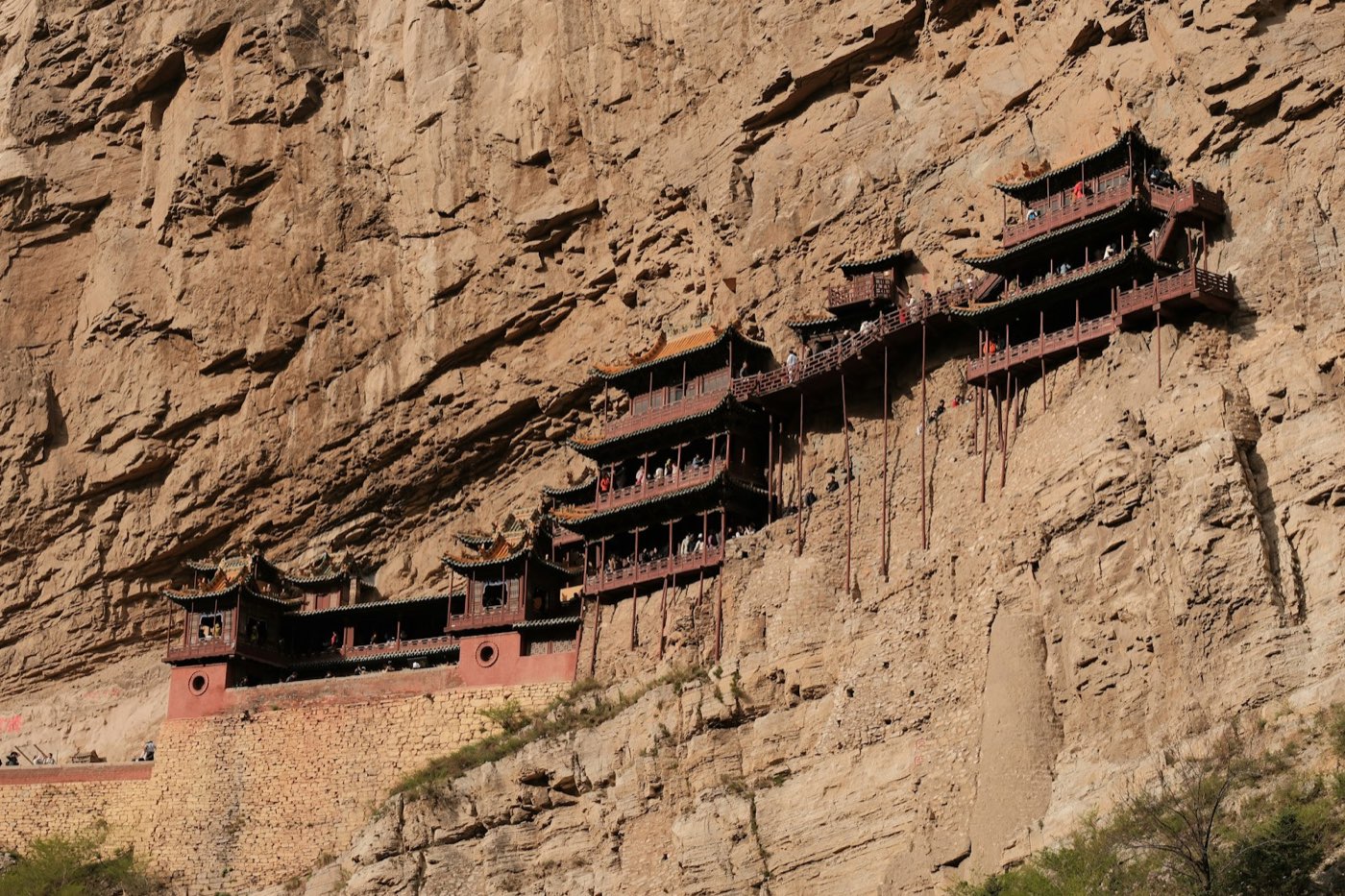
The single most jaw-dropping structure near Datong — and the one where the ticket, not the transport, is the hard part. The Hanging Temple (悬空寺 / Xuankong Si) is a 1,500-year-old wooden monastery pinned to a vertical cliff at the foot of Mt Heng (Hengshan), ~65 km southeast of the city. From the gorge floor it looks physically impossible: halls and walkways held up by thin poles, hanging in mid-air. Read the ticket rules first, because since April 2026 they're tighter than ever.
⚠️ The catch: the climb ticket is capped — and the booking rules keep changing
Entering the scenic area and photographing the temple from the gorge floor is easy. Walking the elevated wooden galleries needs a separate "climb-up" ticket (¥100, on top of the ¥15 entry ticket), and since 1 April 2026 the operator caps those at 2,475 a day, with further cuts promised in future years. Foreign passport holders are not locked out: the Hengshan management center's official ticket notice (15 March 2026) says overseas-visitor tickets are authorised on Trip.com — the main official channel is the Chinese-language Beiyue Yunyou (北岳云游) mini-program — and passport holders can also try the on-the-day counter at the Hengshan Visitor Center while quota lasts. The online release windows were reworked again in June and September 2026, so check the current rules when you book (the official sale window has been about a week ahead). How to play it: book the climb ticket as soon as your dates open, but keep a plan B — if the quota sells out you can still walk the gorge and get the iconic view from below.
Tickets & hours ✓ verified Jun 2026
- Entry ticket ¥15 (¥8 half-price) + climb-up ticket ¥100 (¥50 half-price) = ¥115 for the full experience (official Hengshan ticket notice). Seniors 60+ get free tickets on ID, covering the climb too — but the free climb tickets come from a small daily allotment (the March 2026 notice sets aside 150 online and 200 at the counter), so they can run out. You need the entry ticket to buy the climb ticket.
- Shuttle: since 2025 nobody drives to the temple gate — you buy at (or park at) the Hengshan Visitor Center and ride an official shuttle to the cliff base. Reports put it at about ¥20 per person, ~10 minutes; confirm locally.
- Hours: in the 2026 summer season (6 May–30 Sep) the temple is open 08:00–18:00, with ticket windows and shuttles running 07:30–17:30. Outside summer the schedule is shorter (older guides say roughly 08:30–17:30) — check the seasonal notice.
- Note: the temple reopened on May 1, 2026 after maintenance and rock-hazard remediation.
Getting there — why almost everyone takes a car
- Public transport is awkward: a bus from Datong toward Hunyuan, then a transfer/taxi to the site. Since July 2024 an official scenic-area shuttle (大同景区直通车) also runs from Datong Old Town to the temple, but it's sold on a Chinese-language WeChat mini-program with only a few departures a day (the winter 2025 timetable we found had a morning run out and an afternoon run back). So most foreign visitors still do a private car or a day tour.
- It sits ~65 km southeast (some sources say ~80 km via Hunyuan). Allow 2–3 hours on site.
- Pair it with the Yingxian Wooden Pagoda (below) — both lie southeast toward Hunyuan / Ying County and are commonly combined into one private-car day. (Full day-trip logistics are in Part 4.)
Insider: The view from the gorge floor is the experience — the temple looks more impossible from below than it ever does from the walkways. If you don't land a climb ticket, don't let it deflate the trip; bring a zoom or just your phone, walk the riverbed for the wide shot, and you've got the picture everyone comes home with.
Want the Hanging Temple + Wooden Pagoda done as one smooth private-car day from Datong, with the foreigner ticket rules explained before you go? Ask us on WhatsApp.
Ask us →🗼 Yingxian Wooden Pagoda — the world's tallest wooden pagoda (and why you only get the ground floor)
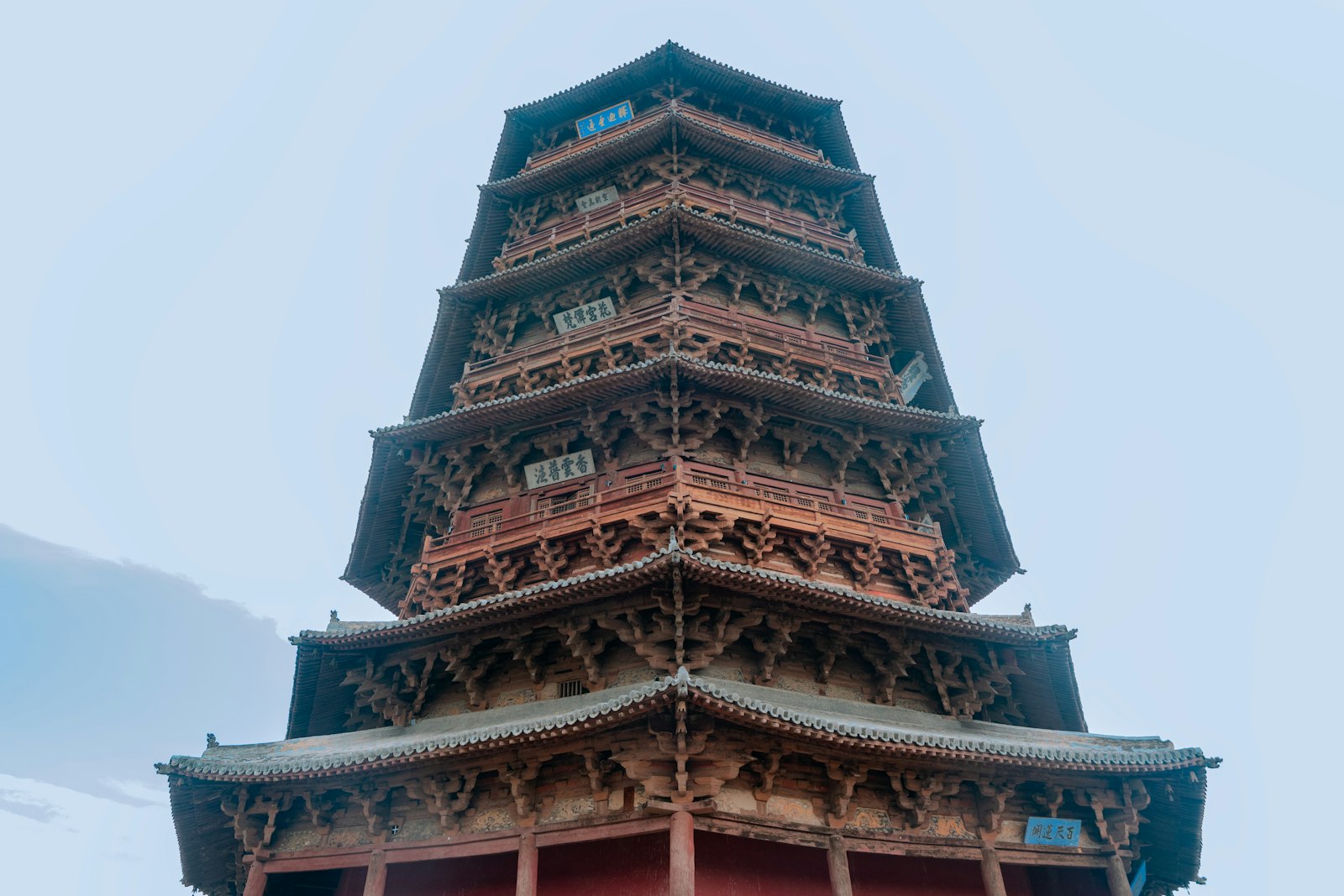
A 970-year-old timber skyscraper that has outlasted earthquakes, wars and dynasties. The Yingxian Wooden Pagoda (应县木塔), built around 1056 AD, is the tallest wooden pagoda in the world (about 67 m) and the oldest fully wooden pagoda still standing in China — assembled from interlocking brackets, without nails. It's a day trip southeast of Datong, usually bolted onto the Hanging Temple, and it rewards the detour with a genuine "how is this still standing" moment.
Tickets & hours ✓ verified Jun 2026
- Price: ¥50 (¥25 half-price for students and ages 6–18; free for seniors 60+ and kids under 1.2 m). The app sometimes shows ¥48.
- Hours: from 4 November 2025 the scenic area runs 08:00–17:00 (last ticket 16:30); summer hours have run later, so check the day you go.
- Book a slot: the site uses timed-entry reservations — reserve on the official "You Shanxi" (游山西) WeChat mini-program or through Trip.com, or try the ticket window and bring your passport. Don't turn up without a booking and expect to walk straight in.
Can you climb it? Only the ground floor. The structure is fragile and visibly leaning after nine-plus centuries, so only the 1st floor is open to the public (a few guides say the first two levels). You can step inside and see the Buddha, Bodhisattva and Arhat statues on the ground floor, but the upper floors are closed — you admire those from outside. Don't expect a climb to the top; it isn't on offer.
Getting there from Datong
- By car: ~1 hour+, easily combined with the Hanging Temple (both southeast toward Hunyuan / Ying County).
- By high-speed train: Datong South → Ying County ~25–35 min (a few D-trains a day — check 12306), then a taxi (roughly ¥30) or a bus (~¥5) ~20 min to the pagoda.
- By official scenic shuttle: the Datong Old Town → Yingxian run exists (see Part 4), but it's booked on a Chinese-language mini-program with a thin timetable.
- Allow ~2 hours on site.
Insider: Because the climb is off-limits, this is a walk-around-and-marvel stop, not a viewpoint stop — give it an hour for the structure and the ground-floor statues, then move on. It earns its place on the day-trip loop precisely because it shares the route with the Hanging Temple; going out solely for the pagoda is a long way for one tower.
🛕 Huayan Monastery & Shanhua Temple: Datong's Liao-Dynasty Temples — in-town, walkable
Datong's old town hides two superb Liao/Jin-dynasty (10th–12th century) temple complexes, both walkable inside the walled city — the perfect contrast to the day-trip drama outside town. Here's the in-town temple pair, with the honest note on ticketing (Datong has been changing its old-town fees, so where sources conflict we say so).
Huayan Monastery (华严寺) — Upper + Lower temple
A grand Liao/Jin complex split into an Upper and Lower temple, famous for its enormous timber Mahavira Hall and a hall of exquisite painted clay figures.
- Price: local listings give ¥50 peak (Apr 1–Oct 31) / ¥40 off-season (Nov 1–Mar 31) for the whole complex, half-price for students and ages 6–18, free for seniors 60+ and kids under 1.2 m. Older guides quote ~¥80 combined or ¥20 + ¥20, and other listings show different numbers, so budget ~¥50 and confirm at the window.
- Hours: 08:30–17:30 peak (Apr 1–Oct 31), 08:30–17:00 off-season — extended into the evening on some public holidays.
- Address: No. 459 Xia Sipo St; ticket line +86-352-2042025.
Shanhua Temple (善化寺)
A second, quieter Liao-era temple complex a short walk away — fewer crowds, big atmospheric halls.
- Price — listings conflict: older listings show ¥50 peak (Apr–Oct) / ¥40 off-season (Nov–Mar), but a 2026 traveler report says entry is currently free with a QR-code or ID sign-in at the gate. Confirm at the gate before you budget for it.
- Hours: roughly 08:00–18:00 in the warm months, 08:30–17:00 in winter (listings vary).
Insider: Both sit inside the old town within easy walking distance of the Nine-Dragon Wall and the food street, so do them as one slow morning on foot rather than separate trips. Bring your passport for any on-the-spot registration, and don't be surprised if the ticketing desk quotes a different price than the internet did — Datong's old-town fee rules moved around this year (the city wall alone changed twice in spring 2026), which is exactly why we won't print a fake-precise number for Shanhua.
🧱 Datong Ancient City Wall & Nine-Dragon Wall — the (nearly) free old-town set pieces
The walled old town is Datong's free, atmospheric heart — and after dark it's the city's real evening attraction. Here are the two set pieces, one free and one nominal, both inside the wall.
Datong Ancient City Walls (大同古城墙) — free to walk
A massive rebuilt Ming-style rampart ringing the old town, lit up at night until late — Datong's old town made a 2025 "most beautiful city night views" list (No. 20, compiled from social-media data), and the illuminated walls are the single best reason to be out after dinner in Datong.
- Price: free to access, open 07:00–22:00. Since 13 June 2026 the whole wall is free at all hours; from 11 May to 12 June an evening lantern zone briefly charged ¥29, so guides written before mid-June are out of date.
- ⚠️ Nuance to confirm: some local guides say the wall still asks for a free timed reservation on the "Datong Ancient City" mini-program, and parts of the wall close for construction from time to time. Write it as "free; check the gate you plan to use on the day."
- Insider: Come back after dark. This is the lit-old-city evening the whole city is built around — pair the wall walk with the Drum Tower food street and you've got your Datong night sorted, no clubs required.
Nine-Dragon Wall (九龙壁) — Ming glazed-tile screen, nominal ticket
A Ming-era glazed-tile screen wall of nine writhing dragons — one of the oldest and largest of its kind in China, and a quick, satisfying old-town stop.
- Price: about ¥10 in Chinese local listings (some English-language sources list it as free) — it's a small park with restrooms and a gift shop.
- ⚠️ Discard the "¥398" figure you may see online — that's a tour-package price, not admission. Confirm the small entry fee at the gate; do not pay ¥398 to "enter."
- Hours: roughly 08:00–18:00 (listings vary between 08:00–18:30 and 08:30–17:30; extended into the evening on some public holidays).
- Insider: It's a 15-minute stop, not an afternoon — a single magnificent wall, a small park, done. Fold it into the same walking loop as Huayan Monastery and the food street; don't build a separate trip around it.
Datong's old-town highlights — glazed dragons, floodlit Ming walls, a night-lit city — cost next to nothing
The two crowd-pleasers inside the wall cost almost nothing: the Nine-Dragon Wall is about ¥10 (ignore the bogus "¥398" tour price floating around online), and the Ancient City Wall is free to walk, lit up nightly until 22:00 — free at all hours since mid-June 2026. So the most photogenic thing you'll do in Datong after dark — stroll a glowing Ming wall over a moat — costs you nothing. Spend the saved cash on a copper hotpot.
Sources — Part 3 (verified June 2026)
Attractions & tickets: trip.com (Yungang tickets & hours, Xuankong Temple, Yingxian Pagoda, Huayan Monastery, Shanhua Temple, Datong Ancient City Wall, Nine-Dragon Wall) · travelchinaguide.com (Yungang WeChat + passport booking, audio/human guide) · topchinatravel.com (Bus 603 to Yungang) · chinaexplorertour.com (Hanging Temple, Huayan) · chinahighlights.com (Hanging Temple how to visit/view) · chinadiscovery.com (Hanging Temple transport, day-trip logistics) · wildgreatwall.com (Yingxian Pagoda climb & access) · asiaodyssey.com (Shanhua Temple) · tripadvisor.com (Nine-Dragon Wall) · babagoeschina.com (taxi meter / DiDi default).
Re-checked Sep 2026 (correction pass): Hengshan Scenic Area Management Center, "Hanging Temple climb-ticket purchase notice" (byhs.net.cn, 15 Mar 2026: 2,475/day cap from 1 Apr 2026; overseas-visitor tickets authorised on Trip.com; main channel is the Beiyue Yunyou mini-program, sales up to 7 days ahead; entry ¥15 + climb ¥100; 60+ free-ticket allotment 150 online + 200 at the counter; also 太原本地宝 bendibao, updated 6 Jan 2026, for the 60+ free-with-ID policy) and its Jul 2026 summer-hours notice; Yungang: China National Radio (cnr.cn, 29 Oct 2025, peak Apr 1–Oct 31 ¥120 / off-season ¥100), Datong city government (dt.gov.cn, republishing Yungang Research Institute notices of 2 Jan 2025 and 15 Feb 2025: online real-name reservation only from 1 Jan 2025, on-site windows cancelled, 7-day booking window, no same-day tickets from 15 Mar 2025, seniors must still reserve; neither notice mentions a foreigner gate or self-service machines, so none is claimed here; direct shuttle Datong South → Yungang from 1 May 2025, ¥10), Yungang hours from local notices (Sep 2026 08:00–17:00; 11 Jul–31 Aug 07:30–18:00); Yingxian pagoda ticket/hours/time-slot booking (bendibao.com, updated 31 Jul 2026); Huayan Monastery ¥50/¥40 and address (bendibao.com, Trip.com); Datong Ancient City Wall free-access announcements (11 May and 13 Jun 2026); Nine-Dragon Wall ¥10 (dt.bendibao.com); Wikipedia (pagoda 67 m, 1056, oldest fully wooden pagoda in China; Hanging Temple 491 AD); UNESCO (51,000 statues) vs Yungang Research Academy (254 caves, 59,000+).
A few Datong ticket prices and rules genuinely vary between sources or changed this year (Hanging Temple climb-ticket release windows, Shanhua Temple price, Nine-Dragon Wall ¥10 vs free, city-wall reservation) and are flagged "confirm locally" above — verify the load-bearing ones on Trip.com or the site's official channel before you commit. The "¥398 Nine-Dragon Wall" figure is a known data error and is not an admission price.
Day Trips from Datong
Here's the thing nobody tells you about Datong: the city itself is a two-day stop, but the two best things in the whole region are out of town — a temple glued to the side of a cliff, and the world's tallest wooden pagoda. Both sit southeast of the city, in the same direction, and the smart move is to bag them in one big day. This is where Datong stops being "a stopover on the way to Pingyao" and starts being a place you're glad you came.
🚗 First, the transport logic (read this once — it changes how you plan)
Datong's day trips do not work like Chengdu's or Beijing's, and this trips people up. There is no bullet train and no ordinary public-bus chain that links the out-of-town sights to each other — just a thin official scenic-area shuttle. Here's the honest map:
- Yungang Grottoes is west of the city — easy by city bus, the official direct shuttle from Datong South, or DiDi, covered in Part 3.
- The Hanging Temple and the Yingxian Wooden Pagoda are both southeast, out toward Hunyuan / Ying County — opposite direction from Yungang. There is no ordinary city bus out there; the official scenic-area shuttle (大同景区直通车, running since July 2024) links Old Town, Yungang, the Hanging Temple, the pagoda and Yanmen Pass, but it's sold on a Chinese-language WeChat mini-program with only a few departures a day (the timetable we found is from winter 2025), so check whether your passport works for booking before you build a day around it.
So the realistic playbook is:
- Yungang → do it on its own, by the direct shuttle, city bus or DiDi (Part 3).
- Hanging Temple + Yingxian Pagoda → these two pair perfectly (same direction, ~1h apart), and the flexible way to do them is a private car / day-tour driver for the loop. A car for the day is the single best money you'll spend in Datong.
- The one ambitious combo — Yungang in the morning, Hanging Temple in the afternoon — is doable in a private car, because they're ~100 km / ~1.5–2h apart and a driver just shuttles you across. On public transport, forget it.
You can't realistically fly into Datong from abroad — and that's fine, the bullet train is better
Datong Yungang International Airport (DAT) has only a handful of seasonal international routes and is not on the 240-hour transit port list. The clean way in for nearly everyone: land in Beijing, then take a high-speed G-train to Datong South — about 1h45 at its fastest, roughly ¥145–170 second class, 30+ departures a day at up to 350 km/h. You arrive rested and right in the city.
Beijing city guide — your gateway to Datong →⛩️ Hanging Temple (Xuankong Si) Day Trip — the cliff-hung wonder with a capped climb
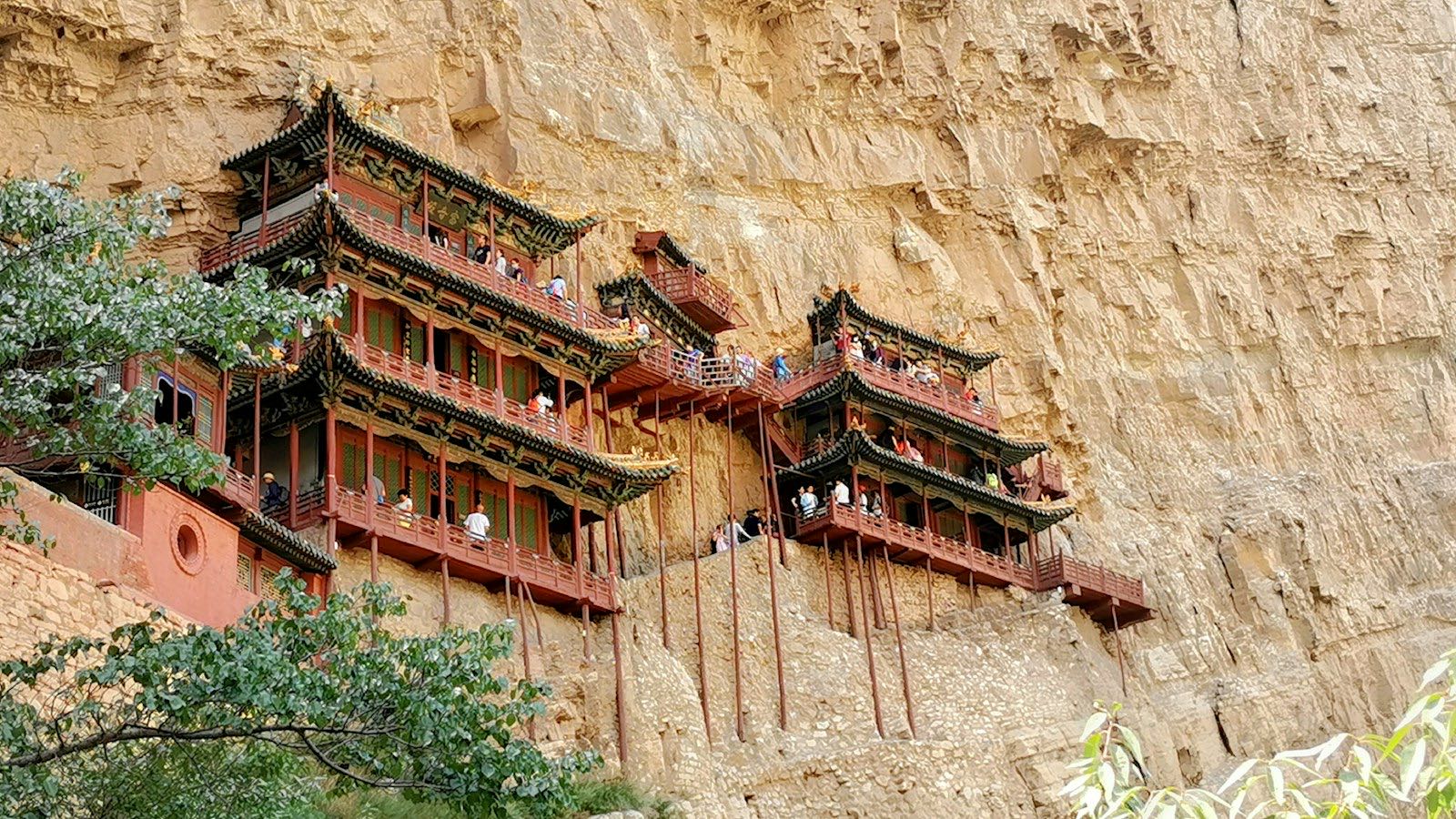
Bottom line: one of the most jaw-dropping structures in China — and the climb onto its galleries is a capped, first-come ticket, so book early and keep a plan B. Know that before you go and it's magic; find out at the gate and it's heartbreak. A 1,500-year-old monastery built into a vertical cliff at the foot of sacred Mt Heng (Hengshan), its halls and walkways held up by what look like impossibly thin wooden poles. It's the kind of thing that doesn't look real even when you're standing under it. It reopened on 1 May 2026 after a maintenance closure, so it's freshly spruced up.
The Hanging Temple's catch: anyone can see it from the gorge floor — but only 2,475 people a day can climb onto it
This is the single most important thing on this page. Since 1 April 2026 the operator caps the "climb-up" ticket at 2,475 a day, and it has promised further cuts in future years to protect the 1,500-year-old timbers. The Hengshan management center's official notice says overseas-visitor climb tickets are authorised on Trip.com, and passport holders can also try the on-the-day counter at the Hengshan Visitor Center — but nothing is guaranteed and the online release rules changed again in June and September 2026. Book as soon as your dates open, and keep a plan B: viewing and photographing the temple from the gorge floor is still spectacular — it's the classic shot. If you'd rather not gamble on the quota, a private tour operator can help — confirm locally, well ahead.
Tickets & hours
- Entry ¥15 + climb-up ¥100 = ¥115 (half-price ¥8 + ¥50), per the official Hengshan ticket notice; add roughly ¥20 for the visitor-center shuttle (reported, confirm locally).
- Hours: 08:00–18:00 in the 2026 summer season (6 May–30 Sep), with ticket windows and shuttles running 07:30–17:30; shorter outside summer — check the seasonal notice.
Getting there
- It's ~65 km southeast of Datong (some sources say ~80 km via Hunyuan).
- Public transport is awkward: a bus from Datong toward Hunyuan, then a transfer or taxi to the site — workable but slow, and it eats the day. The official scenic-area shuttle (Chinese-language WeChat mini-program, a few departures a day) is the only direct option.
- What everyone actually does: a private car / day tour, almost always paired with the Yingxian Wooden Pagoda (next section) since both lie the same way. Allow 2–3 hours on site.
Insider read: Even if you do land a climb ticket, don't expect the galleries to yourself — up to 2,475 people a day share them. Go in expecting to stand in the gorge, crane your neck, and have your mind quietly blown that anyone built this in the 6th century. Framed that way, it's unforgettable. Pair it with the pagoda, give a driver the day, and you've got the best day in the region.
🗼 Yingxian Wooden Pagoda Day Trip — the world's tallest wooden pagoda
Bottom line: a ~970-year-old, entirely wooden tower that's still standing — and the natural partner to the Hanging Temple. Built around 1056 AD, Sakyamuni Pagoda (everyone calls it the Yingxian Wooden Pagoda) is the tallest wooden pagoda in the world and the oldest fully wooden one still standing in China — assembled from interlocking timber brackets, without nails, and it's survived nearly a millennium of earthquakes on sheer carpentry genius. Standing under it, faintly leaning, is a humbling thing.
The thing to set expectations on: you can only go inside the ground floor. The ~970-year-old structure is fragile and tilting, so only the 1st floor is open — you'll see the interior Buddha and statues at ground level, but the upper floors are closed to entry; you admire the tiers from outside. Don't promise yourself a climb to the top — it isn't on offer, and that's the price of it still existing.
Tickets & hours
- Entry ¥50 (¥25 half-price; free for seniors 60+ and kids under 1.2 m). Entry is by timed slot — reserve on the "You Shanxi" (游山西) mini-program or Trip.com, or try the ticket window with your passport.
- Hours: 08:00–17:00 (last ticket 16:30) since 4 Nov 2025; check for seasonal changes. Allow ~2 hours on site.
Getting there
- ~1 hour-plus by car from Datong — and since it sits southeast toward Ying County, it slots into the same private-car day as the Hanging Temple. This is why the two are the classic combo.
- By rail (if you're DIY-ing just the pagoda): high-speed train Datong South → Ying County, ~25–35 min, then a taxi (roughly ¥30) or bus (~¥5) about 20 minutes to the pagoda.
Insider read: On its own, the pagoda is a 2-hour stop — beautiful, but not a full day. Chained to the Hanging Temple in one private-car loop, the pair becomes the day trip out of Datong: two world-class, wildly different feats of ancient building, one driver, one day, back in the old city for a copper-hotpot dinner.
A private driver for the whole southeast loop costs less than a single museum ticket back home
A car-and-driver day handling the Hanging Temple and the Yingxian Pagoda — the two best things near Datong, in opposite-to-Yungang country with only a thin scenic shuttle between them — is the highest-leverage spend of your trip. No backtracking, no missed last bus, no standing on a Hunyuan roadside at dusk. Exact rates shift, so confirm locally (or let us quote it) — but this is the one Datong day where DIY genuinely isn't worth the savings.
🗺️ The bigger picture: Datong as a Shanxi gateway
Quick note so nobody plans this wrong: the Yungang Grottoes — UNESCO, 50,000+ carved Buddhas, the headline site of the whole region — is west of the city and reached by shuttle, city bus or DiDi, so we cover it fully in Part 3 as a half-day from town, not as an out-of-town day trip.
The combo question, answered
Can you do Yungang + Hanging Temple in one day? Yes — but only with a private car. They're in opposite directions from the city (~100 km / 1.5–2h apart), so the move is Yungang in the morning → drive across → Hanging Temple in the afternoon, then back to Datong. It's a packed day, and you must have pre-booked Yungang (and ideally your Hanging Temple climb ticket). On public transport it's not realistic.
Datong isn't an island — it's the northern anchor of one of China's richest history routes. Two natural extensions, both worth flagging before you lock your dates:
- Datong → Pingyao. The classic Shanxi pairing: Datong's grottoes and cliff temples up north, the perfectly-preserved Ming walled city of Pingyao down south. If you've got a week in Shanxi, this is the itinerary — see Pingyao. Heads-up for 240-hour transit travelers: Pingyao (in Jinzhong) is outside Shanxi's permitted 240-hour area (Taiyuan + Datong only), so this extension only works on 30-day visa-free entry or a visa — not on the 240-hour transit.
- Datong on the great northern history loop. The three legendary Buddhist-cave sites of China — Yungang here, the Longmen Grottoes near Luoyang, and the Mogao Caves at Dunhuang — plus the imperial heavyweights at Xi'an form a single grand circuit for travelers chasing old China. Datong's Yungang is the northern keystone. (See Luoyang, Xi'an, Dunhuang.)
For US travelers on the 240-hour visa-free transit, there's a clean bonus: Beijing is a 240h entry port, and Datong sits inside the permitted Shanxi zone (Taiyuan + Datong), with cross-province travel back to Beijing allowed — so Beijing-in → Datong → Beijing-out is tidy and compliant. (Full visa breakdown: Part 1.)
🗓️ Datong Itinerary: 2, 3 & 4 Days — hour-by-hour, the sights actually strung together
These plug straight into Part 3 (Yungang, the old city walls, Huayan Temple, Nine-Dragon Wall, knife-sliced noodles, copper hotpot) and the day trips above. Times assume a base inside or just around the old city (the move — see "Where to Stay" below). Tap a day to open the hour-by-hour plan.
⏱️ 2 Days — the essential Datong
Day 1 Yungang's 50,000+ Buddhas + the lit old city at night
- Night beforeBook your Yungang ticket on the official WeChat mini-program (or Trip.com), passport name + number matched, choose the morning slot. No same-day tickets at the door. (Full booking playbook: Part 3.)
- 08:00Head out to Yungang by DiDi (easiest), the direct shuttle from Datong South, or bus 603 from the main Railway Station (check current times). Aim to be at the gate near opening — you beat the tour buses and get the open-air caves nearly to yourself.
- 08:45–12:00Yungang Grottoes. Passport at the gate, no paper ticket. Lose yourself in the big caves; grab an audio guide (roughly ¥20–30) so you know what you're looking at.
- 13:00Back in town. Lunch: a bowl of knife-sliced noodles (刀削面) — Datong's signature dish — at Dongguan Sliced Noodles on Yuhe South Rd, ¥5–10, order it with dried beancurd.
- 14:30–17:00Old-city core on foot: Huayan Monastery (the great Liao/Jin temple complex) and the Nine-Dragon Wall (the Ming glazed-tile screen — a small park with a nominal ticket, takes 20 min).
- 18:00Copper hotpot (铜火锅) dinner — the local charcoal-brass-pot specialty — at Yuheyuan on North Yuhe Rd (budget roughly ¥50–90pp; Datong copper-hotpot places we checked list around ¥80).
- 20:00The real Datong-after-dark move: walk the illuminated Ancient City walls and the Drum Tower (鼓楼) food street. The lit old town made a 2025 "most beautiful city night views" list — this is the nightlife here, and it's gorgeous.
Day 2 The day trip: Hanging Temple + Yingxian Pagoda
- 08:00Meet your private driver (the flexible way to do this loop). Head southeast toward Hunyuan / Ying County.
- 09:15–12:00Hanging Temple (Xuankong Si): walk the gorge, photograph the cliff-glued monastery from below, and climb the galleries if you landed a capped climb ticket (book it ahead — see Part 3). ~2–3 hrs on site.
- 12:30Lunch en route (your driver will know a spot).
- 14:00–16:00Yingxian Wooden Pagoda: the ~970-year-old, nail-free timber tower; ground-floor interior + Buddha statues, admire the tiers from outside. ~2 hrs.
- 16:00Drive back to Datong (~1h+). Easy old-city dinner; you've earned it.
⏱️ 3 Days — the comfortable version (breathe + go deeper in the old city)
Days 1–2 As above, unrushed
Run the 2-day plan, but stop racing. Push Yungang into a slow morning and early afternoon, linger over the audio guide, and ride the shuttle or bus both ways (or just DiDi back).
Day 3 Slow old Datong
- MorningThe rest of the walled-city set: walk a stretch up on the Ancient City Wall rampart (free, open 07:00–22:00 since mid-June 2026 — check the gate you plan to use), then Shanhua Temple (善化寺) for the quiet Liao-era halls.
- LunchA second, better bowl of knife-sliced noodles on Yunzhong Road, or branch out to local Shanxi dishes.
- AfternoonDrift the old city: tea, lanes, the small museums, the Drum Tower quarter by daylight.
- EveningOne more loop of the lit city walls + Drum Tower food street skewers. If you want an actual bar, one venue reported in the Hong'an International Hotel is Charles Bar — we couldn't confirm it's still operating, so check any nightlife venue on a map app before trekking out (Datong's online bar listings are notoriously full of ghosts).
⏱️ 4 Days — the full Datong (+ a Yungang/Hanging power-combo or a Pingyao launch)
Days 1–3 The 3-day plan above
City + the southeast day trip + a slow old-city day.
Day 4 Option A: the power-combo, or Option B: launch to Pingyao
Option A (ambitious, private car): Yungang in the morning → drive across (~1.5–2h) → Hanging Temple in the afternoon in a single packed day — only if you'd rather double up than slow down, and only with a driver. (You'd swap this in for the separate Yungang + day-trip days above.)
Option B (keep moving south): Use Day 4 to train on to Pingyao and continue the Shanxi loop — Datong's grottoes north, Pingyao's Ming walled city south. (See Pingyao. Pingyao is outside Shanxi's permitted 240-hour area (Taiyuan + Datong only), so this option only works on 30-day visa-free entry or a visa — not on the 240-hour transit.)
Want this turned into a real plan — Beijing bullet train booked, Yungang planned (we'll show you how to book it on your passport), a private driver for the cliff temple + pagoda, and the right hotel inside the old walls? Send us your dates on WhatsApp.
Send dates →🛏️ Where to Stay in Datong: Best Areas — with real price bands
No booking links, no commission — just where each type of traveler should sleep and what you'll roughly pay. The single best base is inside or right around the Old Town (within the city wall) — you wake up walkable to Huayan Temple, the Nine-Dragon Wall, the Drum Tower food street, and the lit night walls, instead of commuting in for all of it. The other sensible cluster is near the railway station if you're arriving late or leaving early.
Bands below are indicative nightly rates from OTA aggregates — they move with season and date, so confirm live on your booking app.
| Area | Best for | Why here | Rough nightly band |
|---|---|---|---|
| 🏯 Inside / around the Old Town | First-timers — the default | Walkable to Huayan Temple, Nine-Dragon Wall, Drum Tower food street and the lit night walls. Character courtyards live here too. Where I'd put almost anyone, full stop. | Budget from ~$11–40; mid-range ~$40–80 |
| 🏮 Old-town courtyard / boutique | Atmosphere-seekers | Character stays in the walled city — e.g. Yunzhong Traditional Courtyard (quiet family courtyard, walk to Huayan / Nine-Dragon) or Pipa Hotel (historic building, ~4-min walk to Huayan Temple East Plaza). | Mid-range and up; confirm locally by date |
| 🚆 Near the railway station | Late arrivals / early trains | Pure convenience for the Beijing bullet train and the Yungang shuttle from Datong South. Options like Tongtie, Feitian, Hongqi Grand, Jiahe International Inn. Less charm, more practicality. | Budget–mid; confirm locally |
| 🏨 Mid-range 4★ (downtown) | Comfort-seekers | Full-service if you want wifi/breakfast/gym/bar under one roof — e.g. Datong Garden Hotel, central downtown. | Upper band, ~$80+ |
My honest pick: Stay inside or right beside the old city wall. Datong's whole evening magic — the floodlit ramparts, the Drum Tower food street — happens here, and you want to stroll into it after a copper-hotpot dinner, not taxi back to it. Only base by the station if a pre-dawn train genuinely demands it.
A character courtyard inside a walled ancient city, for motel-back-home money
A clean room in or around Datong's old town starts around $11–40 a night, with comfortable mid-range stays ~$40–80. You can sleep a 4-minute walk from a 1,000-year-old Liao temple, wake to the lit walls, and pay less than a chain motel off a Western highway. The "historic + affordable" trade-off just doesn't exist here.
Sources — Part 4 (verified June 2026)
Day-trip transport: chinadiscovery.com, chinahighlights.com (Yungang ↔ Hanging Temple ~100 km / 1.5–2h; Hanging Temple + Yingxian pair as one private-car day); Datong city government (dt.gov.cn) on the official scenic-area shuttle 大同景区直通车 (running since 15 Jul 2024; winter-2025 timetable published 11 Jan 2025 — check the current one).
Hanging Temple / Yingxian Pagoda (tickets, hours, climb rules, reopening): Hengshan Scenic Area Management Center notices (byhs.net.cn), trip.com, chinaexplorertour.com, chinahighlights.com, wildgreatwall.com; bendibao.com (Yingxian pagoda tickets and time-slot booking, updated 31 Jul 2026).
Getting in (Beijing rail / DAT not a 240h port): travelchinaguide.com, chinadiscovery.com; visaforchina.cn 240-hour port list.
Food (knife-sliced noodles, copper hotpot venues) & nightlife (Charles Bar, phantom-bar warning): travelchinaguide.com, wanderlog.com, youngpioneertours.com, tour-beijing.com.
Hotels / areas / price bands: chinadiscovery.com, Booking.com, Tripadvisor (budget from ~US$11, mid US$40–80, upper US$80+).
Know Before You Go
🧠 Culture, money & health — the fine print
🤝 Culture shocks & etiquette (the 6 that trip up first-timers)
- No tipping. Anywhere. Restaurants, taxis, your private driver, hotels — none of it. Trying to tip causes confusion, not gratitude. Keep your change (a few ¥1 notes come in handy if you ride city buses — see the bus note below).
- Carry your own tissues + hand sanitizer. Public restrooms (and many squat toilets, the norm at older sites like the temples) often have neither paper nor soap. A pack of tissues is the single most useful thing in your bag.
- You order by scanning a QR code at most restaurants — point your camera at the table sticker, a menu opens, you tap, you pay, food arrives. No waiter, no flagging anyone down. (Menu's usually Chinese — Google Translate's camera, on your eSIM, reads it instantly.)
- Tap water is NOT drinkable — locals boil it or drink bottled. Every hotel room has a kettle and free bottles; restaurants serve hot water or tea by default.
- Strangers may ask to take a photo with you — especially with kids, and especially out at the temples and grottoes where foreign faces are still a novelty for domestic tourists. It's genuine friendly curiosity, not a scam or a setup. Smile, say yes or politely wave it off; nobody's angling for anything.
- Personal space & volume run differently — expect closer queuing, louder restaurants, some throat-clearing. It's cultural, not rude. Roll with it.
💵 The one possible cash trap in Datong: city buses (read this — it may catch you out)
Most people in China pay by phone — one phone covers almost everything. Datong's city buses may be the exception, and it can catch foreigners out:
- One detailed 2026 guide says you can't add a Datong bus card to Alipay without a mainland Chinese ID number — which would mean foreigners pay buses in CASH. Other guides say the onboard Alipay/WeChat QR works, so we couldn't pin it down for foreign-card accounts. Fare is ¥1–3, and drivers give no change, so carry a few ¥1 notes if you plan to use city buses (including the 603 to Yungang). conflicting sources; confirm locally
- The safe default for everyone: DiDi (ride-hailing). English app, pay in-app, zero cash, zero language friction. Taxis run a meter (~¥7–8 flag-fall / first 3 km, then ~¥1.6/km by day). Datong has no metro; the old town is compact and walkable. (Full getting-around: Part 2.)
- Bottom line: keep a few ¥1 notes for buses, but lean on DiDi and you'll never think about it again.
💰 What's dirt-cheap vs. surprisingly pricey
Absurdly cheap (spend freely):
- Knife-sliced noodles — Datong's signature bowl is ¥5–10, ¥5–15 at casual chains.
- City transport — buses ¥1–3 (bring cash), cross-town DiDi/taxi a handful of dollars.
- Major sights — Yungang ¥100–120, the Yingxian Pagoda ¥50, Huayan Monastery ~¥50, the Nine-Dragon Wall about ¥10 and the city walls free.
- Copper hotpot & local food — a hearty brass-pot dinner roughly ¥50–90pp.
Worth budgeting for:
- A private driver for the southeast day trip — easily your biggest single line item, and worth every yuan (the only public option is a thin scenic-area shuttle). Confirm rates locally.
- Imported goods & Western food/coffee — scarcer and pricier in a mid-size inland city than back home; eat local and you'll barely spend a thing.
🚑 Emergencies & health (save these before you fly)
- Don't drink the tap water — bottled or boiled only. Your hotel kettle is your friend; ice in proper restaurants is fine, street-food stalls use your judgment.
- Altitude & sun: Datong sits on a plateau around 1,000m — nothing like Tibet-level altitude, but the sun is strong and the air is dry, especially up at the grottoes and on the cliff-temple gorge. Sunscreen, water, a hat; it's drier and higher than most of China.
- Spring dust: if you come between March and May, the region gets occasional dust storms blowing off the Mongolian plateau — a mask and eye drops on a bad-air day make a real difference.
- Pharmacies (药店) are everywhere, well-stocked, cheap, no prescription needed for basics — point to the problem or show a translated note.
- Travel insurance is strongly worth having; larger hospitals have VIP/international desks, but care is easier with cover.
❓ FAQ — straight answers to what everyone actually asks
Can I fly into Datong from abroad?
Realistically, no. Datong Yungang International Airport (DAT) is a small port with only a handful of seasonal international and regional routes (routes to South Korea, Mongolia, Hong Kong and Thailand have been listed, and schedules change season to season) and it is not one of the 65 approved 240-hour transit ports. The clean route in for nearly everyone is fly into Beijing, then take a high-speed G-train to Datong South (~1h45 fastest, roughly ¥145–170 second class, dozens of trains a day). US travelers on the 240-hour transit scheme: Beijing is an approved 240h port and Datong sits inside the permitted Shanxi zone (Taiyuan + Datong), so Beijing-in → Datong works. (Full visa + arrival: Parts 1–2.)
Do I need a visa to visit Datong in 2026?
Probably not — but check which regime applies to you. 50 countries get 30 days visa-free (most of Europe, Australia, NZ, Japan, Korea; UK & Canada added Feb 2026; the scheme currently runs to 31 Dec 2026 for most countries) — this is nationwide and covers Datong. US citizens are not on the 30-day visa-free list, but are eligible for 240-hour visa-free transit if they meet the policy's conditions, including entry through an approved port and an onward ticket with a confirmed date and itinerary, leaving within 240 hours for a third country or region different from their departure country or region. Enter via a port like Beijing, then travel to Datong (Shanxi's permitted zone is Taiyuan + Datong). Always confirm against en.nia.gov.cn before booking. (Full breakdown: Part 1.)
How do I get from Beijing to Datong?
High-speed G-train, and it's easy. Datong South Railway Station, the bullet-train hub, is ~1h45 from Beijing at its fastest (range roughly 1h45–2h30 by service), about ¥145–170 second class depending on the train, with 30+ high-speed trains a day at up to 350 km/h (counts differ by source, so check 12306 for your date; most leave from Beijing North or Qinghe). Book on Trip.com or 12306 with your passport; tap the passport at the gate. From Datong South into the center, guides give anywhere from roughly 6 to 12 km — taxi ~¥20–30 / ~20 min, or city buses (¥1–3).
Do I need to book Yungang Grottoes tickets in advance — and how, as a foreigner?
Yes — book ahead; same-day tickets are not sold at the door. Reserve and pay online via the official Yungang Research Institute (云冈研究院) WeChat mini-program, and here's the load-bearing bit: every ticket must be booked with the visitor's exact passport number and name (a mismatch = entry denied), and you pick a time slot. Present your passport at the gate — no paper ticket needed. Can't use WeChat? It's also bookable via Trip.com / GetYourGuide. Price: ¥120 peak (Apr 1–Oct 31), ¥100 off-season (Nov 1–Mar 31); hours change with the season and are extended in summer (08:00–17:00 through September 2026), so check the booking page for your date. (Full Yungang playbook: Part 3.)
Can I climb the Hanging Temple (Xuankong Si) as a foreigner?
Yes, foreigners can climb it — but the climb-up ticket is capped and the booking rules keep changing. Tickets come in two parts: ¥15 to enter the scenic area (view from below) + ¥100 for the elevated-walkway climb. Since April 1, 2026 the operator caps climb tickets at 2,475 a day. The official Hengshan ticket notice (March 2026) says overseas-visitor tickets are authorised on Trip.com, and passport holders can also buy on the day at the Hengshan Visitor Center counter while quota lasts. Nothing is guaranteed — if the quota sells out you can still enter the scenic area, walk the gorge, and get the classic shot of the temple clinging to the cliff, which is still spectacular. The temple reopened May 1, 2026 after maintenance; check the current booking rules before you go.
How do I get to the Hanging Temple and Yingxian Pagoda — is there a bus?
There's no easy public-transport chain — most foreign visitors hire a private car or join a day tour. Both sites sit southeast toward Hunyuan / Ying County (Hanging Temple ~65 km out) and are ~1 hour apart from each other. Since July 2024 an official scenic-area shuttle (大同景区直通车) links Datong Old Town with Yungang, the Hanging Temple and the pagoda, but it is sold on a Chinese-language WeChat mini-program and runs only a few departures a day, so check that your passport works for booking before you plan around it. A private car/driver does the loop in one easy day (the Hanging Temple ~2–3 hrs, the pagoda ~2 hrs). If you must DIY just the pagoda: train Datong South → Ying County ~30 min, then a taxi or short bus ride. (Full logistics: Part 4.)
Can I do Yungang and the Hanging Temple in the same day?
Yes, but only with a private car. They're in opposite directions from Datong (~100 km / 1.5–2h apart), so the play is Yungang in the morning → drive across → Hanging Temple in the afternoon, then back to the city. It's a full, packed day, and you must have pre-booked Yungang (no door tickets) and ideally your Hanging Temple climb ticket too. On public transport it's not realistic.
How many days do I need in Datong?
2–3 days covers it well. 2 days = Yungang + the lit old city on day one, the Hanging-Temple-and-pagoda day trip on day two. 3 days lets you breathe and add a slow walled-city day (Shanhua Temple, up on the city wall, the Drum Tower quarter). A 4th day is worth it only to power-combo Yungang + the Hanging Temple, or to train on to Pingyao and continue the Shanxi loop (on 30-day visa-free entry or a visa only — Pingyao is outside the 240-hour transit area).
When's the best time of year to visit Datong?
Late April–October, with May, June, September and early October the sweet spot — and autumn is the peak. Crisp, transparent air and brilliant blue skies in Sept–early Oct give the best light for the Yungang carvings. Two honest caveats: spring (mostly March–May) brings occasional dust storms off the Mongolian plateau (poor visibility — pack a mask), and Datong is a plateau city, so summers are genuinely cool (avg ~19–22°C) when the rest of China bakes. Winter is cold (January averages about −10°C) but quiet, with off-season discounts and a cheaper Yungang ticket (¥100 from Nov 1 to Mar 31). (Full season guide: Part 1.)
Is the Nine-Dragon Wall worth a ticket — I saw it costs a lot online?
Ignore the scary price — the widely-circulated "¥398" figure floating around online is a tour-package price, not admission. The Nine-Dragon Wall (a Ming-era glazed-tile screen) is a small old-town park with a nominal ticket (about ¥10 in Chinese local listings; some English sources list it as free), open roughly 08:00–18:00. It's a 20-minute stop in the old city. Confirm the exact price at the gate, but do not pay ¥398.
Is Datong safe at night, including for solo women?
Very. Like Chinese cities generally, Datong is well-lit, busy in the evening around the old city and Drum Tower food street, and heavily CCTV'd. The lit-up walls draw plenty of strolling locals and families well into the night. Street crime is rare and you'll feel comfortable walking the old town after dark.
Is Datong worth visiting — or just a stopover?
Genuinely worth it for 2–3 days. Between Yungang's 50,000+ carved Buddhas (UNESCO), the Hanging Temple, the world's tallest wooden pagoda at Yingxian, a walkable Ming walled old city that's floodlit and beautiful at night, and signature knife-sliced noodles + copper hotpot, Datong punches well above "stopover." It's also the perfect northern anchor for a Shanxi loop down to Pingyao or the wider grotto circuit (Longmen/Luoyang, Mogao/Dunhuang, Xi'an).
📣 Plan it with us
Want the whole thing handled?
The Beijing bullet train booked, your Yungang visit planned (we'll show you exactly how and when to book it), a private driver for the cliff temple and the wooden pagoda, and the right hotel inside the old walls. That's exactly what we do — and Datong, with its passport-matched bookings, capped Hanging Temple climb tickets, and thin-transport day trips, is a city where a little local help saves you a lot of grief. Real humans, real local knowledge. Tell us your dates and what you're into, and we'll take it from there.
Plan your Datong trip on WhatsApp
All sources (verified June 2026)
Visa & entry: en.nia.gov.cn (30-day unilateral visa-free, extended through 2026 for most countries, UK+Canada added Feb 2026; 240-hour transit — 57 countries, 65 ports, announcement of 20 Aug 2026), visaforchina.cn (240-hour transit — Shanxi zone = Taiyuan + Datong, only Taiyuan Wusu as port), gov.cn (transit relaxation). Transport: travelchinaguide.com, chinaairlinetravel.com, chinadiscovery.com, chinahighlights.com, Trip.com / 12306; babagoeschina.com (DiDi default, taxi meter, cash-only buses — one source, conflicting reports, confirm locally); Datong city government (dt.gov.cn) for the official scenic-area shuttle. Attractions/tickets: trip.com, travelchinaguide.com, topchinatravel.com, chinaexplorertour.com, chinahighlights.com, wildgreatwall.com, asiaodyssey.com, tripadvisor.com. Food & nightlife: travelchinaguide.com, wanderlog.com, youngpioneertours.com, tour-beijing.com. eSIM & payment: unusualnomad.com, traveltomtom.net, cybernews.com, realchinatrip.com, trip.com, ltl-school.com. Hotels / best time / climate: chinadiscovery.com, Booking.com, Tripadvisor, travelchinaguide.com.
⚠️ Live-confirm before travel: Datong has several genuinely unsettled data points — the Hanging Temple climb-ticket quota and release windows (changed several times in 2026), the Shanhua temple price (listings disagree, some say free), Nine-Dragon Wall ¥10 vs free, whether the city wall needs a free timed reservation, and how foreign accounts pay on city buses (conflicting reports) can all shift. Tickets/hours → the attraction's official channel or Trip.com; Yungang booking → the official Yungang Research Institute WeChat mini-program (passport-name-matched, book ahead) or Trip.com; visa → en.nia.gov.cn. When in doubt, default to DiDi for transport and a private driver for the southeast day trip.